Tuesday, April 30, 2019

Stravinsky & Balanchine


No. 310 of the ongoing ITYWLTMT series of audio montages, which can be found in our archives at https://archive.org/details/pcast310


=====================================================================

This week’s Tuesday Blog is our quarterly podcast, and features a trio of short ballets by Igor Stravinsky that were all once choreographed by George Balanchine.


According to a 2002 article from the New York Times, although Stravinsky wrote only four scores for ballets by George Balanchine, the two artists had a long and mutually fruitful working relationship. Even as a young ballet student at the Imperial Theater School in Petersburg, Georgi Balanchivadze was immediately drawn to Stravinsky's vibrant music. By the time of his death in 1983, he had choreographed many of the composer's most important works. The powerful pulse of Stravinsky's music flowed relentlessly forward, begging to be placed into physical motion, to be visualized, to be danced. Even through those electrically charged Stravinskyan moments of silence that so powerfully jolt the music's continuity. No matter what the piece, the genre, the instrumentation, the choreographer declared that “every measure Eagerfeodorovitch ever wrote is good for dancing”.

The first ever Balanchine/Stravinskty collaboration was a 1925 “revival” of a choreographed interpretation of his tone poem Le Chant du Rossignol, which Diaghilev’s Ballets Russes attempted to mixed results five years earlier. Stravibnsky wrote then that “[he] had destined Le Chant du Rossignol for the concert platform, and a choreographic rendering seemed to [him] to be quite unnecessary." Originally, the choreography was to be by staff choreographer Leonid Massine's, but when that fell through, Diaghilev chose one of his newest students, George Balanchine, to choreograph the ballet. Stravinsky and Balanchine had similar taste in art, music, and movement and loved to create. This is the opening work in this week’s montage.

Diaghilev soon promoted Balanchine to ballet master of the company and encouraged his choreography. Between 1924 and Diaghilev's death in 1929, Balanchine created nine ballets, as well as lesser works. During these years, he worked with composers such as Stravinsky, Sergei Prokofiev,  Claude Debussy, Erik Satie, and Maurice Ravel, and artists who designed sets and costumes, such as Pablo Picasso, Georges Rouault, and Henri Matisse, creating new works that combined all the arts.

Among his new works, during 1928 in Paris, Balanchine premiered Apollon musagète (Apollo and the muses) in collaboration with Stravinsky; it was one of his most innovative ballets, combining classical ballet and classical Greek myth and images with jazz movement. He described it as "the turning point in my life". Apollo is regarded as the original neoclassical ballet and  brought the male dancer to the forefront, giving him two solos within the ballet. Apollo is known for its minimalism, utilizing simple costumes and sets. This allowed the audience not to be distracted from the movement. Balanchine considered music to be the primary influence on choreography, as opposed to the narrative. Apollo is the middle work in this week’s montage.

Closing the trio, Agon occupies a central position in Balanchine’s oeuvre, a ground-shifting masterpiece in which he and Stravinsky drew from mid-17th-century court dances to create what Balanchine called a “quintessential contemporary ballet” that represented a total collaboration with the composer. Harshly astringent at times, sportily athletic at others, the tightly knit “Agon” includes one of the most eerily intense and sensuous of pas de deux.


I think you will love this music too


Friday, April 26, 2019

Des Knaben Wunderhorn (Mahler)

This is my post from this week's Once or Twice a Fortnight.


Today’s OTF music share considers a second Mahler song cycle; last month, I shared the Kindertottenlieder and this week, it’s a broader cycle, composed in dribs and drabs over almost two decades and whose subject matter – and music – permeates some of Mahler’s early symphonic output.

According to Wikipedia, Des Knaben Wunderhorn: Alte deutsche Lieder (literally; "The boy's magic horn: old German songs") is a collection of German folk poems and songs edited by Achim von Arnim and Clemens Brentano, and published in Heidelberg, Baden. The book was published in three editions: the first in 1805 followed by two more volumes in 1808.


The collection of love, soldier's, wandering and children's songs was an important source of idealized folklore in the Romantic nationalism of the 19th century. Selected poems from this collection have been set to music by a number of composers, 

including Weber, Mendelssohn, Schumann, Brahms, Zemlinsky, Schoenberg, and Webern, but it’s Mahler’s settings that have endured. He numbered the collection among his favourite books and set its poems to music throughout much of his career. The text of the first of his four Lieder eines fahrenden Gesellen, begun in 1884, is based directly on the Wunderhorn poem "Wann [sic] mein Schatz".

His first genuine settings of Wunderhorn texts, however, are found in the Lieder und Gesänge ('Songs and Airs'), published in 1892 and later renamed by the publisher as Lieder und Gesänge aus der Jugendzeit ('Songs and Airs from Days of Youth'). The nine Wunderhorn settings therein were composed between 1887 and 1890, and occupied the second and third volumes of this three-volume collection of songs for voice and piano.

Mahler began work on his next group of Wunderhorn settings in 1892. A collection (not a 'cycle') of 12 of these was published in 1899, under the title Humoresken ('Humoresques'), and formed the basis of what is now known simply (and somewhat confusingly) as Mahler's 'Songs from "Des Knaben Wunderhorn"'.

Today’s share includes 14 songs that are – shall I say – commonly grouped and performed in concert as a cycle, though some lieder are sometimes omitted as they are already included (in sometimes more elaborate ways) in Mahler symphonies. For instance, Urlicht was rapidly incorporated (with expanded orchestration) into the SecondSymphony as the work's fourth movement; Es sungen drei Engel, by contrast, was specifically composed as part of the Third Symphony, requiring a boys' chorus in addition to an alto soloist. Other songs found themselves serving symphonic ends in other ways: a singer-less version of Des Antonius von Padua Fischpredigt forms the basis of the Scherzo in the 2nd Symphony, and Ablösung im Sommer is adopted in the same way by the 3rd.

An additional setting from this period was Das himmlische Leben; by the year of the collection's publication (1899) this song had been re-orchestrated and earmarked as the finale of the Fourth Symphony.

Belgian conductor Philippe Herreweghe and his Orchestre des Champs Élysées, founded in 1991 are known for playing Romantic and pre-Romantic repertoire on original instruments. I found it interesting that they chose to record many of the lieder from Des Knaben Winderhorn for Harmonia Mundi in 2006; this is the recording I am sharing with you this week.

A four-star Amazon review of this recording summarizes well my opinion of this fine reading by Herreweghe, a well-travelled HIP specialist much influenced by Nikolaus Harnoncourt and Gustav Leonhardt. His Des Knaben Wunderhorn yanks this music out of the refined interior of the concert hall, back to its rough and rustic roots.

Dietrich Henschel is the picture of a sunburnt peasant and battle-worn grenadier. He avoids any hint of sophisticated smoothness, which some listeners won't find entirely appealing. (The sly humor is stripped from St. Anthony's sermon to the fishes, for example.) Sarah Conolly's voice is also countryfied; she is a believable peasant woman who has experienced the harshness of life and yet yearns for romance wherever she can find it. Because the two singers are so consistent, you feel them as the same characters form song to song. On every other recording that I know, the soloists try to do the opposite, shifting color and mood to suit each song. The fact that this version is different makes for a refreshing alternative.

Happy Listening


Gustav MAHLER (1860-1911)

Songs from "Des Knaben Wunderhorn" (1892-1901)
Selected lieder, as presented in this recording:

"Revelge" – Reveille (July 1899)
"Verlor'ne Müh" – Labour Lost (February 1892)
"Des Antonius von Padua Fischpredigt" – St. Anthony of Padua's Sermon to the Fish (July/August 1893)
"Das irdische Leben" – The Earthly Life (after April 1892)
"Trost im Unglück" – Solace in Misfortune (April 1892)
"Wo die schönen Trompeten blasen" – Where the Fair Trumpets Sound (July 1898)
"Wer hat dies Liedlein erdacht?" – Who Thought up this Song? (April 1892)
"Lob des hohen Verstandes" – Praise of Lofty Intellect (June 1896)
"Der Tamboursg'sell" – The Drummer Boy (August 1901)
"Das himmlische Leben" - The Heavenly Life ( February 1892)
"Lied des Verfolgten im Turm" – Song of the Persecuted in the Tower (July 1898)
"Rheinlegendchen" – Little Rhine Legend (August 1893)
"Der Schildwache Nachtlied" – The Sentinel's Nightsong (January/February 1892)
"Urlicht" – Primeval Light (1893)

Sarah Connolly, Mezzo-Soprano
Dietrich Henschel, Baritone
Orchestre des Champs-Élysées
Philippe Herreweghe, conducting
Harmonia Mundi 290192


Tuesday, April 23, 2019

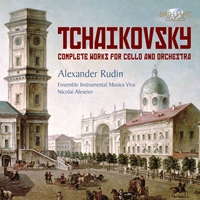
Tchaikovsky: Complete works for cello and orchestra


This is my post from this week's Tuesday Blog.


This week’s Cover 2 Cover post is another album from the Brilliant Classics label, this one dedicated to the music of Tchaikovsky.

As is often the case with these Brilliant Classics releases, this CD is a re-issue (or re-distribution). The recording has been in the catalog of Saison Russe, Le Chant du Monde and Harmonia Mundi since 1994 and features Russian cellist Alexander Rudin and the Moscow-based Musica Viva Chamber Orchestra.

As the official website discusses, Tchaikovsky’s complete works for cello and orchestra amount to less than half this disc’s duration, comprising as they do a couple of miniatures (the Pezzo Capriccioso and Nocturne) and the evergreen Rococo Variations. But the first point of importance is that Rudin plays the original version of the score, and not the much more widely available piece of well-meaning butchery by a cellist of Tchaikovsky’s own time, Wilhelm Fitzenhagen. Fitzenhagen fiddled around with the order of the variations and left one out altogether, as well as somewhat simplifying the composer’s original and strenuous but effective demands upon the soloist. A return to the original reveals what we have been missing in the way of a rather more substantial and coherent work, and there are but one or two rival versions on the market.

In addition, Rudin complements the Variations with the gorgeous interlude from Sleeping Beauty that features a solo cello, as well as an arrangement of the famous Andante cantabile from the First String Quartet.

As filler to this CD, Rudin conducts the orchestra in the Serenade for Strings.

Happy Listening!


Pyotr Ilyich TCHAIKOVSKY (1840-1893)
Variations on a Rococo Theme in A major, Op. 33 [TH 57] (Tchaikovsky's original version)
Nocturne [TH 64], No. 4 fromTchaikovsky's Six Pieces for piano, Op. 19
Andante cantabile [TH 63 ] from Tchaikovsky's String Quartet No. 1, Op. 11
Pezzo capriccioso in B minor, Op. 62 [TH 62]
Scene of Aurora and Désiré (Andante cantabile), Adapted from The Sleeping Beauty, Op. 66 (Act II, No. 15 (a))
(*) Serenade for String Orchestra in C major, Op. 48 [TH 48]

Alexander Rudin, cello
Musica Viva Chamber Orchestra
Nikolay Alekseev and Alexander Rudin (*), conducting

Recorded 1993.11 and 1993.02 (*) at Mosfilm Studios, Moscow

Website - https://www.brilliantclassics.com/ar...and-orchestra/


Internet Archive -  https://archive.org/details/TchaikovskyCompleteWorksForCelloAndOrchestra

Sunday, April 21, 2019

Project 366 - Piano Concerto Collections

Project 366 continues in 2019 with "The Classical Collectionss - A Continued journey through the Western Classical Music Repertoire". Read more here.


Our first chapter in the Classical Collections provided a survey of the Piano Concertos of Mozart. Todaay, we will focus on the works of four pianists (keyboardists to be more precise) who happen to be composers. Let is consider their collections in chronological order.

The Keyboard Concerti of Johann Sebastian Bach

The keyboard (harpsichord) concertos (BWV 1052–1065) follow the standard solo keyboard,  strings and continuo configuration of the Baroque period. There are seven complete concertos for a single harpsichord (BWV 1052–1058), three concertos for two harpsichords (BWV 1060–1062), two concertos for three harpsichords (BWV 1063 and 1064), and one concerto for four harpsichords (BWV 1065). Two other concertos include solo harpsichord parts: the concerto BWV 1044, which has solo parts for harpsichord, violin and flute, and Brandenburg Concerto No. 5 in D major, with the same scoring. In addition, there is a nine-bar concerto fragment for harpsichord (BWV 1059) which adds an oboe to the strings and continuo.

Most of Bach's harpsichord concertos (with the exception of the 5th Brandenburg Concerto) are thought to be arrangements made from earlier concertos for melodic instruments – mainly the violin, but sometimes the oboe (in the case of BWV 1060, both of them!)

Today’s collection ignores the fragmentary concerti, and the concerti for three and four solo instruments.

Concerto No. 1 in D minor, BWV 1052 [Guide #141]
Concerto No. 2 in E Major, BWV 1053 [Guide #271]
Concerto No. 3 in D Major, BWV 1054 [Guide #271]
Concerto No. 4 in A Major, BWV 1055 [Guide #141]
Concerto No. 5 in F minor, BWV 1056 [Guide #141]
Concerto No. 6 in D Major, BWV 1057 [Guide #142]
Concerto No. 7 in G minor, BWV 1058 [Guide #271]
Concerto for Two Keyboards in C minor, BWV 1060 [Guide #271]
Concerto for Two Keyboards in C minor, BWV 1062 [Guide #271]

Listener Guide #271 - Christophe Rousset Plays J.S. Bach

I recall having discussed many times Johann Sebastian Bach’s penchant for reusing his compositions, and setting them for different instrument combinations. Let’s recall, for instance, the curious case of the keyboard concerto BWV 1052 and again presented in its violin setting in another Listener Guide in our series. As is the case for most of these concertos, it is left unclear which came first… (ITYWLTMT Podcast # 285 - 27 July 2018)


The Beethoven Piano Concertos

There are five Beethoven Piano Concertos given opus numbers in the Kinsky catalog – there is one “youth” piano concerto and a concerto movement contemporary to concertos 1 and 2 in the WoO list – neither of these are in this survey. Although it was published as “#1”, the first concerto performed publically was “#2” in Vienna as part of Beethoven’s official debut concert.

Perhaps due to the Violin Concerto's lack of success at its premiere, and at the request of Muzio Clementi, Beethoven revised it in a version for piano and orchestra, which was later published as Op. 61a. For this version, which is present as a sketch in the Violin Concerto's autograph alongside revisions to the solo part, Beethoven wrote a lengthy, somewhat bombastic first movement cadenza which features the orchestra's timpanist along with the solo pianist.

Piano Concerto No.1 in C major, Op.15 [Guide #177]
Piano Concerto No.2 in B flat major, Op.19 [Guide #178]
Piano Concerto No.3 in C minor, Op.37 [Guide #272]
Piano Concerto No.4 in G Major , Op.58 [Guide #179]
Piano Concerto No.5 in E flat major Op.73 -"Emperor" [Guide #273]
Piano Concerto in D major, Op. 61a (after the violin concerto, op. 61) [Guide #178]


Listener Guide #272 – Beethoven and Schoenberg

The two concertos featured (Beethoven’s third and Schoenberg`s) are both featuring Glenn Gould in the 1950’s accompanied by incarnations of the CBC Radio orchestra. At one point, the CBC had four orchestras across the country: Montreal, Toronto, Winnipeg and Vancouver. A few years ago, the only CBC orchestra left (in fact, the only full-time radio orchestra in North-America at the time) was the Vancouver-based orchestra. (ITYWLTMT Podcast #39 - 20 Jan 2012)

Listener Guide #273 – Beethoven Sonatas and Concerto

Of the five Beethoven concertos, the fifth (Emperor) is surely his best known, and its powerful rondo stands out as probably a precursor of the great piano concertos that will follow in the coming century – notably the great Russian concertos, part virtuoso showpiece and part catchy tune. The late great Vladimir Horowitz is the soloist, with Fritz Reiner conducting the RCA Victor Symphony (i.e. the NBC Symphony). (ITYWLTMT Podcast # 158 - 30 May 2014)

Frederic Chopin’s works for Piano and Orchestra

Relatively early in his career Chopin realised that he excelled in performance of more intimate delicacy than was generally possible in the concert hall. Nevertheless in a world that still made little distinction between composer and performer, he provided himself with compositions for piano and orchestra with which to make his name at the start of his career. It was only once he had established himself in Paris in the 1830s that he turned rather to the kind of playing that he made so much his own, performances that demanded great technical proficiency, but made no attempt to impress, as Liszt and Kalkbrenner did, by displays of sound and fury.

The concertantre works rely heavily on the solo instrument, and Chopin himself played them on occasions without the assistance of an orchestra.

Variations on "Là ci darem la mano" from Mozart's Don Giovanni, in B♭ major, op. 2 [Guide #274]
Piano Concerto No. 1 in E minor, op. 11 [Guide #185]
Fantasy on Polish Airs, in A major , op. 13 [Guide #275]
Rondo à la Krakowiak, in F major , op. 14 [Guide #276]
Piano Concerto No. 2 in F minor , op. 21 [Guide #275]
Andante spianato et grande polonaise brillante, in E♭ majo, op. 22 [Guide #277]

Listener Guide #274 – Claudio Arrau (1903–1991)
Claudio Arrau León was a Chilean pianist known for his interpretations of a vast repertoire spanning the baroque to 20th-century composers, especially Bach, Beethoven, Schubert, Chopin, Schumann, Liszt and Brahms. He is widely considered one of the greatest pianists of the twentieth century. (ITYWLTMT Podcast # 302 – 22 Jan 2019)


Listener Guide #275 – Chopin Showcase
The Piano Concerto in F minor dates from 1829. Chopin wrote the piece before he had finished his formal education, at around 20 years of age. It was first performed on 17 March 1830, in Warsaw, Poland, with the composer as soloist. It was the second of his piano concertos to be published and so was designated as "No. 2", even though it was written first. The performance I retained is from an old vinyl in my collection featuring a young Cecile Licad. (ITYWLTMT Podcast # 292 - 5 Oct 2018)

Listener Guide #276 – Piano and Orchestra
Rondo à la Krakowiak (subtitled “Grand Rondeau de Concert”) was written in 1828 and dedicated to Princess Anna Zofia Sapieha, whose mother, Izabela Czartoryska, was influential in shaping the burgeoning Romantic aesthetic in Poland. Its title derives from a Renaissance-era Polish dance, said to be associated with courtship practices. Chopin, always showing an interest in native dances, as demonstrated by his numerous mazurkas and polonaises, was well-suited to adapting folk-like music to the concert hall. (ITYWLTMT Podcast # 307 – 29 Mar 2019)

Listener Guide #277 – This and That
This listener guide. Comprising two=part titles, includes Chopin's breath taking Andante spianato and grande polonaise brillante. (ITYWLTMT Podcast # 42 - 10 Feb 2012)

Sergei Rachmaninov’s works for Piano and Orchestra

Unlike their illustrious predecessor Tchaikovsky, both Prokofiev and Rachmaninov were great pianists ,  both Conservatory trained on the instrument. Rachmaninov however had to turn to his pianistic abilities shortly after the Russian Revolution as a way to provide income for his household, relegating his composing to the back burner. His formidable technique does transpirte in every page of his four piano concerti, and his late masterpiece, the Rhapsody on a theme by Paganini.

Piano Concerto No 1 in F sharp minor, Op 1 [Guide #278]
Piano Concerto No 2 in C minor, Op 18  [Guide #215]
Piano Concerto No 3 in D minor, Op 30 [Guide #72]
Piano Concerto No 4 in G minor, Op 40 [Guide #279]
Rhapsody on a theme of Paganini, Op 43 [Guide #79]

Listener Guide #278 – Concerto #1
Less travelled in this collection are the first and fourth piano concertos. The First has the distinction of being Rachmaninov's "opus 1", though he had composed some other works during his conservatory years - including an abandoned attempt at a concerto. Like Prokofiev's First, this is a student work - composition students were usually advised to base their efforts on a specific model for their first exercises in new forms. In this case the model was the Grieg Piano Concerto which was a favorite work of his.. (ITYWLTMT Podcast #113 - 12 Jul, 2013)

Listener Guide #279 – Concerto #4
Rachmaninov wrote the initial sketches of what would be his fourth concerto  just prior to his exile and only returned to it in 1926 during a period of particular homesickness. The creative process was also difficult, as he made revisions even before its publication and struggled mightily with the length of the work – which had yet to be performed publicly. (ITYWLTMT Podcast # 119 - 23 Aug 2013)