Showing posts with label Once Upon the Internet. Show all posts

Tuesday, October 26, 2021

Ballets français


This is my post from this week's Tuesday Blog.

This week’s Tuesday post is another in our ongoing series Once Upon the Internet with three works taken from the Italian public domain music site LiberMusica. The common thread shared by the three works featured this week is French ballet music, emanating from two different eras.

André Ernest Modeste Grétry was a Belgian composer from the Prince-Bishopric of Liège, who worked from 1767 onwards in France and took French nationality. Staged during the French Revolution, his one-act opera La rosière républicaine lampoons of the well-established practice of entrusting religious authorities with the organization of "public holidays." We see a church transformed into a republican feast, replacing the “dismal emblems” by “the attributes of virtue and reason”, and the clergy become good republicans. The final ballet – featured here - (whose background is "too light to be seriously judged") was greatly appreciated.

The final two ballet suites are taken from two large classical ballets by Léo Delibes. Dr. Coppélius has made a life-size dancing doll. Coppélia is so lifelike that Franz, a village youth, becomes infatuated with it and sets aside his heart's true desire, Swanhilda. She shows him his folly by dressing as the doll, pretending to make it come to life and ultimately saving him from an untimely end at the hands of the inventor.

Sylvia's origins are in Tasso's 1573 play Aminta, which provides the basic plot of Delibes' work; Boy loves girl, girl captured by bad man, girl restored to boy by god.

Happy listening!


André-Modeste GRETRY (1741 – 1813)
La rosière républicaine, ou La fête de la vertu (1794)
Ballet suite
Orchestre de la Société Philarmonique de Paris
Roger Désormière, conducting


Le Chant Du Monde – LDY-8124
Discogs - https://www.discogs.com/release/9256...8re-La-Rosiere


LiberMusica - https://www.liberliber.it/online/aut...ite-de-ballet/


Léo DELIBES (1836-1891)
(*) Coppélia (suite from the ballet, 1883)
(**) Sylvia (suite from the ballet, 1880)
RIAS Symphonie-Orchester Berlin
Anatole Fistoular (*) and Georges Sebastian (**), conducting


Remington – R-199-208
Discogs - https://www.discogs.com/release/1653...llet-Sylvia-Su


LiberMusica - https://www.liberliber.it/online/aut...-dal-balletto/ (*), https://www.liberliber.it/online/aut...-dal-balletto/ (**)


Archive Page - https://archive.org/details/09-sylvia-suite-dal-balletto-04. 

Tuesday, February 23, 2021

Arturo Toscanini (1867-1957)


This is my post from this week's Tuesday Blog.


For our tenth anniversary year, I couldn't resist programming a Once Upon the Internet montage, featuring tracks I downloaded years ago from the now defunct Japanese site Public Domain Classic.

The site (as well as the still active Italian site LiberMusica) contained lots of old mono recordings from the NBC Symphony Orchestra under Arturo Toscanini, inclosing his complete 1949-52 Beethoven cycle - from which I chose the second symphony - and some other fine gems, including this Cherubini requiem captured from a live broadcast around the same time.

(The latter serves to fulfill our usual Lenten programming).

Happy listening!

Ludwig van BEETHOVEN (1770-1827)
Symphony No.2 in D Major, Op.36
Recorded November 7, 1949, and October 5, 1951, in Carnegie Hall

Luigi CHERUBINI (1760-1842)
Requiem Mass No.1 in C Minor (1816)
From NBC Broadcast of February 18, 1950
(with the Robert Shaw Chorale)

NBC Symphony Orchestra
Arturo Toscanini, conducting

Internet Archive - https://archive.org/details/2-01-bee...o.-2-toscanini:

Tuesday, April 7, 2020

Ludwig van Beethoven, NBC Symphony Orchestra, Arturo Toscanini ‎– Missa Solemnis


This is my post from this week's Tuesday Blog.


Today's post combines our ongoing #Beethoven2020 series and Holy Week with a Once Upon the Internet share sourced from the old Japanese Public Domain Classic site we so often have acknowledged in past Tuesday Blogs.

A few days ago on my Friday Blog and Podcast, I began a look at Beethoven's sacred choral works with the oratorio Christus am Ölberge and a YouTube share of the Mass in C. Today, we complete the trifecta with the Missa Solemnis in a vintage performance featuring the Robert Shaw Chorale, Canadian and American soloists and the NBC Symphony all under the direction of Arturo Toscanini. I believe this recording was part of a complete Beethoven symphony cycle issued on RCA Victor.

Composed from 1819 to 1823, it was first performed on 7 April 1824 in Saint Petersburg, Russia, under the auspices of Beethoven's patron Prince Nikolai Galitzin; an incomplete performance was given in Vienna on 7 May 1824, the Kyrie, Credo, and Agnus Dei were conducted by the composer at the same concert which premiered the Ninth Symphony. It is generally considered one of the composer's supreme achievements and, along with Bach's Mass in B minor, one of the most significant Mass settings of the common practice period.

There are at least three commercially-available performances of the Missa under Toscanini, two (from 1940 and 1953) with the NBC Symphony stir debate among aficionados, most preferring the soloist quartet and overall performance of the earlier version. However, the 1953 session benefits from Carnegie Hall as a venue and a better engineered result. Whether it ranks #1 or #2, let's all agree that Toscanini captures the solemnity of the piece, and gets he most out of his singers and orchestra.

Happy listening!


Ludwig van BEETHOVEN (1770- 1827)
Missa Solemnis, in D Major, op. 123

Lois Marshall, Soprano
Nan Merriman, Mezzo-soprano
Eugene Conley, Tenor
Jerome Hines, Bass
The Robert Shaw Chorale (Chorus Master – Robert Shaw)
NBC Symphony Orchestra
Arturo Toscanini, conducting

Recording: New York, 1953
Source: Public Domain Classic

Discogs - https://www.discogs.com/Ludwig-van-B...elease/5287415
Internet Archive - https://archive.org/details/103missasolemnisop.123credo

Tuesday, November 5, 2019

In Memoriam Jörg Demus (1928-2019)


This is my post from this week's Tuesday Blog.


This week’s Once Upon the Internet playlist, like our last post on Paul Badura-Skoda, features assorted downloads (mainly from the old MP3.COM) of works featuring Jörg Demus, a fellow Austrian pianist oif the same generation who also passed away earlier this year. He has released over 350 LPs and over 200 CDs, focusing on German items such as Bach, Mozart and Schumann, and has received international acclaim.

He entered the Vienna Academy of Music at the age of 11, and received instruction from Walter Kelschbaumer, Hans Swarowsky, Josef Krips and Joseph Marx. After graduating in 1945, he studied with Yves Nat in Paris, Walter Gieseking at the Salzburg Conservatory, and master classes with Wilhelm Kempff, Arturo Benedetti Michelangeli, Edwin Fischer, and other legendary masters. He won the Busoni International Competition in 1956, and has been active worldwide.

The opening paragraph of his Telegraph obituary is both telling and a bit snippy if you ask me: “Jörg Demus, who has died aged 90, was an old-school Austrian pianist best known for his sensitive accompaniment of singers such as Elisabeth Schwarzkopf, Elly Ameling and, above all, Dietrich Fischer-Dieskau; he made his name with the music of Vienna – Haydn, Mozart, Schubert and Beethoven – and, according to one reviewer, often performed as if the 20th century had never happened.”

Like Badura-Skoda, Demus was featured on a good number of our past playlists and montages – in fact, some of this week’s tracks are re-used from at least two of our Friday montages – most notably nboth books of Bach’s Well-Tempered Clavier from 2013.

Enjoy!

(All works featuring Jörg Demus, piano)

Wolfgang Amadeus MOZART (1756-1791)
Twelve Variations on“Ah, vous dirais-je, Maman” in C Major, K. 265
(Played on the Fortepiano)

Frédéric CHOPIN (1810-1849)
Nocturne in E Major, op. 62, no. 2

Johann Sebastian BACH (1685-1750)
Chromatic Fantasia and Fugue in D minor, BWV 903

Robert SCHUMANN (1810 –1856)

Blumenstück in D-flat Major, Op. 19

Franz Joseph HAYDN (1732 –1809)
Keyboard Concerto in G major, Hob.XVIII:4
(conducting the Tokyo Chamber Players)

Franz SCHUBERT (1797 —1828)
Ganymed, D. 544
(with Elly Ameling, soprano)

Wanderer-fantasie, D. 760

Internet Archive URL - https://archive.org/details/009wande...tasieop.15d760

Tuesday, October 22, 2019

In Memoriam - Paul Badura-Skoda (1927-2019)


This is my post from this week's Tuesday Blog.


Legendary pianist Paul Badura-Skoda left us a little less than a month ago, on 25 September. At 91 he was still active on four continents!

Paul Badura-Skoda was one of the last representatives of a generation for which music is the quintessence of European culture. Music reflects in each of the great composers the life and living style of his epoch, its striving for wisdom, sense, harmony, beauty, fulfilment in love as well as its search for the divine. When Paul Badura-Skoda played Bach, Mozart, Schubert, Chopin, Ravel or Frank Martin, he succeeded in breathing into his performances the innate spirit of their works. What sets him apart from many other performing artists was his capacity to play not only the notes but also what happens between the notes, thus welding them into a poetic language, making them "speak." His concerts thus became a special experience for his listeners—an event. Like his teacher Edwin Fischer, he created a special, personal sound with many different tone colours. In his hands, his instrument (be it a modern grand or a period piano) sang like a human voice or take on the fullness of an orchestra.

We featured him many times on our Tuesday Blogs and Friday podcasts - in piano duo with Jörg Demus, or in duet with violinist Walter Barylli playing Mozart (look those up in past Tuesday Blogs).

The works assembled today show the breadth of Mr. BAdura-Skoda's repertoire, from the familiar Beethoven and Chopin, to the less familiar Bartok. I believe ost of these tracks are live recordings.

Happy Listening!

Béla BARTÓK (1881-1945)
Suite for Piano, Op.14 [Sz. 62]

Ludwig van BEETHOVEN (1770-1827)
Piano Sonata No.8 in C Minor, Op. 13 ('Pathétique')

Claude DEBUSSY (1862-1918)
Estampes, L. 100

Frédéric CHOPIN (1810-1849)
12 Etudes, Op. 25

Ludwig van BEETHOVEN (1770-1827)
32 Variations on an Original Theme in C Minor, WoO 80

Oaul Badura-Skoda, piano
(Downloaded from MP3.COM, 2001)

Internet Archive - https://archive.org/details/107etude...esemineurpourp

Tuesday, October 9, 2018

Guitar Selections, Once Upon the Internet


This is my post from this week's Tuesday Blog.


This week's musical share is a series of tracks downloaded mainly off the old MP3.COM between 2001 and 2003. They feature three guitarists.

The English-born guitarist, Tomo Iwakura, began to learn the guitar with Iwao Suzuki when he was 12 years old. After his completion of a faculty of law at "Gakusuin Univaersity" in Tokyo, he studied the guitar with Michael Koch at the "Peter-Cornelius Konservatorium" in Mainz, Germany. Also he took lessons of Narciso Yepes, Julian Bream, A. Pierri and David Russell. He won the first prize and a special prize at "Gakusei Guitar Competition" in Tokyo and is also a prize winner of "Concours International de Guitare" in Ile de Re, France.

The first few selections from today's playlist are from one of his albums titled Recuerdos de la Alhambra: Romantic Spanish Guitar Music, which is available in its entirety on YouTube.

Scott Morris gave his New York recital debut at Carnegie Hall in 1998. He has since appeared as a soloist and chamber musician throughout North America, Central America, Europe and Asia. In 2005 he gave solo concerts in both Beijing and Shanghai to great critical review. A 2008 solo performance in Beijing was given at the famous 1,800-seat National Opera House and broadcast on Chinese Central Television (CCTV). Currently, he is the Supervisor of Guitar Studies at California State University, Dominguez Hills and the CSU Summer Arts Guitar Course Coordinator in Monterey, CA. His selections are from his album Invocation.

Finally, "One of the most reknown and admired Italian guitarists" (Il Fronimo), Flavio Cucchi has given hundreds of recitals in Europe, America, Asia and Australia in addition to participating in radio and TV shows for the some of the biggest world-wide broadcasting corporations (the BBC, RAI, ZDF, Bayerischer Rundfunk, Televisa Mexico, Television Corporation of Singapore, Radio Praga, and others). The fine Sonata concertata by Paganini is a great reminder that the Itaian master was both an excellent guitarist and violinist.

Happy Listening!

Isaac Manuel Francisco ALBÉNIZ Y PASCUAL (1860 – 1909)
Suite española No. 1 (fa majeur) "Granada" op. 47, no. 1
Piezas características, Torre Bermeja, serenata (mi majeur), op. 92, no. 12

Antonio Jiménez MANJÓN (1866 –1919)
Leyenda , WoO

Fernando SOR (c. 1778 –1839)
Fantaisie et variations brillantes, op. 30
Tomo Iwakura

Introduction et variations sur “ Malbrough s`en-va-t-en guerre”, op. 28

Juan Leovigildo BROUWER MEZQUIDA (* 1939)
Alogio de la danza (1964)

Niccolò PAGANINI (1782 – 1840) 
Guitar Sonatas, MS 84
No. 1 in A Major,
No. 2 in A Major
No. 8 in G Major
No. 10 in D Major
Scott Morris

Sonata concertata in A for Violin and Guitar, Op.61 [MS 2]
Flavio Cucchi, guitar
Myra Lin, violin 


Tuesday, June 5, 2018

Scherchen/Haydn - Four More London Symphonies


This is my post from this week's Tuesday Blog.


Almost a year ago, I shared a series of Joseph Haydn's London symphonies from a 1950s MONO collection, under the baton of Hermann Scherchen.

Scherchen was musically self-taught. Early in his career, he played viola, and for a time he accompanied Arnold Schoenberg on tour. Interned in Russia during the First World War, he returned to Berlin after the war and founded in 1918 the Neue Musikgesellschaft ("Society for New Music"). In 1933, he fled Germany for Belgium, where he was publisher of Musica viva (1933-36), and conducted in Spain, France and elsewhere in Europe during and after the Second World War; he made his American debut with the Philadelphia Orchestra in 1964.

Scherchen collaborated with avant-garde composers by presenting their works on record and in concert. He recorded with orchestras of Vienna, London and Paris and devoted special attention to the works of Baroque and classical masters in addition to contemporary voices.

You will find the complete collection of the twelve London symphonies as well as some other selections from Scherchen's near-complete Haydn cycle on the Italian website LiberMusica.

Happy Listening!


Joseph HAYDN (1732-1809)

Symphony No. 93 in D Major, Hob.I:93
https://www.liberliber.it/online/aut...giore-hob-i93/

Symphony No. 99 in E-Flat Major, Hob.I:99
https://www.liberliber.it/online/aut...giore-hob-i99/

Symphony No. 100 in G Major, Hob.I:100 « Military » (*)
https://www.liberliber.it/online/aut...itar-hob-i100/

Symphony No. 101 in D Major, Hob.I:101 «The Clock »
https://www.liberliber.it/online/aut...lock-hob-i101/

Wiener Staatsopernorchester
Wiener Symphoniker (*)
Hermann Scherchen, conducting


Internet Archive - https://archive.org/details/haydn_sinf_93_sh_02_largo_c_etc

Tuesday, February 13, 2018

Vladimir Horowitz. Tchaikovsky - Piano Concerto No. 1 / Brahms - Piano Concerto No. 2


This is my post from this week's Tuesday Blog.


This week’s installment of Once Upon the Internet brings us back to the Italian Public Domain siteLiberMusica, for a pair of concerti featuring Vladimir Horowitz, his Father-in-Law Arturo Toscanini and his NBC Symphony Orchestra.

The source pages from the Italian site don’t clearly identify the performances – a search on the Web using the title of the source album strongly suggests that the tracks come from a Classica D'oro recording which, according to AllMusic.com, was a March 2001 remastered reissue of 1940’s recordings of these concerti. There is a plethora of digitally restored albums reissuing these well-travelled recordings, notably a Naxos Historical recording which has the benefit of copious background and technical notes.

According to these excellent notes (excerpts liberally rearranged):

Vladimir Horowitz held a singular place in twentieth-century music. He was both an international celebrity and serious artist whose performances and recordings were anxiously anticipated and widely discussed. His recordings of Brahms's Second Concerto (1940) and Tchaikovsky's First Concerto (1941) are among the most influential piano recordings ever produced and they helped to propel his career into the 1940s and beyond.

Perhaps through a combination of dutiful compliance to his wife and Toscanini’s renowned indomitable will, Horowitz always remained far more in awe of his father-in-law, at least when in his company, both socially and musically. Referring to the Brahms concerto recording, he famously remarked at a later time, "Toscanini had his own conception, and I followed it, even if it was sometimes against my own wishes."

Horowitz's May 6, 1940 performance of the [Brahms] B-Flat Concerto in New York was a sensation. The event was an all-Brahms charity concert at Carnegie Hall with Toscanini and the NBC Symphony Orchestra. New York Times' critic Olin Downes wrote that "Mr. Horowitz played what is probably the greatest of piano concertos with all the sincerity, the virility and fire of his young heart, and the abundant virtuosity and power which are phenomenally at his command, and...one ventures to say that this was playing of a breadth, a masculinity, a poetry and withal a heroic spirit which would have satisfied the composer." Downes reported the audience to have applauded each movement and cheered at the end. On May 9 he recorded the concerto at the RCA Victor studios in Camden, New Jersey. [Blogger's Note: some other sources claim the recording venue was Carnegie Hall]

The Brahms recording hit the shops and was an enormous commercial and critical success. RCA Victor executives were thus anxious to follow up the Brahms with Horowitz's showpiece, Tchaikovsky's First Concerto. In 1941 Americans had long been familiar with Tchaikovsky's First Concerto, and with Horowitz's interpretation of it. Horowitz had made the concerto a central part of his repertoire early in his career.

On 19 April 1941 Horowitz played the concerto with Toscanini and the NBC Symphony Orchestra at an all-Tchaikovsky concert at Carnegie Hall, marking the fiftieth anniversary of the dedication of the famous auditorium. Noel Straus, writing in the New York Times, called Horowitz's playing "brilliant, poetic and vital...a truly stupendous exhibition of pianism, as emotionally expansive as it was amazing in its tonal hues and subtlety of nuance." Once again, the studio recording took place a few days later and, as with the Brahms, the Horowitz-Toscanini version quickly became the one to own.
For many music lovers the 1941 recording of the Tchaikovsky, long available on 78-rpm discs and later on vinyl LPs, is one of the very Romantic interpretations of the concerto and it is an absolute treasure.

Happy Listening!


Johannes BRAHMS (1833-1897)
Piano Concerto No. 2 in B flat major, op. 83
https://www.liberliber.it/online/aut...aggiore-op-83/

Peter Ilyich TCHAIKOVSKY (1840-1893)
Piano Concerto No. 1 in B flat minor, op. 23 [TH 55]
https://www.liberliber.it/online/aut...chestra-op-23/

Vladimir Horowitz, piano
NBC Symphony Orchestra
Arturo Toscanini. Conducting
Recorded 9th May, 1940 (Brahms), and 14th May, 1941 (Tchaikovsky) in Carnegie Hall, New York City

Source album: Classica d'Oro 3001


Internet Archive URL - https://archive.org/details/051.AllegroNonTroppoEMoltoMae

Tuesday, December 26, 2017

Beethoven Live!


This is my post from this week's Tuesday Blog.


For my final Tuesday Blog for 2017, as promised, here are some year-end fireworks from Mr. Beethoven: two symphonies that were created almost 210 years ago, on the fateful evening of 22 December 1808 - his Symphonies no. 5 and 6, performed in front of a captive audience and captured for posterity.

The first performance is from a radio broadcast of 23 May 1954, the last year of Furtwangler's life with the Berlin Philharmonic. The Pastorale is very slow, ruminative, moving to a different and more bucolic pace with a lingering, sweet quality, almost as though Furtwangler were losing himself in Beethoven's countryside for the last time.

In 1950 Victor de Sabata was temporarily detained at Ellis Island along with several other Europeans under the newly passed McCarran Act (the reason was his work in Italy during Benito Mussolini’s Fascist regime). In March 1950 and March 1951 de Sabata conducted the New York Philharmonic in a series of concerts in Carnegie Hall, many of which were preserved from radio transcriptions to form some of the most valuable items in his recorded legacy. From these concets, we are featuring his stirring rendition of Beethoven's Fifth Symphony.

Both performances are enhanced by the energy provided by the audience - don't you think?

Happy listening!

Ludwig van BEETHOVEN (1770-1827) 

Symphony No. 6 in F Major, op. 68 ('Pastoral')
Berliner Philharmoniker
Wilhelm Furtwangler, conducting
(Live, 23 May 1954)

https://www.liberliber.it/online/aut...-68-pastorale/

Symphony No. 5 in C Minor, op. 67
New York Philharmonic
Victor de Sabata, conducting
(Live, 19 March, 1950)

https://www.liberliber.it/online/aut...-minore-op-67/


Tuesday, October 17, 2017

Four Bach Keyboard Suites


This is my post from this week's Tuesday Blog.


Today I dig through some old MP3.COM downloads for a Once Upon the Internet playlist o four keyboard suites by Johann Sebastian Bach. Bach composed suites, partitas and overtures in the baroque dance suite format for solo instruments such as harpsichord, lute, violin, cello and flute, and for orchestra.

In Bach’s solo keyboard catalog, we typiocally focus on the following sets of 19 suites for keyboard, six English Suites, BWV 806–811, six French Suites, BWV 812–817, the six Partitas, BWV 825-830 and the Overture in the French style, BWV 831.

The nomenclature “English” and “French” isn’t necessarily attributed to Bach and his contemporary publisher - Suites were later given the name 'French' (first recorded usage by Friedrich Wilhelm Marpurg in 1762). Likewise, the English Suites received a later appellation.

Bach's biographer Johann Nikolaus Forkel wrote in his 1802 biography of Bach, "One usually calls them French Suites because they are written in the French manner." This claim, however, is inaccurate: like Bach's other suites, they follow a largely Italian convention. The Courantes of the first (in D minor) and third (in B minor) suites are in the French style, the Courantes of the other four suites are all in the Italian style. Some of the manuscripts that have come down to us are titled "Suites Pour Le Clavecin", which is what probably led to the tradition of calling them "French" Suites.

Bach's English Suites display less affinity with Baroque English keyboard style than do the French Suites to French Baroque keyboard style; the name "English" is thought to date back to a claim that these works might have been composed for an English nobleman. It has also been suggested that the name is a tribute to Charles Dieupart, whose fame was greatest in England, and on whose Six Suittes de clavessin Bach's English Suites were in part based.

The six partitas for keyboard are the last set of suites that Bach composed and the most technically demanding of the three. Although each of the Partitas was published separately under the name Clavier-Übung (Keyboard Practice), they were subsequently collected into a single volume in 1731, with the same name, which Bach himself chose to label his Opus 1.

Happy listening!

Johann Sebastian BACH (1685-1750)

English Suite No. 2 in A minor, BWV 807
Justine McIntyre, piano

English Suite No. 3 in G minor, BWV 808
French Suite No. 6 in E Major, BWV 817
Sonia Rubinsky, piano

Partita No.1 in B Flat Major, BWV 825
Elaine Lau, piano

Downloaded from MP3.COM (December 2002)


Tuesday, June 13, 2017

SCHERCHEN / The 1950s Haydn Symphonies Recordings


This is my post from this week's Tuesday Blog.


Everyone wants to know me. I had to dine out six times up to now, and if I wanted I could have an invitation every day; but first I must consider my health, and second my work. Except for the nobility, I admit no callers till 2 in the afternoon.
These words, from private correspondence to a friend, describe Haydn’s welcome in London in early 1791. Haydn’s presence in the English capital had been arranged by the violinist-cum-impresario Johann Peter Salomon; Haydn’s secluded life as Kapellmeister to Prince Nikolaus Esterházy had hardly prepared him for the feverish musical and social activity in London.

Haydn’s fame in England, as in France, was based above all on his symphonies from the 1770s and 1780s, and the main part of his lucrative deal with Salomon was the composition of six new symphonies (Nos 93–98) over two seasons, for which he would receive £300—equal to approximately £25,000 today.

There are 12 so-called London Symphonies, and they can be categorized into two groups: Symphonies Nos. 93–98, which were composed during Haydn's first visit to London, and Symphonies Nos. 99–104, composed in Vienna and London for Haydn's second visit. Every London Symphony, apart from one (No. 95), has a slow introduction to the first movement.

This week’s share takes us back to my Once Upon the Internet series, and some downloads from the Japanese site Public Domain Classic and the Italian site LiberMusica – the latter still active.

Today’s featured conductor, Herrmann Schechen, was one of the 20th-century’s great new-music conductors yet he recorded an unusually wide range of repertoire, from the baroque to the contemporary.

Recorded in mono for the Westminster company between 1950 and 1953 Scherchen’s recordings of the 12 London symphonies with the Vienna State Opera Orchestra and Vienna Symphony are pioneer performances because, at a time when precious few took these works seriously, Scherchen granted them the time and care they deserved. The result is not just a worthy acknowledgement of Haydn’s historical importance, but a true realisation of his greatness. Scherchen turns out to be a classicist of humanity and warmth.

From these I retained three of the London symphonies – nos. 97, 102 and 103; 8 of the remaining 9 can be found on LiberMusica.

Happy Listening!


Joseph HAYDN (1732-1809)

Symphony No.97 in C Major, Hob.I:97
Symphony No.102 in B-Flat Major, Hob.I:102 (*)
Symphony No.103 in E-Flat Major ('Drum Roll'), Hob.I:103

Wiener Symphoniker
Hermann Scherchen, conducting
Source: Public Domain Classic and LiberMusica (*)


Tuesday, March 28, 2017

Shellac's Revenge


This is my post from this week's Tuesday Blog.


It is our custom during Lent to program organ music, and this year I have two posts (this one, and another next week) where we will explore baroque and renaissance organ repertoire, performed (unashamedly, might I add) with “big organ” bombast.

Before getting started with this week’s post, I want to “plug” a blog that I have encountered last year, The Shellackophile, which presents “Recordings of classical music from the 78-rpm era (mostly)”. Today’s musical shares and some of the commentary come from this fine effort by a like-minded music collector and enthusiast.

George Dorrington Cunningham (1878 - 1948) was an important English organist and teacher, who counted among his students the two other eminent British organists on deck this week, E. Power Biggs and George Thalben-Ball. There is no doubt that there is a long tradition of organ music in Britain, and it probably dates back to one of the great organ composers of the Baroque era, Georg Fredertic Handel, who elected to become a British subject in 1726.

The Handel organ concertos, composed in London between 1735 and 1751, were written as interludes for performances of his oratorios. They were the first works of their kind for organ with chamber orchestra accompaniment and served as a model for later composers.

The Shellackophile writes:

[Cunningham’s] recordings of two Handel concerti, with George Weldon and the City of Birmingham Orchestra, were made late in his life, and exhibit a considerably beefier style of Handel playing than we are accustomed to today, with a big organ sound and a full symphonic-sized string orchestra accompaniment:

[George Thalben-Ball] turns in a performance of Handel's Organ Concerto in B-Flat, Op. 7, No. 3, as arranged and orchestrated by Sir Henry J. Wood. Thalben-Ball's playing is flamboyant, to say the least, and the Wood orchestration, for full symphony orchestra with brass and percussion, is certainly anachronistic but it's great fun! Handel's original ordering of the movements is also altered, and this performance interpolates not only the Minuet from "Berenice" but also a big cadenza by Thalben-Ball that takes up most of the last side.

[E. Power Biggs’] career at Columbia spanned some thirty years, but before this, he had been at Victor from 1939 to 1946, where most of his work was done on the 1937 Aeolian-Skinner organ built to Baroque specifications and located in Harvard's Germanic Museum. His recordings included collaborations with Arthur Fiedler and his Sinfonietta composed of Boston Symphony players.
The digital transfers are quite good, though we have to remember that the recording (and playback) technology would have been taken to its limits by such a tsunami of sound!

Happy Listening!

George Frideric HANDEL (1685 –1759)

Organ Concerto No. 2 in B-Flat, Op. 4, No. 2 [HWV 290]
Organ Concerto No. 4 in F, Op. 4, No. 4 [HWV 292]
G. D. Cunningham (William Hill & Sons organ, Birmingham Town Hall)
City of Birmingham Orchestra
George Weldon, conducting
[Recorded June 4, 1945; English Columbia DX 1358 – 1360]
Source: http://shellackophile.blogspot.ca/20...concertos.html

Concerto No. 13 in F Major ("The Cuckoo and the Nightingale") [HWV 295]
E. Power Biggs (Aeolian-Skinner organ, Germanic Museum, Harvard University)
Arthur Fiedler's Sinfonietta
[Recorded March 17, 1940; RCA Victor set M-733]
Source: http://shellackophile.blogspot.ca/20...ale-biggs.html

Organ Concerto No. 9 in B-Flat, Op. 7, No. 3 [HWV 308]
(arr. Henry J. Wood)

Thomas Augustine ARNE (1710 –1778)
First movement (Allegro moderato) from Organ Concerto No. 6 in B-Flat (ca. 1751)
(Arr. George Thalben-Ball)
George Thalben-Ball (unspecified organ [Handel], St-Mark's Chursch, London [Arne])
Philharmonia Orchestra
Walter Susskind, conducting
[Recorded June 4, Sept. 23, and Oct. 11, 1948; HMV C 3814 – 3816]
Source: http://shellackophile.blogspot.ca/20...concertos.html


Tuesday, January 17, 2017

Three Scandinavian Symphonies


This is my post from this week's Tuesday Blog.


This week’s Tuesday Blog presents a trio of symphonies by a pair of Scandinavian composers – one well-known, the other less.

Let’s start with the better known of the two composers. Jean Sibelius wrote seven symphonies; and his Third Symphony represents a turning point in Sibelius's symphonic output. His First and Second symphonies are grandiose Romantic and patriotic works. The Third, however, shows a distinct, almost Classical desire to contain the largest amount of musical material in the fewest possible melodic figures, harmonies, and durations. It is a good-natured, triumphal, and deceptively simple-sounding piece which hardly foreshadows the more austere complexity of his later symphonies

The Sibelius is flanked by a pair of symphonies by the early-romantic Swedish composer Franz Berwald. Berwald came from a family with four generations of musicians; his father, a violinist in the Stockholm Royal Opera Orchestra, taught Franz the violin from an early age; and in 1812, Berwald started playing the violin in the court orchestra and the opera, receiving lessons from Edouard du Puy, and also started composing:a violin concerto (not well-received at its premiere), some symphonies, operas never staged, even a Piano Concerto that was premiered nearly 40 years after his death by his grand-daughter in a student recital! Berwald's music was not recognised favourably in Sweden during his lifetime, even drawing hostile newspaper reviews, but fared a little better in Germany and Austria.

In 1911, Carl Nielsen wrote of Berwald, "Neither the media, money nor power can damage or benefit good Art. It will always find some simple, decent artists who forge ahead and produce and stand up for their works. In Sweden, you have the finest example of this: Berwald."

Ten years after Berwald's death, his Symphony No. 4 in E-flat major, "Naïve", was premiered ; this gap between composition and first performance was relatively short, however, compared to what befell the Symphony No. 2 in D major, "Capricieuse" and Symphony No. 3 in C major, "Singulière". Those two pieces were not premiered until 1914 and 1905, respectively.

Igor Markevitch recorded Berwald’s symphonies no 3 and 4 (along with a past share, Schubert’s 4th Symphony) with the Berlin Philharmonic in the mid-1950’s. You wouldn’t think of him in association with the music of Berwald, particularly in 1955, and particularly with the Berlin Philharmonic, but such was Markevitch’s gift that he could impose his will on just about any orchestra, in any music, and achieve stunning results. He simply has the Berlin Philharmonic playing its heart out, and the period mono sonics are extremely bold and vivid.

The Sibelius symphony I am sharing today was part of the first domestically available “complete” set of Sibelius symphonies in the UK. The project was handed to the then ex-pat conductor and composer Anthony Collins (1893-1963) who had been making a conducting and composition (film) career for himself in California. In the clean-limbed Third Symphony Collins puts across the controlled icy fever of the string writing and does so with great fervour.

Happy Listening!


Franz BERWALD (1796-1868)
Symphony no. 3 in C Major, "Sinfonie Singulière" (1845)
Symphony no. 4 in E flat Major, "Sinfonie Naïve" (1845)
Berliner Philharmoniker
Igor Markevitch, conducting
(Jesus Christus Kirche, Berlin, Dec 1955)
(Downloaded from LiberMusica)

Jean SIBELIUS (1865-1957)
Symphony no 3 in C major, op. 52
London Symphony Orchestra
Anthony Collins, conducting
(Kingsway Hall, London, May 1954)
(Downloaded from Public Domain Classic)

Tuesday, December 27, 2016

In Performance from WGBH Boston


This is my post from this week's Tuesday Blog.


As I scrape the drawer for Once Upon the Internet material, I thought I would share some music I downloaded from podcasts produced by WGBH in Boston, one of the flagship stations of the American Public Broadcaster, NPR.

The works on the playlist are from some of your favourite composers, and played by musicians based in the North-Eastern US and (in the case of Jonathan Crow, long-tome associate concertmaster of the Montreal Symphony and now concertmaster of the Toronto Symphony) Eastern Canada .

The Beethoven string quartet was part of a past Tuesday Blog, where I had only shared the link. Many of these podcasts have since been removed from the station's roster, so they are worthy of our "departed site" treatment in that sense... The Brahms horn trio falls loosely in our earlier look at "odd trios" of Brahms.

The Chopin polonaise and Kreisler "works in the stuyle" aren't heard as much, so for that reason, worth sharing.

As this is the last PTB of 2016, Happy New Year, and look for a new addition to our "content rotation" in the new year.

Enjoy!

Ludwig van BEETHOVEN (1770-1827)
String Quartet #3 in D major, op. 18, no.3
Harlem String Quartet

Johannes BRAHMS (1833-1897)
Trio for Horn, Violin and Piano in E-Flat Major, op. 40
William Purvis, horn
Jonathan Crow, violin
Mihae Lee, piano

Frédéric CHOPIN (1810-1849)
Introduction and Polonaise in C Major, for cello and piano, op. 3
Bion Tsang, cello
Anton Nel, piano

Fritz KREISLER (1875-1962)
Tempo di minuetto (in the style of Pugnani) [1910]
Andantino (in the style of Padre Martini) [1910]
Nikolaj Znaider, violin

Deborah DeWolf Emery, piano

Tuesday, November 29, 2016

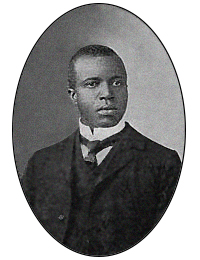
The Piano Music of Scott Joplin (Part 2)


This is my post from this week's Tuesday Blog.


To complete our two-part survey of the piano music of Scott Joplin, I wanted to share tracks I downloaded from a still-active Public Domain site, LiberMusica.


In the first installment in this series I observed that the tempo on some of the ragtime tracks I unearthed years ago was, well, rather tame. My "go to" references for Joplin rags are the Dick Hyman/James Levine CD of Joplin's "Greatest Hits" (BMG) and the original soundtrack to the 1974 Motion Picture "The Sting", performed by Marvin Hamlisch (using Gunther Schuller's editions).

Joplin himself never made an audio recording as a pianist; however his playing is preserved on sevenpiano rolls. All seven were made between April and June 1916: six released under the Connorized label and the other roll, a recording of "Maple Leaf Rag" was recorded on the Uni-Record label in June 1916. It was recorded on better equipment than the Connorized rolls thus giving a truer record of Joplin's playing. (We note that at the time Joplin was suffering from the advanced symptoms of syphilis which would take his life 10 months later, so this recording is not a true record of his more youthful ability.)

These rolls are featured in the following YouTube playlist - with thanks to "Erik Satie".


It is therefore highly doubtful hat the performances provided in the so-called "Original piano rolls (1896-1917)" come from the playing of Joplin. Nonetheless, they are quite insightful and provide a better, more "authentic" tempo and playing style than the vast majority of the tracks I share last time. You can compare, as I highlight below the tracks that are "common" to both sets.

Enjoy!

Scott JOPLIN (c.1868-1917)

  • The Entertainer (1902)
  • Pine Apple Rag (1908)
  • Reflection Rag (ca. 1907)
  • The "Rag Time Dance" (1902)
  • Sugar Cane (1908)
  • Combination March (1896)
  • Elite Syncopations (1902)
  • A Real Slow Drag (1911, Treemonisha:Act 3, no. 9)
  • Paragon Rag (1909)
  • Scott Joplin's New Rag (1912)
  • Solace (1909)
  • Paecherine Rag (1901)
  • Rose Leaf Rag (1907)
  • Swipesy Cake Walk (1900)
  • The Sycamore (1904)
  • Stoptime Rag (1910)
  • Silver Swan Rag (1914-18)
  • Original Rags (collab. with Charles Daniels, 1899)
  • Pleasant Moments. Rag-Time Waltz (1909)
  • Scott Joplin's Best Rag (Medley)

Piano Rolls (1896-1917)


Tuesday, November 15, 2016

The Piano Music of Scott Joplin (Part 1)


This is my post from this week's Tuesday Blog.


This month has five Tuesdays and, as luck would have it, I happen to have some spare material to share. So here's the first of a two-part series, for your listening pleasure.

This week's installment of Once Upon the Internet brings in music from two source sites: the old MP3.COM and an Italian public domain site that is no longer active, vitaminc.it.

Back in the day, I amassed quite a few tracks from the piano music of the great African-American composer Scott Joplin, performed by a pair of (amateur?) pianists, Robert Daria and Dario Ronchi.

Ragtime is a musical genre that enjoyed its peak popularity between 1895 and 1918. Its cardinal trait is its syncopated, or "ragged", rhythm which takes me back to single-reel silent movies or Prohibition-era speakeasies. Scott Joplin became famous through the publication of the "Maple Leaf Rag" (1899) and a string of ragtime hits, although he was later forgotten by all but a small, dedicated community of ragtime aficionados until the major ragtime revival in the early 1970s – spurred in part by New England Conservatory president Gunther Schuller, and Hollywood director George Roy Hill.

The MP3.COM verbiage, as I recall, claimed that the performances adhered strictly to the tempo indications. To my ear, that seems a bit hard to accept, as it is rather customary to treat “Allegro” differently in musical tradition X from that of musical tradition Y, simply because composers of a given tradition may view “fast” as others may view it as “faster still”.


Ragtime, unlike the minuet or the waltz, doesn’t strictly adhere to a metric pattern. Wikipedia points out that “it is rather a musical genre that uses an effect that can be applied to any meter. The defining characteristic of ragtime music is a specific type of syncopation in which melodic accents occur between metrical beats.” Joplin, known as the "King of Ragtime", called the effect "weird and intoxicating." He also used the term "swing" in describing how to play ragtime music: "Play slowly until you catch the swing..." The name swing later came to be applied to an early genre of jazz that developed from ragtime.

I own other recordings of these little gems, notably a CD recorded by jazz pianist Dick Hyman and (yes by “the”) James Levine, and the tempo they adopt is night and day compared to Ronchi/Daria: break-neck speed vs cautious restraint.

Today’s musical share includes 21 tracks - the Daria tracks appear to have been recorded using an electronic piano made to "sound" rickety. I find that a bit annoying at times, but he does perform less kn own tracks - waltzes, marches and two-steps - I hadn't heard much before. The Ronchi tracks are recorded on a regular acoustic piano, and have a crisper sound quality..

A lot like I did with Kirkpatrick’s recording of the Scarlatti sonatas a couple of years ago, for the sake of disclosure, I wanted to provide a clear warning about overindulging on these. Maybe it’s the recording quality (poor to fair, generally) or just the style, but this stuff can give you a tummy ache if you’re not careful. Pace yourselves!

Scott JOPLIN (ca. 1868–1917)

  • Bethena. A Concert Waltz (1905)
  • Binks Waltz (1905)
  • Leola. Two Step (1905)
  • Rosebud. Two-Step (1905)
  • Antoinette. March and Two-Step (1906)
  • Reflection Rag (ca. 1907)
  • The Nonpareil. A Rag & Two Step (1907)
  • Pine Apple Rag (1908)
  • School of Ragtime: Exercises (1908)
  • Pleasant Moments. Rag-Time Waltz (1909)
  • The Augustan Club Waltz (1901)
  • Cleopha. March and Two Step (1902)
  • The Crush Collision March (1896)
  • The Favorite. Ragtime Two Step (1904)
  • The Harmony Club Waltz (1896)
  • The "Rag Time Dance" (1902)

Robert Daria, piano (Downloaded from MP3.COM)

  • A Real Slow Drag (1911, Treemonisha:Act 3, no. 9)
  • Gladiolus Rag (1907)
  • I Want to See My Child (1911, Treemonisha:Act 3, no. 2)
  • Rose Leaf Rag (1907)
  • Searchlight Rag (1907)

Dario Ronchi, piano (Downloaded from vitaminic.it)


Tuesday, October 18, 2016

Three Bach Cello Suites


This is my post from this week's Tuesday Blog.


This month’s Once Upon the Internet digs into our many downloads from the defunct site MP3.COM. (I should point out that I am slowly but surely running out of tracks to share with you from that site...)

The trio of pieces I retained this month are three of the six Cello Suites (or more exactly Suites à Violoncello Solo senza Basso or Suites for cello solo without bass). The corpus of six suites is among some of the most frequently performed and recognizable solo compositions ever written for cello.

Bach wrote a lot of music for solo instrument – keyboard, violin, lute and of course organ – but these stand out because of the paradox they represent; they are simple yet complex, they achieve the effect of implied three- to four-voice contrapuntal and polyphonic music in a single musical line.
As formulaic compositions, they follow the usual Baroque musical suite make-up, each movement based around a baroque dance type. The cello suites are structured in six movements each: prelude, allemande, courante, sarabande, two minuets or two bourrées or two gavottes, and a final gigue.

There is no malice aforethought in the threesome proposed here – they are simply three suites I downloaded from the old site nearly 15 years ago. Two are performed by John Michel (featured cellist in our recent post of quartet music from Central Washington University), and the third is a “sample” posted on the site by Eroica Classical Recordings featuring cellist Yehuda Hanani.

Happy Listening!

Johann Sebastian BACH (1685-1750)
Suite No. 1 in G Major, BWV 1007
Suite No. 3 in C Major, BWV 1009
John Michel, cello

Suite No. 4 in E-Flat Major, BWV 1010
Yehuda Hanani, cello