As we showed on a graphic in the previous installment, not all
instruments are created equal, and not all instruments are showcased equally in
solo repertoire. Keyboard instruments like the piano have a bigger share of
that repertoire because they provide a greater range of tones.
Physics explains how instruments produce sounds – it’s all
about creating waves, and amplifying them. Sound waves are generated through
the transfer of a mechanical wave,
that is to say, how a string, or a surface can be made to vibrate either
through the action of striking it, or plucking it, or blowing in it.
More Power
To get from Point A to Point B, people choose many mode of
transportation, one that suits their needs. A bicycle is very economical to
ride, doesn’t require much space, and provided that you are (physically) up to
it can get you anywhere through any road.
But who doesn’t like a train? There’s something
awe-inspiring about a powerful locomotive, how it makes the ground shake and
the air move… All this to say that it’s in our collective DNA – we always
look for things that can be made to be more powerful, more awe-inspiring. It’s
true of music and of musical instruments.
Size matters! Physics also dictates that the size of the
physical source of a sound wave (a string’s length or thickness, the size of a
reed, the thickness of the skin on a drum) dictates vibration frequency, which
explains why a violin has four strings and a long fret. It stands to reason
that a large keyboard instrument can house many strings, thus support a larger
breadth of tones.
Keyboard instruments, the piano in particular, are the
results of innovations and evolution. The harpsichord,
which is really the grandfather of the piano, was designed to “pluck” strings,
and as such was limited in “dynamic range” – it doesn’t matter how “hard” or
how “softly” you hit the keyboard, the resulting sound is the same.
By “hammering” on strings rather than plucking them, the fortepiano provided this added dimension
of “dynamics”. Like the name suggests, this keyboard instrument has the ability
to play notes hard (forte) or softly
(piano). The last innovation is the
ability to further enhance the dynamics by “dampening” the vibration of the
string – this action, which is achieved by raising or lowering the instruments’
bottom surface through a pedal, takes us to the instrument we know recognize as
the “modern acoustic piano”.
Let’s think outside the box for a minute; simple wind
instruments – like a flute –create distinct notes through standing acoustic waves. A standing wave results in this case from acoustic waves bouncing off the ends of a pipe several thousand times a second
“beating” into each other until we get a unique “signature” wave. The resulting
note is dictated by that signature wave that is unique to the pipe (whose
characteristics change when a flautist changes how he blows in the flute, or
plugs holes with his fingers and instrument keys).
What if you engineered an instrument with several pipes,
tuned to specific pitches, and came up with a way to pick the pipes you want to
create the notes you want… That’s precisely what an organ does – it produces sound by driving pressurized air through
pipes selected using a keyboard. The organ's continuous supply of wind allows
it to sustain notes for as long as the corresponding keys are depressed, unlike
the piano whose sound begins to decay soon after a key is hit.
The potential for an organ to achieve epic scales is, well, huge!
The smallest portable pipe organs may have only one or two dozen
pipes and one keyboard (or manual);
the largest may have over 20,000 pipes and several manuals. They are installed in
churches, synagogues, concert halls, schools, and other public buildings
primarily because they are so large, require so much space and care that they
are not practical anywhere else.
From Ancient Greece to Gothic Churches
The origins of the pipe organ
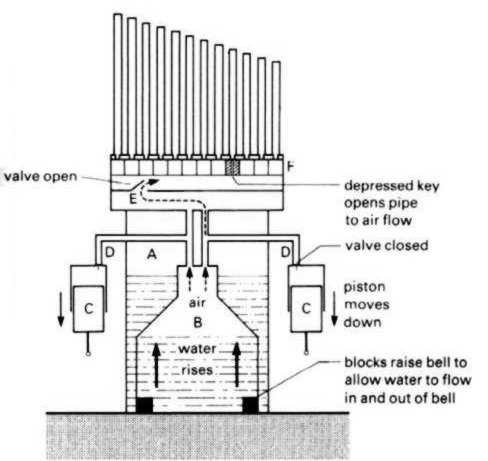
can be traced back to the Hydraulis, literally
"water (driven) pipe (instrument)." It is attributed to Ctesibius of
Alexandria, an engineer of the 3rd century BC. The hydraulis was the world's
first keyboard instrument and was, in fact, the predecessor of the modern
organ.
Technical Diagram of Ctesibius; Hydraulis
The Hydraulis of Dion, Dion Archaeological Museum
Unlike the instrument of the Renaissance period, the ancient hydraulis was played by hand, the keys were balanced and could be played with a light touch, as is clear from the reference in a Latin poem by Claudian, who uses this very phrase (magna levi detrudens murmura tactu . . . intonet, “let him thunder forth as he presses out mighty roarings with a light touch”).
We can trace the origins of
the organ to the Ancient Greeks, however advances in
engineering over centuries culminate with the first documented permanent organ
installation, in Halberstadt, Germany in 1361. The Halberstadt organ was the
first instrument to use a chromatic key layout across its three manuals and
pedalboard, had twenty bellows operated by ten men, and the wind pressure was
so high that the player had to use the full strength of his arm to hold down a
key.
Now that’s power!
During the Renaissance and Baroque periods, the organ's
tonal colors became more varied. Organ builders fashioned stops that imitated
various instruments, such as the viola da gamba. The Baroque period is often
thought of as organ building's "golden age," as virtually every
important refinement was brought to a culminating art.
Overview of the Repertoire
As for the repertoire for the organ it is quite varied:
concert music, sacred music, secular music, popular music… In the early 20th
century, pipe organs were installed in theaters to accompany films during the
silent movie era!
Because organs have been used constantly over the centuries,
there are significant works for the pipe organ throughout the ages. However, in
my opinion, we can narrow things down to two distinct periods – the Baroque and
the period after 1865, with an emphasis on generation or two of French artists
that dominated the landscape at the turn of the 20th century.
Although most countries whose music falls into the Western
tradition have contributed to the organ repertoire, France and Germany in
particular have produced exceptionally large amounts of organ music.
German sacred organ music is dominated by the chorale, hymnal music of the Lutheran
faith. Composers such as Samuel Scheidt
and Heinrich Scheidemann wrote
chorale preludes, chorale fantasias, and chorale motets. Towards the end of the
Baroque era, the chorale prelude and the partita (or suite) became mixed, forming
the chorale partita. This genre was developed by Georg Böhm, Johann Pachelbel,
and Dieterich Buxtehude. The primary
type of free-form piece in this period was the praeludium, as exemplified in the works of Matthias Weckmann, Nicolaus
Bruhns, Böhm, and Buxtehude.
Johann
Sebastian Bach composed extensively for the organ (as well as the
keyboard), and his works are both secular (large-scale preludes and fugues) and
sacred (chorale-based works), dedicated to the organ or featuring the organ in
one of his many cantatas.
In France, very little secular organ music was composed
during the Baroque period; the written repertoire is almost exclusively
intended for liturgical use. The important names there were Jean Titelouze, François Couperin, and Nicolas
de Grigny.
Organ music was seldom written in the Classical era, as
composers preferred the piano with its ability to create dynamics. In Germany,
the six sonatas op. 65 of Felix
Mendelssohn (published 1845) marked the beginning of a renewed interest in
composing for the organ. Inspired by the work of renowned French organ builder
Aristide Cavaillé-Coll, the French organist-composers César Franck, Alexandre
Guilmant and Charles-Marie Widor
led organ music into the symphonic realm. Guilmant and Widor were not only
great organists and composers, they were also great teachers, and among their
students and apprentices we count Louis
Vierne and Marcel Dupré who, in
turn, instructed Olivier Messiaen,
and the brother and sister tandem of Jehan
Alain and Marie-Claire Alain. Many of these organists were closely
associated with the many great church organs in France, from Notre-Dame-de-Paris to Saint Sulpice.
 The Great Organ at Saint Sulpice (Paris), reconstructed by Aristide Cavaillé-Coll in 1862
The development of symphonic organ music continued with
Vierne and
Charles Tournemire. Widor
and Vierne wrote large-scale, multi-movement works called
organ symphonies that exploited the full possibilities of the
symphonic organ.
Exploring the organ repertoire - Some Listener Guides
Listener Guide #7 - "Norddeutsche Orgelschule": A selection of works from the North-German organ school performed by Dutch organist Piet Kee: Sweelinck, Buxtehude ad J. S. Bach. (
ITYWLTMT Montage #217 - 11 March 2016)
Listener Guide #8 - "J.S. Bach - Ton Koopman - Organ Works": Dutch organist Ton Koopman performs some Toccatas and Fugues by J. S. Bach, including his well-known Toccata and Fugue in D Minor. (
Vinyl's Revenge #7 - 10 March 2015)
Listener Guide #9 - "French Organ Masterworks": A collection of French organ works from Late Romantic and Early Contemporary French organ composers: Franck, Dupre, Messiaen, Widor and Vierne. (
Once Upon the Internet #25 - 18 March 2014)


:format(jpeg):mode_rgb():quality(90)/discogs-images/R-6456291-1452265242-2200.jpeg.jpg)