Friday, July 27, 2018

Christophe Rousset Plays J.S. Bach

No. 285  of the ongoing ITYWLTMT  series of audio montages, which can be found in our archives at https://archive.org/details/pcast285


=====================================================================
I recall having discussed many times Johann Sebastian Bach’s penchant for reusing his compositions, and setting them for different instrument combinations. Let’s recall, for instance, the curious case of the keyboard concerto BWV 1052 (which was featured in a podcast from last December) and again presented as part of a Back to Bach montage from October 2013 in its violin setting. As is the case for most of these concertos, it is left unclear which came first…

This week’s montage of keyboard concertos revisits the remaining four concertos from that October violin montage – including the pair of double concertos – and allowes us to appreciate them in this alternate setting. The only “new” concerto is BWV 1053 which was (originally?) set for oboe and orchestra. Here is a YouTube version of the concerto in that setting:


When it comes to keyboard performance standards of Bach’s catalog, I have most often provided works performed on “modern” instruments – Glenn Gould, Angela Hewitt, Edwin Fischer and Jörg Demus are performers we’ve featured here and on our Tuesday Blog. There is, however, an alternate school of performance – on “period” instruments. The main defenders of that school would include Rosalind Tureck, Ralph Kirkpatrick and today’s featured artist, Christophe Rousset. The five works this week come from his concerto cycle with Christopher Hogwood and the Academy of Ancient Music.


I think you will love this music too!

Tuesday, July 17, 2018

Bruch, Wieniawski, Michael Rabin, Sir Adrian Boult ‎– Scottish Fantasy / Concerto #1


This is my post from this week's Tuesday Blog.


This week’s edition of Vinyl’s Revenge proposes a vintage recording of violin concertante works, one by Bruch and the other by Wieniawski – featuring American violinist Michael Rabin accompanied by Sir Adrian Boult and the Philharmonia Orchestra.

Michael Rabin was of Romanian-Jewish descent. His mother Jeanne was a Juilliard-trained pianist, and his father George was a violinist in the New York Philharmonic. He began to study the violin at the age of seven. His parents encouraged his musical development. After a lesson with Jascha Heifetz, the master advised him to study with Ivan Galamian, who said he had "no weaknesses, never." He began studies with Galamian in New York and at the Meadowmount School of Music and the Juilliard School.

At his Carnegie Hall debut in 1950 at age 13, Dimitri Mitropoulos called Rabin “the genius violinist of tomorrow, already equipped with all that is necessary to be a great artist.” George Szell described him as “the greatest violin talent that has come to my attention during the past two or three decades.” And Artur Rodzinski added: “Rabin's is not the usual musical prodigy story. No one beat him to make him practice his scales. He was not overprotected and shut off from the world, but managed to enjoy a perfectly normal American boy hood.”

As is too often the case for precocious talents, the commitments that ensued with his prodigal launch as a teenage virtuoso had been too much for him to handle; he turned to drugs to cope with the anxieties. The coroner found barbiturates in Rabin's blood after the violinist was found dead in his apartment. He had slipped on a rug and struck his head on a table – he was only 35 years old.

The two works on this LP harken back to Pablo de Sarasate and Henryk Wieniawski, two preeminent violin virtuosi of the late Romantic period. Sarasate was the dedicatee of Bruch’s Scottish Fantasy, and Wieniawski composed a pair of concerti for his own use – the first being featured here. Both these works feature Rabin in top form and fully display his fabulous natural technique and melancholic temperament.

Happy listening!


Max BRUCH (1838-1920)
Scottish Fantasy, Op. 46

Henryk WIENIAWSKI (1835-1880)
Concerto No. 1 In F Sharp Minor, Op. 14

Michael Rabin, violin
Philharmonia Orchestra
Sir Adrian Boult, conducting
(Originally released in 1958)

Label: Seraphim ‎– 60342
Format: Vinyl, LP, Album *MONO)
Released: 1980

Details - https://www.discogs.com/Michael-Rabi...elease/9119674


Internet Archive - https://archive.org/details/04ScottishFantasyForViolin

Friday, July 13, 2018

Due South

No. 284 of the ongoing ITYWLTMT  series of audio montages, which can be found in our archives at https://archive.org/details/pcast284


=====================================================================

To launch our summer series of podcasts, I thought I’d provide a “musical passport” montage, something we haven’t done much of in the past couple of summers. In past years, we’ve provided travelogue-style podcasts that explore specific countries and regions, often not by native composers.
Today’s theme has to do with “going South”. South can be both a relative and an absoluter term. To illustrate, in one of his solo albums, Québec singer-song writer Michel Rivard talks of the South in this way (my translation) – At the pub, they sing farewell to Johnny, who’s headed South. South of Shefferville isn’t Jamaica, it’s Québec CIty, or Matane, or New Brunswick.

It’s in that vein that we should consider our first track, the concert overture In the South by Edward Elgar. Subtitled “Alassio” for the Italian Riviera town where Elgar and his family stayed in the winter of 1903 to 1904, it paints a picture of Elgar strolling around during the visit, while the buildings, landscape and history of the town provided him with sources of inspiration. In his words, “Then in a flash, it all came to me – the conflict of the armies on that very spot long ago, where I now stood – the contrast of the ruin and the shepherd – and then, all of a sudden, I came back to reality. In that time I had composed the overture – the rest was merely writing it down.”

We turn later in the montage to another British composer, Ralph Vaughan Williams, and his seventh symphony subtitled “Sinfonia antartica”. The symphony revisits the music Vaughan Williams provided for the film Scott of the Antarctic in 1947.

The symphony is in five movements; the composer specified that the third movement lead directly into the fourth. The score includes a brief literary quotation at the start of each movement. They are sometimes declaimed in performance, although the composer did not say that they were intended to form part of a performance of the work. The quotes are:

  • To suffer woes which hope thinks infinite,/ To forgive wrongs darker than death or night,/ To defy power which seems omnipotent,/ ... / Neither to change, nor falter, nor repent:/ This ... is to be/ Good, great and joyous, beautiful and free,/ This is alone Life, Joy, Empire and Victory. (Shelley, Prometheus Unbound)
  • There go the ships, and there is that Leviathan whom thou hast made to take his pastime therein. (Psalm 104, Verse 26)
  • Ye ice falls! Ye that from the mountain's brow/ Adown enormous ravines slope amain —/ Torrents, methinks, that heard a mighty voice,/ And stopped at once amid their maddest plunge!/ Motionless torrents! Silent cataracts! (Coleridge, Hymn before Sunrise, in the vale of Chamouni)
  • Love, all alike, no season knows, nor clime,/ Nor hours, days, months, which are the rags of time. (Donne, The Sun Rising))
  • I do not regret this journey; we took risks, we knew we took them, things have come out against us, therefore we have no cause for complaint. (Scott's Last Journal)

The only work on today’s montage emanating from a Southern composer is by Argentina’s King of the Tango. Written between 1965 and 1970, the Cuatro Estaciones Porteñas, are a set of four tango compositions written by Ástor Piazzolla, which were originally conceived and treated as different compositions rather than one suite. By giving the adjective porteño, referring to those born in Buenos Aires, the Argentine capital city, Piazzolla gives an impression of the four seasons in Buenos Aires. Note the order of the seasons doesn’t match the “Northern” order of Vivaldi’s concerti!

The pieces were scored for his quintet of violin (viola), piano, electric guitar, double bass and bandoneón. The version I chose is an arrangement for piano trio.


I think you will love this music too

Tuesday, July 3, 2018

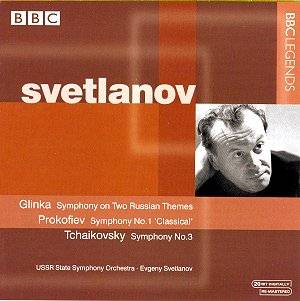
Svetlanov, Glinka, Prokofiev, Tchaikovsky, USSR State Symphony Orchestra


This is my post from this week's Tuesday Blog.


This week’s Cover 2 Cover share actually began as a potential Vinyl’s Revenge. In searching for a YouTube clip of an old Melodiya vinyl recording in my collection of Tchaikovsky’s Polish Symphony, I found a contemporaneous performance of the same work by the same orchestra and conductor, but in a public setting.

The Soviet military intervention that concluded the Prague Spring on 20 August 1968 coincided with a tour of the USSR State Symphony Orchestra in the UK. According to a review of today’s feature performance, the following evening, the USSR State SO was guesting at the Proms (and playing Czech music to boot - the Dvořák Cello Concerto, with Rostropovich). Four days later, the orchestra found itself in Edinburgh, to give the concert on this disc.

When I compare the studio disc to the concert recording, there’s definitely more “zing” to the orchestra, and the well-deserved ovation at the end only stands to prove that music transcends anything and everything, even East-West political tensions.

The first part of the program – the well-known Prokofiev Classical symphony and the single surviving movement of Glinka’s Symphony on Two Russian Themes are also rendered with all their subtlety and “Russianness” by what can be perceived in today’s thinking as one of the flagshiop orchestras of the Soviet regime, with one of its most respected conductors in Mr. Svetlavov.

This is a beautiful document, and a great way to start our Summer season!

Happy Listening


Mikhail GLINKA (1804-1857) 
Symphony on Two Russian Themes in D minor, G. i193

Sergei PROKOFIEV (1891-1953) 
Symphony No. 1 in D Major, op. 25, ‘Classical’

Peter Ilyich TCHAIKOVSKY (1840-1893) 
Symphony No. 3 in D Major, op. 29, ‘Polish’ [TH 26]

USSR State Symphony Orchestra
Evgeny Svetlanov, conducting
Live performances from Usher Hall, Edinburgh, on August 24th, 1968.

BBC Music ‎– BBCL 4145-2 (BBC Legends)
Format: CD, Stereo ADD
Released 2004
Details - https://www.discogs.com/Svetlanov-Gl...elease/4796722


Internet Archive URL - https://archive.org/details/06SymphonyNo3InDMajorOp29