Saturday, April 11, 2020

Easter Vigil

No. 336 of the ongoing ITYWLTMT series of audio montages can be found in our archives at https://archive.org/details/pcast336


=====================================================================
I delayed this week’s Blog and Podcast to better fit the Lenten calendar, and not rob the solemnity of our daily share for Good Friday.

Among liturgical western churches including the Roman Catholic Church, the Anglican Communion, and Lutheran churches, Easter Vigil, is observed in traditional Christian churches as the first official celebration of the Resurrection of Jesus. Historically, it is during this liturgy that people are baptized and that adult catechumens are received into full communion with the Church. It is held in the hours of darkness between sunset on Holy Saturday and sunrise on Easter Day – most commonly in the evening of Holy Saturday or midnight – and is the first celebration of Easter, days traditionally being considered to begin at sunset.

The three works I assembled for this Easter Vigil montage provide the spectrum of Darkness – with a pair of works inspired by the Passion – and Light - with a sacread cantata associated with Easter morning.

As with most of the nicknames that have become attached to Haydn's symphonies, that of Haydn’s Symphony no. 49 did not originate with the composer himself. It was long believed that the nickname "La passione" or The Passion derived from the nature of the music itself: the slow opening movement of the sinfonia da chiesa, its minor key modality and its association with the Sturm und Drang period of Haydn's symphonic output. However, the nickname can be traced back to a single source from a performance given during Holy Week in the Northern German city of Schwerin in 1790, where secular music was banned from performance between 1756 and 1785. This suggests that the name was derived circumstantially and not thematically and that reading the symphony as having a Passion-related motif is post-facto interpretation.

French organist and composer Marcel Dupré made the first of his many visits to America in 1921. He refers in his memoirs to the evening of 8 December when, at a recital he was giving on the Wanamaker Grand Court Organ in Philadelphia, he was offered several liturgical themes on which to improvise—Iesu redemptor omnium, Adeste fideles, Stabat mater dolorosa and Adoro te devote. He instantly decided to improvise an organ symphony in four movements which depicted in music the life of Jesus: ‘The world awaiting the Saviour’, ‘Nativity’, ‘Crucifixion’ and ‘Resurrection’. This improvisation became the basis of his Symphonie-Passion, Op 23, which he began to compose on his return to France.

Christ lag in Todes Banden ("Christ lay in the snares of death") is a chorale cantata, a style in which both text and music are based on a hymn. In this instance, the source was Martin Luther's hymn of the same name, the main hymn for Easter in the Lutheran church. The composition is based on the seven stanzas of the hymn and its tune, which was derived from Medieval models. This cantata is one of J. S. Bach’s earliest church cantatas. It is agreed to be an early work partly for stylistic reasons and partly because there is evidence that it was probably written for a performance in 1707. Bach went on to complete many other works in the same genre, contributing complete cantata cycles for all occasions of the liturgical year.


I think you will love this music too


Tuesday, April 7, 2020

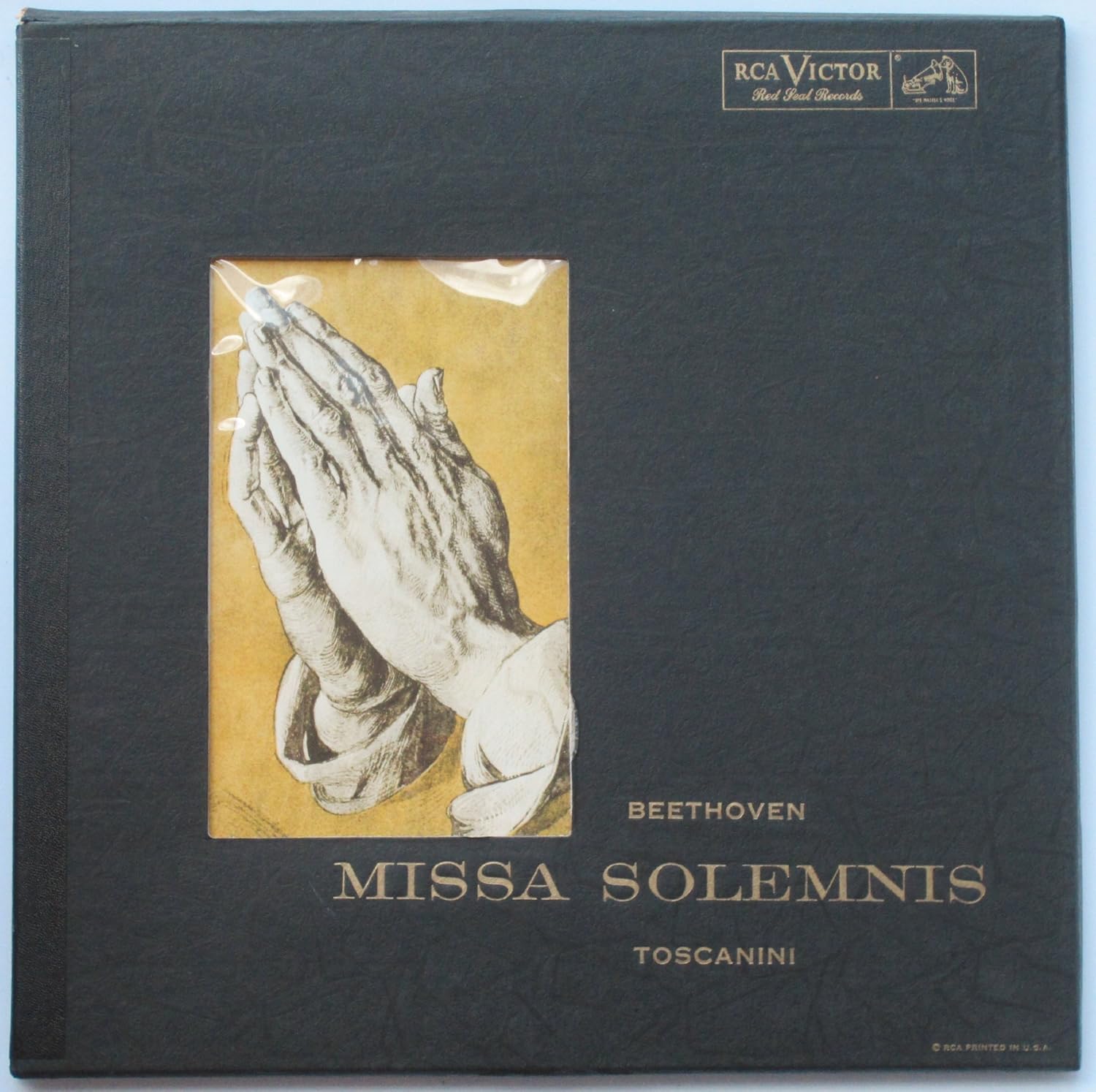
Ludwig van Beethoven, NBC Symphony Orchestra, Arturo Toscanini ‎– Missa Solemnis


This is my post from this week's Tuesday Blog.


Today's post combines our ongoing #Beethoven2020 series and Holy Week with a Once Upon the Internet share sourced from the old Japanese Public Domain Classic site we so often have acknowledged in past Tuesday Blogs.

A few days ago on my Friday Blog and Podcast, I began a look at Beethoven's sacred choral works with the oratorio Christus am Ölberge and a YouTube share of the Mass in C. Today, we complete the trifecta with the Missa Solemnis in a vintage performance featuring the Robert Shaw Chorale, Canadian and American soloists and the NBC Symphony all under the direction of Arturo Toscanini. I believe this recording was part of a complete Beethoven symphony cycle issued on RCA Victor.

Composed from 1819 to 1823, it was first performed on 7 April 1824 in Saint Petersburg, Russia, under the auspices of Beethoven's patron Prince Nikolai Galitzin; an incomplete performance was given in Vienna on 7 May 1824, the Kyrie, Credo, and Agnus Dei were conducted by the composer at the same concert which premiered the Ninth Symphony. It is generally considered one of the composer's supreme achievements and, along with Bach's Mass in B minor, one of the most significant Mass settings of the common practice period.

There are at least three commercially-available performances of the Missa under Toscanini, two (from 1940 and 1953) with the NBC Symphony stir debate among aficionados, most preferring the soloist quartet and overall performance of the earlier version. However, the 1953 session benefits from Carnegie Hall as a venue and a better engineered result. Whether it ranks #1 or #2, let's all agree that Toscanini captures the solemnity of the piece, and gets he most out of his singers and orchestra.

Happy listening!


Ludwig van BEETHOVEN (1770- 1827)
Missa Solemnis, in D Major, op. 123

Lois Marshall, Soprano
Nan Merriman, Mezzo-soprano
Eugene Conley, Tenor
Jerome Hines, Bass
The Robert Shaw Chorale (Chorus Master – Robert Shaw)
NBC Symphony Orchestra
Arturo Toscanini, conducting

Recording: New York, 1953
Source: Public Domain Classic

Discogs - https://www.discogs.com/Ludwig-van-B...elease/5287415
Internet Archive - https://archive.org/details/103missasolemnisop.123credo

Friday, April 3, 2020

Christus am Ölberge


This montage from our Podcast Vault revisits a post from April 3, 2015. It can be found in our archives at https://archive.org/details/pcast267


 =====================================================================


In recent months, our Friday visits into the Podcast Vault are complementary to Project 366, as we post daily from our musical calendar and take advantage of planned shares. This week, however, Project 366 is contemplating Beethoven’s Fidelio, which gives us a nice segue into Beethoven’s choral output.

Past montages/listener guides have considered Beethoven’s Choral symphony (which we will be featuring on the Project in May), and his late choral works – all secular in nature. Beethoven did contribute three sacred works to his choral repertoire, two are featured as part of our Lenten programming – today and this coming Tuesday – and the third, his Mass in C Major, is our “bonus” track.

Christus am Ölberge (Christ at the Mount of Olives) is Beethoven's only sacred oratorio. Unlike Bach and other composers before him, Beethoven does not consider a complete setting of the Passion rather focusing on one specific episode. In doing so, Beethoven creates a work of human proportions (rather than a two-hour magnum opus), allowing for a focus on the human aspects rather than a continuous narrative of the biblical story. The libretto for this oratorio is from poet Franz Xaver Huber, and the work was likely created in the lenten season of 1803 (April 5th) in a concert that also premiered his second symphony. The work is later revised in 1811, explaining its later Hess number (op. 85) compared to that of its contemporary symphony (op. 36). The work was published near the time of the MasS in C (op. 86).

The filler material in the montage is film music by Jacques Ibert for the 1935 French film Golgotha by Julien Duvivier.

The bonus selection, as teased earlier, is a complete performance of the Beethoven Mass in C, featuring the Orchestre Révolutionnaire et Romantique, conducted by John Eliot Gardiner and played on period instruments.


I think you will (still) love this music too.


Wednesday, April 1, 2020

Project 366 - Dates on the Musical Calendar for April 2020

Project 366 continues in 2019 with "Dates on the Musical Calendar". Read more here.


Highlights
This month’s “musical dates” include the conclusion of our Lenten Listener Guides (culminating with the three-day period starting on Good Friday), four complete operas (Beethoven’s Fidelio, Thomas’ Mignon, Wagner’s Tristan and Leoncavallo’s (not Puccini’s) version of La Bohème (Guides 334 and 335). And a few stage works including Debussy’s seculat cantata La demoiselle élue (Guide #332). Among some new “filler” listener guides, I added three Mendelssohn concertos (Guide #333) and a selection of Liszt’s Hungarian Rhapsodies in their original piano form (Guide #336).

Your Listener Guides

Listener Guide #332 - In Memoriam - Claude Debussy (1862-1918)
Claude Debussy died a century ago, but his music has not grown old. Bound only lightly to the past, it floats in time. As it coalesces, bar by bar, it appears to be improvising itself into being—which is the effect Debussy wanted. After a rehearsal of his orchestral suite “Images,” he said, with satisfaction, “This has the air of not having been written down.” In a conversation with one of his former teachers, he declared, “There is no theory. You merely have to listen. Pleasure is the law.” (ITYWLTMT Montage # 297 - 30 Nov 2018)


Listener Guide #333 - Felix Mendelssohn: Concertos
Felix Mendelssohn composed eight concertos, for solo piano, violin and combinations thereof. In addition to the E Minor violin concerto we can add the two piano concertos (opp. 25 and 40) as part of the “mature” works in the genre by Mendelssohn. The violin concerto in D Minor from 1823 is probably the best-known of the “early” Mendelssohn concertos. (ITYWLTMT Podcast #183 - 30 Jan 2015)


Listener Guide #334 & 335 – La Bohème (Leoncavallo)
Puccini wasn’t the only composer to attempt a work on Henri Murger's novel Scènes de la vie de bohème. In February 1893, two Milan newspapers announced that two operas were to be composed on the subject of La bohème, one by Leoncavallo and one by Puccini. Ruggero Leoncavallo, best known as the composer of Pagliacci, first considered composing the opera, and offered a libretto that he had written to Puccini, who refused because he supposedly was considering another subject. Puccini then employed Luigi Illica and Giuseppe Giacosa to provide him with their version, which reached the stage in 1896, while Leoncavallo’s version debuted in the following year. Although Leoncavallo’s version was well received at its premiere, it shortly was totally eclipsed by Puccini’s work. (Once or Twice a Fortnight – 15 Oct 2016)


L/G 334 (Acts 1 and 2) - 

L/G 335 (Acts 3 and 4) - 

Listener Guide #336 - Liszt’s Hungarian Rhapsodies (original piano version)
As Liszt toured Europe as a piano virtuoso, notably in the late 1830’s, he returned to his native Hungary where he re-encountered the folk tunes of his youth, and from there the Hungarian Rhapsodies are finally hatched. All the works bear dedications to important Hungarians of the day (Szerdahelyi, Teleki, Festetics, Kázmér Esterházy, Mme Reviczky, Apponyi, Orczy, Augusz, Egressy), or to musicians with Hungarian interests (Joachim, Ernst, von Bülow). (ITYWLTMT Podcast #177 - 12 Dec 2014)