Friday, March 30, 2018

Tchaikovsky Waltzes

No. 275 of the ongoing ITYWLTMT series of audio montages, which can be found in our archives at https://archive.org/details/pcast275


=====================================================================

This week, I postponed my usual early-morning post of our Friday Blog and Podcast, as I didn’t feel irt was right for me to provide light music on Good Friday. I view this more as an Easter share.

When one thinks of the waltz, two names spring to mind: the Viennese Waltz King (Johann Strauss) and Poland’s greatest composer (Frederic Chopin). However, as today’s podcast suggests, we shouldn’t overlook Russia’s Peter Tchaikovsky. Today’s playlist gathers several waltz movements and stand-alone waltzes from Tchaikovsky’s symphonic, stage and piano catalogues.

When one thinks of a Symohony, it is generally expected that one movement will be dance-themed. In the classical symphony, that form is that of the minuet, in the early Romantic, the minuet is replaced by the scherzo which can be thought of as a caricature of the minuet. It isn’t uncommon for late Romantics to explore different dance motifs – think of Mahler and the rustic Ländler. In Tchaikovsky’s Fifth symphony, he inserts a waltz between his unformgettably lyrical adagio movement and the procession-like finale. The waltz, in the requisite ¾ time, follows the deliberate leitmotiv-like principal line of the symphony. Another example (which I left out of the montage) is the 5/4 time near-waltz of the Pathetique symphony.

More “symphonic waltzes” I have retained include that from the serenade for strings, two waltz movements from his symphonic suites and the valse-scherzo for violin and orchestra
Three of Tchaikovsky’s most well-known waltzes come from his three ballets. A fourtyh “stage waltz” is  from the opening ballroom scene of his opera Eugnene Onegin.

The last works on the montage come from Tchaikovsky’s (under-appreciated) piano catalog, including one that was deftly adapted by Canadian conductor and trombonist Alain Trudel for his own use (accompanied at the piano by another Canadian conductor who we rarely hear as a pianist…)


I think you will love this music too.

Tuesday, March 27, 2018

Sibelius, Helsinki Philharmonic Orchestra, Paavo Berglund ‎– Symphony No. 4 & 7


This is my post from this week's Tuesday Blog.


This week’s Tuesday Blog is another installment of Vibnyl’s Revenge, this time dedicated to a pair of short symphonies by Jean Sibelius.

In a fine survey article, Tom Huizenga relates (and provides excerpts from) a 2002 interview by author Michael Steinberg providing his insights on Sibelius and his seven symphonies (an Eighth was composed but mysteriously disappeared).

Here are some of Steinberg;s commentary on the two symphonies featiured in today’s share, the fourthand the seventh:

When Sibelius was in his mid-40s, he thought he was going to die. His doctors had found a growth in his throat and after several operations his prognosis was still not good. He was a hard-living, hard-drinking cigar smoker. For a time, he gave it all up and wrote his dark, inward-looking, modern-sounding Symphony No. 4, a work that baffled not only many listeners but conductors as well.

[...]

One of the ideals of the Romantic era in classical music was to achieve unity, and it's been said that the Symphony No. 7 by Sibelius, first heard in 1924, consummates the 19th-century search for symphonic unity. It's in just one movement, shifting from tempo to tempo, idea to idea. Musicologist Donald Tovey wrote, "Sibelius has achieved the power of moving like aircraft." Steinberg says the conclusion of the Seventh Symphony, despite the fact Sibelius had composed an Eighth, seems to say, "The End."
During the mid-1950s, Jean Sibelius heard today’s conductor Paavo Berglund conduct some of the symphonies and the Suite Rakastava, and told Berglund how much he had enjoyed the performances.

Berglund's source-critical research on the Sibelius Seventh Symphony began in 1957, when he conducted the Seventh with the Helsinki Philharmonic Orchestra, and noticed that they were playing from parts that Sibelius had corrected. He saw that the printed parts had numerous errors. His subsequent research led to the publication of a new edition of the symphony by Hansen in 1980. Paavo Berglund conducted his last concert in Paris with the French Radio Philharmonic Orchestra and the program included Sibelius' Symphony No. 4.

Berglund recorded the complete Sibelius symphonies three times, and today’s vinyl selection is part of his set with the Helsinki Philharmonic for EMI.


Jean SIBELIUS (1865-1957)
Symphony No. 4 In A Minor, Op. 63
Symphony No. 7 In C Major , Op. 105
Helsinki Philharmonic Orchestra
Paavo Berglund, conducting

Angel Records ‎– DS-38135
Format: Vinyl, LP (DDA)

Details - https://www.discogs.com/Sibelius-Hel...elease/2096497 


YouTube playlist - https://www.youtube.com/playlist?lis...ERAGmoNwKkZnCs

Friday, March 23, 2018

Sir Andrew Davis conducts Richard Strauss

No. 274  of the ongoing ITYWLTMT series of audio montages, which can be found in our archives at https://archive.org/details/pcast274


=====================================================================

UPDATE - OTF Link https://operalively.com/forums/showthread.php/3200-OTF-%E2%80%93-Strauss%E2%80%99-Four-Last-Songs

There are many angles that I can use to introduce today’s podcast dedicated to Richard Strauss:
  • Two albums from my personal Vinyl collection shared cover to cover;
  • Works that exemplify two of Strauss’ main genres: lieder and tone poems
  • Works all conducted by Sir Andrew Davis.


The two principal works showcased today are Strauss’ Four Last Songs, and Ein heldenleben (A Hero’s Life), which as a tone poem provides sections where the solo violin plays a key role.
Strauss produced Lieder throughout his career. The Four Last Songs are among his best known, along with "Ruhe, meine Seele!", "Cäcilie", "Morgen!", "Heimliche Aufforderung", "Traum durch die Dämmerung", and others (some of these are featured as “filler tracks” from the album I selected for today’s podcast). Richard Strauss’ wife, soprano Pauline de Ahna , was a great source of inspiration to him. Throughout his life, he preferred the soprano voice to all others, and all his operas contain important soprano roles. Strauss's songs have always been popular with audiences and performers, and are generally considered by musicologists—along with many of his other compositions—to be masterpieces.

In 1948, Strauss wrote his last work, the Four Last Songs for soprano and orchestra. He reportedly composed them with Kirsten Flagstad in mind and she gave the first performance, which was recorded. Today’s soloist, Dame Kiri Te Kanawa, has recorded this song cycle with Davis and later with Georg Solti.

At the time of this Strauss/LSO recording, Sir Andrew was in the midst of his longstanding association with the Toronto Symphony (1975-1988, now its Conductor Laureate). Midway through his Toronto tenure, CBC Records began commercial venture, the SM-5000 series, digital recordings featuring mainly the orchestras in Toronto, Vancouver and Calgary as well as its in-house CBC Radio orchestra.

In 1986, Davis and the TSO released their version of Heldenleben, featuring its then-concertmaster, Steven Staryk. Generally agreed to be autobiographical in nature, Heldenleben contains more than thirty quotations from Strauss's earlier works, including Also sprach Zarathustra, Till Eulenspiegel, and Death and Transfiguration. Davis re-recorded the work 30 years later with the Melbourtne Symphony Orchestra (an ensemble under his tutelage since 2013).

Interesting footnote, Steven  Staryk was one of the “Symphony Six” – members of the Toronto Symphony  who were denied permission to enter the United States for a concert tour in November 1951. He later came to prominence when chosen by Sir Thomas Beecham as concertmaster and soloist of the Royal Philharmonic Orchestra, at age 24 and was the youngest musician, at that time, to fill the dual role. He later held the position with the Concertgebouw Orchestra and the Chicago Symphony. His discography of over 190 compositions ranks him as one of the most recorded classical Canadian musicians.


I think you will love this music too.


Tuesday, March 13, 2018

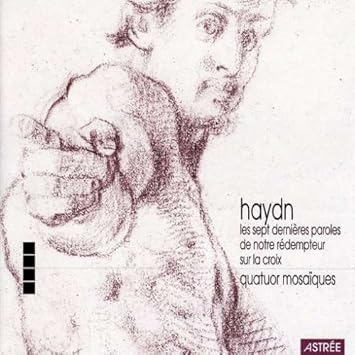
Haydn: Seven Last Words / Mosaiques Quartet


This is my post from this week's Tuesday Blog.


I’ve not shared anything yet for the Lenten season. In past years, I have used this opportunity to program some organ selections, but opted out of that for 2018. Here is my only programmed share for Lent this year.

The Seven Last Words of Our Saviour on the Cross (German: Die sieben letzten Worte unseres Erlösers am Kreuze) was a commission made to Joseph Haydn in 1786 for the Good Friday service at Oratorio de la Santa Cueva (Holy Cave Oratory) in Cádiz, Spain. Published in 1787 and performed then in Paris, Berlin and Vienna. The composer adapted it in 1787 for string quartet and in 1796 as an oratorio (with both solo and choral vocal forces), and he approved a version for solo piano.

The seven main meditative sections—labelled "sonatas" and all slow—are framed by a slow Introduction and a fast "Earthquake" conclusion, for a total of nine movements.

The long-term popularity of Haydn’s The Seven Last Words among string quartets tends to mask the fact that it was originally an orchestral work designed for performance in a specific cathedral (Cadiz) in conjunction with biblical readings and priestly meditations. Perhaps the intimacy of the quartet genre has something to do with it (four players in seven prayerful Adagios).

In my personal collection, I have a pair of quartet interpretations – one by the Lindsay quartet (complete with the prologue and epilogue sections), and another by the Emerson quartet (limited to the seven sonatas). However, as I do in the Ciover 2 Cover series, I chose a version available on YouTube by the Mosaïques quartet.

Quatuor Mosaïques may be the finest period instrument string quartet in the world – high praise from AllMusic.com. No other group (not even the old Quartetto Esterházy) comes close to the deep, mellow tone of the Quatuor Mosaïques' individual instruments (Eric Hobarth and Andrea Bischof on violins, Anita Mitterer on viola, and Christophe Coin on cello, all period instruments), and no other group (not even the new Salomon String Quartet) approaches its rich, warm ensemble sound. Most importantly, no other period instrument quartet and very few modern instrument quartets can match the Quatuor Mosaïques level of musicianship.


Franz Joseph HAYDN (1732-1809)
Die sieben letzten Worte unseres Erlösers am Kreuze, Hob. XX:02 [op. 51]
Quatuor Mosaïques
Erich Höbarth & Andrea Bischof (Violin)
Anita Mitterer (Viola)
Christophe Coin (Cello)
Label: Naive Catalog #: 8803


IA Link - https://archive.org/details/SevenLastWordsOfChristOnTheC


Further listening – a YouTube playlist that includes all four versions of the work - https://www.youtube.com/playlist?lis...rqcMCVCH7q6I7_