Tuesday, February 13, 2018

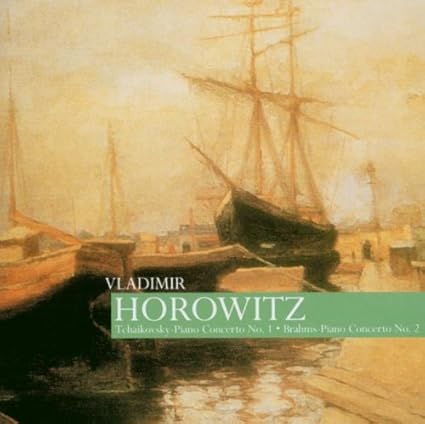
Vladimir Horowitz. Tchaikovsky - Piano Concerto No. 1 / Brahms - Piano Concerto No. 2


This is my post from this week's Tuesday Blog.


This week’s installment of Once Upon the Internet brings us back to the Italian Public Domain siteLiberMusica, for a pair of concerti featuring Vladimir Horowitz, his Father-in-Law Arturo Toscanini and his NBC Symphony Orchestra.

The source pages from the Italian site don’t clearly identify the performances – a search on the Web using the title of the source album strongly suggests that the tracks come from a Classica D'oro recording which, according to AllMusic.com, was a March 2001 remastered reissue of 1940’s recordings of these concerti. There is a plethora of digitally restored albums reissuing these well-travelled recordings, notably a Naxos Historical recording which has the benefit of copious background and technical notes.

According to these excellent notes (excerpts liberally rearranged):

Vladimir Horowitz held a singular place in twentieth-century music. He was both an international celebrity and serious artist whose performances and recordings were anxiously anticipated and widely discussed. His recordings of Brahms's Second Concerto (1940) and Tchaikovsky's First Concerto (1941) are among the most influential piano recordings ever produced and they helped to propel his career into the 1940s and beyond.

Perhaps through a combination of dutiful compliance to his wife and Toscanini’s renowned indomitable will, Horowitz always remained far more in awe of his father-in-law, at least when in his company, both socially and musically. Referring to the Brahms concerto recording, he famously remarked at a later time, "Toscanini had his own conception, and I followed it, even if it was sometimes against my own wishes."

Horowitz's May 6, 1940 performance of the [Brahms] B-Flat Concerto in New York was a sensation. The event was an all-Brahms charity concert at Carnegie Hall with Toscanini and the NBC Symphony Orchestra. New York Times' critic Olin Downes wrote that "Mr. Horowitz played what is probably the greatest of piano concertos with all the sincerity, the virility and fire of his young heart, and the abundant virtuosity and power which are phenomenally at his command, and...one ventures to say that this was playing of a breadth, a masculinity, a poetry and withal a heroic spirit which would have satisfied the composer." Downes reported the audience to have applauded each movement and cheered at the end. On May 9 he recorded the concerto at the RCA Victor studios in Camden, New Jersey. [Blogger's Note: some other sources claim the recording venue was Carnegie Hall]

The Brahms recording hit the shops and was an enormous commercial and critical success. RCA Victor executives were thus anxious to follow up the Brahms with Horowitz's showpiece, Tchaikovsky's First Concerto. In 1941 Americans had long been familiar with Tchaikovsky's First Concerto, and with Horowitz's interpretation of it. Horowitz had made the concerto a central part of his repertoire early in his career.

On 19 April 1941 Horowitz played the concerto with Toscanini and the NBC Symphony Orchestra at an all-Tchaikovsky concert at Carnegie Hall, marking the fiftieth anniversary of the dedication of the famous auditorium. Noel Straus, writing in the New York Times, called Horowitz's playing "brilliant, poetic and vital...a truly stupendous exhibition of pianism, as emotionally expansive as it was amazing in its tonal hues and subtlety of nuance." Once again, the studio recording took place a few days later and, as with the Brahms, the Horowitz-Toscanini version quickly became the one to own.
For many music lovers the 1941 recording of the Tchaikovsky, long available on 78-rpm discs and later on vinyl LPs, is one of the very Romantic interpretations of the concerto and it is an absolute treasure.

Happy Listening!


Johannes BRAHMS (1833-1897)
Piano Concerto No. 2 in B flat major, op. 83
https://www.liberliber.it/online/aut...aggiore-op-83/

Peter Ilyich TCHAIKOVSKY (1840-1893)
Piano Concerto No. 1 in B flat minor, op. 23 [TH 55]
https://www.liberliber.it/online/aut...chestra-op-23/

Vladimir Horowitz, piano
NBC Symphony Orchestra
Arturo Toscanini. Conducting
Recorded 9th May, 1940 (Brahms), and 14th May, 1941 (Tchaikovsky) in Carnegie Hall, New York City

Source album: Classica d'Oro 3001


Internet Archive URL - https://archive.org/details/051.AllegroNonTroppoEMoltoMae

Friday, February 9, 2018

Mozart 2-3-4

No. 271 of the ongoing ITYWLTMT series of audio montages, which can be found in our archives at https://archive.org/details/pcast271


=====================================================================
This week’s podcast is intended to be part of our Time Capsule project, and is a sampling of Mozart’s many concertos for solo instrument and orchestra, featuring three instruments – the horn, the violin and the piano. As I often due, allow me a little numerical fun as the works follow the numerical sequence 2, 3 and 4.

Last year, as part of our Friday series and our Vinyl’s Revenge series we spent some time exploring Mozart’s piano concertos, so I don’t plan to say much about this week’s selection in that department – the Piano Concerto no. 4 - other than to say that it is part of Geza Anda’s landmark complete set as soloist and conductor with the Mozarteum Orchestra of Salzburg, featured in a few of our past podcasts devoted to the Mozart corpus.

Mozart composed several concerti for wind instruments – flute, bassoon, oboe (repurposed for the flute), clarinet and horn, and many of these have been part of past podcasts and Tuesday shares. This week’s selection, the horn concerto no. 2 has a very catchy rondo finale – a formula Mozart will reuse in his fourth horn concerto.

According to the Köchel catalog of Mozart’s works, he may have composed as many as seven violin concerti – the final two (K 268 and 271a) fall in the “doubtful” category – see our recent post on Mozart’s 37th symphony for a larger discussion on these spurious entries in the catalog. Mozart’s five “numbered” concertos were all composed in 1775 and today’s podcast features the concerto no. 3 which Mozart in his own correspondence calls the “Straßburg” concerto as the rondo finale borrows from a local Strasburgian folk tune, a sort of pot-pourri in the French style. The podcast performance is from the EMI complete cycle of the violin concertos by David Oistrakh as both soloist and conductor with the Berlin Philharmonic.

To complete the podcast, I added a performance of the Violin Concerto (no. 7) in D major, K. 271a. It has also been called the Kolb Concerto due to a reference by Mozart’s father, Leopold, as "the concerto you [Wolfgang] wrote for Kolb". Kolb was originally thought to be Franz Xavier Kolb (1731–82), but it also could have been his older son Johann Andreas (born sometime around 1746-8).
The work may have been completed by Wolfgang Amadeus Mozart on 16 July 1777 in Salzburg; the true provenance of the concerto remains unknown and debated.


I think you will love this music too.

Tuesday, January 30, 2018

Michael Haydn & Mozart


This week's Tuesday Blog is no. 270 of the ongoing ITYWLTMT series of audio montages, which can be found in our archives at https://archive.org/details/pcast270


=====================================================================

2018’s first “fifth Tuesday” quarterly montage proposes as its key work one of Mozart’s numbered symphonies that should be rightly assigned to Joseph Haydn’s brother; the so-called Symphony No. 37 adds an introduction by Mozart to a symphony in G by Michael Haydn.

According to Wikipedia , the number of symphonies actually written by Mozart is imprecisely known; of the 41 formally numbered, three (Nos 2, 3 and 37) are established as by other composers and another, No. 11, is considered by scholars to be of uncertain authorship. Outside the accepted sequence 1–41, however, there are around twenty other genuine Mozart symphonies, and beyond these, a larger number of problematic works which have not been authenticated as Mozart's.

The Symphony no. 37 was for a long time believed to be a work by Mozart, but is now known to have actually been written by Michael Haydn, being his Symphony No. 25 in G major, [Perger 16, Sherman 25, MH 334]. As a result, this symphony, which had been quite widely played when thought to be a Mozart symphony, has been performed considerably less often since this discovery in 1907.

Indeed, several of Michael Haydn's works influenced Mozart. To give just three examples: the Te Deum (which Wolfgang was later to follow very closely in K. 141); the finale of the Symphony No. 23 which influenced the finale of the G major Quartet, K. 387; and the (fugal) transition and (nonfugal) closing theme of the G major second subject expositions of the finales of both Michael's Symphony No. 29 (1784) and Mozart's monumental last Symphony No. 41 ("Jupiter") (1788), both in C major.

Mozart probably copied out the score in order to learn from it, but he wrote a new Adagio maestoso introduction for it (few of Michael Haydn's symphonies have slow introductions). The introduction was probably composed in late 1783 to be performed in the same concert in Linz, in which Mozart's Symphony No. 36 received its premiere.

Modern commentators find it difficult to comprehend how Mozart scholars could have considered the three movements of the G major Symphony (more aligned with Mozart’s early symphonic output) as the immediate successor of the 'Linz' Symphony.

Although his compositions are less known and performed than his brother’s, Michael Haydn was no slouch! Haydn's sacred choral works are generally regarded as his most important; his musical taste and skill showed themselves best in his church compositions and were already in his lifetime old-fashioned. He was also a prolific composer of secular music, including forty symphonies and wind partitas, and multiple concertos and chamber music including a string quintet in C major was once thought to have been by his brother Joseph.

The montage opens with another Michael Haydn symphony – his 28th. The montage closes with Mozart’s Symphony no. 39, the first of his “final trilogy” of symphonies.

Happy listening!

Tuesday, January 23, 2018

Stravinsky, RSO Berlin • Riccardo Chailly ‎– Symphonie De Psaumes


This is my post from this week's Tuesday Blog.


Riccardo Chailly was chief conductor of the Berlin Radio Symphony Orchestra from 1982 to 1989, making dozens of fine recordings during that time period, including a splendid trio of recordings from 20th Century masters – I featured his Carmina Burana in one of my Friday montages last year, and I appreciated his reading of Deryck Cooke’s “reconstruction:” of Mahler’s 10th. Today’s edition of Vinyl’s Revenge pairs Chailly with another 20th Century composer, Igor Stravinsky in a trio of short works and one major one – his Symphony of Psalms.

Unlike many pieces composed for chorus and orchestra, Stravinsky said that “it is not a symphony in which I have included Psalms to be sung. On the contrary, it is the singing of the Psalms that I am symphonizing.”

The work was commissioned by Serge Koussevitzky to celebrate the 50th anniversary of the Boston Symphony Orchestra. Although the piece was written for the Boston orchestra, the world premiere was actually given in Brussels by the Société Philharmonique de Bruxelles on December 13, 1930, under the direction of Ernest Ansermet.

Igor Stravinsky's cantata Zvezdoliki' (Звездоликий, The King of the Stars), set to a text by the Russian poet Konstantin Balmont, was composed in 1911–12, thus contemporaneous to his great trilogy of ballets – Firebird, Petrouchka and the Rite of Spring. The original Russian title literally means "Star-face" or "The Star-Faced One". The work is more commonly known by the French title as translated by Michel-Dimitri Calvocoressi, Le Roi des Étoles, thus explaining its usual English title.

Claude Debussy, to whom the work is dedicated, praised the work in a 1913 letter to the composer; though describing it as "extraordinary". The work is very rarely performed however as it is probably too elaborate (written for an unusually large orchestra plus six-part men's chorus) for not much payoff (barely five minutes and encompasses just 54 measures). In fact, it was not performed in public until 1939.

Le chant du rossignol (in English, The Song of the Nightingale), is a symphonic poem written by Stravinsky in 1917. The score is adapted from his earlier 1914 opera, Le rossignol (The Nightingale), based on Hans Christian Andersen's tale. The symphonic poem mostly uses music from acts two and three of the 1914 opera. Although not conceived as a dance piece at first, the piece’s ballet debut occurred on February 2, 1920 at the Theatre National de l'Opera in Paris. Stravinsky himself was not entirely pleased. "I had destined Le Chant du Rossignol for the concert platform, and a choreographic rendering seemed to me to be quite unnecessary," he says later in his autobiography.

Stravinsky agreed to do a revival of the ballet in 1925 and for the occasion, Diaghilev chose one of his newest students, George Balanchine, to choreograph the ballet. This is when Stravinsky first met Balanchine, who later became his most important creative partner.

To complete the album, Chailly chose the short orchestral fantasy, Feu d'artifice (Fireworks).

Happy listening!


Igor STRAVIN SKY (1882-1971)
Symphony of Psalms (1930)
Feu d'Artifice, op.4
Le Roi des Étoiles (1911-12)
Le Chant du Rossignol (1914-17)

Radio-Symphonie-Orchester Berlin Und Chor
(Chorus Master – Ernst Senff)
Riccardo Chailly, conducting

Recorded at Jesus Christus Kirche, Berlin. February 1984

Decca ‎– 414 078-1 (Vinyl, LP DDA)
Details - https://www.discogs.com/Stravinsky-R...elease/9404265


Posted to YouTube by Arquivista dos Sons.


Internet Archive copy