 | This is a past Tuesday Blog from Jun-16-2015. |
This week’s PTB concludes our look at the J.S. Bach Sonatas and Partitas for solo violin with the three partitas and – as a bonus, the partita for solo flute all performed on the viola by Scott Slapin.

According to notes available on the Eroica Classical Recordings website Myron Rosenblum, founder and first president of the American Viola Society wrote, "Scott Slapin is a musician of great talent and abilities - a violist of technical accomplishments and superior musicality. He is a violist to watch".
Scott Slapin studied the viola at the Manhattan School of Music and earned his Bachelor of Music degree by the age of eighteen, making him one of the youngest graduates in the school's history.
Scott began his professional career as the on-stage solo violist in the New York City production of Orpheus in Love (1992-93), a chamber opera by Gerald Busby and Craig Lucas He has premiered other works by Busby including his Muse for Solo Viola in Carnegie's Weill Hall (1994), and he has inspired other outstanding American composers including Richard Lane, David Noon and Frank Proto to write him solo works as well. In the late 1990's, Scott gave the premiere performances of Richard Lane's Third Viola Sonata and Nocturne for Solo Viola.
Scott and his wife, violist Tanya Solomon, often perform together as a duo, and have toured extensively throughout the United States and South America as members of the Philadelphia Virtuosi Chamber Orchestra, the Louisville Orchestra and the Sao Paulo Symphony Orchestra, and they are former principal violists of the Knoxville and Chattanooga symphonies.
Scott was the first violist in history to have recorded the complete cycle of J.S. Bach's Sonatas and Partitas on the viola, a cd-set which has been widely featured in print and on radio. Here is an excerpt from an article written by Scott about the sonatas and partitas:
I feel the Sonatas and Partitas are the best solo Bach the viola has. Yes, as a cycle, better than the Cello Suites. […] From my vantage point, it would seem natural, since we have no solo Bach of our own, to borrow from the closer instrument of the two, which is the violin.
[…] Bach himself transcribed many of his own works into different keys for different instrumentation-- including several movements from the Sonatas and Partitas. […] As great as the Cello Suites are, I feel the Sonatas and Partitas as an overall set are simply even greater, more interesting music. Bach, the master of polyphony, clearly felt technically freer with the violin to write more complex works. Whether we're talking about the three-part fugues, the Chaconne, or the beautiful slow movements of the sonatas, the additional lines that are close to non-existant or just hinted at in most of the Cello Suites really add to the beauty and interest of the violin sonatas and partitas.
Lastly there's the issue of the viola's character and the character of the music; […] most of the Sonatas and Partitas are very introspective, contemplative (the opening movements of all three sonatas come to mind.) I think many of the movements gain depth by being played a fifth lower. While I enjoy the Cello Suites an octave higher on the viola, I'm not sure that I look at any of the movements on viola as an improvement or as enhancing their musical character, I tend to see it as just something different.
Hard to disagree!
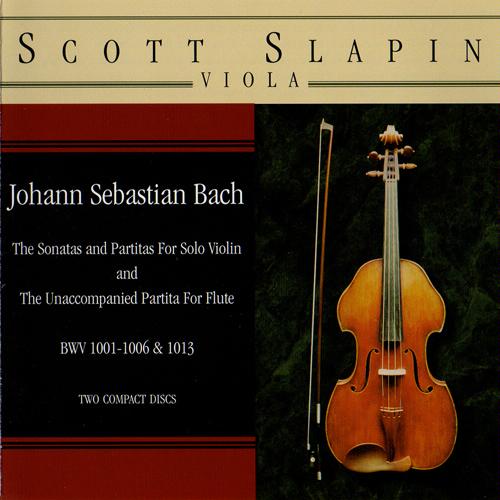
Johann Sebastian BACH (1685-1750)
Partitas (Partias) for solo violin
Partita No. 1 in B minor, BWV 1002
Partita No. 2 in D minor, BWV 1004
Partita No. 3 in E Major, BWV 1006
Partita in A minor for Solo Flute , BWV 1013
Scott Slapin, viola
(1st recording of these works by S. Slapin. Jan 1998)
Eroica Classical Recordings JDT-3025
Downloaded from MP3.COM, 15 May 2002
According to notes available on the Eroica Classical Recordings website Myron Rosenblum, founder and first president of the American Viola Society wrote, "Scott Slapin is a musician of great talent and abilities - a violist of technical accomplishments and superior musicality. He is a violist to watch".
Scott Slapin studied the viola at the Manhattan School of Music and earned his Bachelor of Music degree by the age of eighteen, making him one of the youngest graduates in the school's history.
Scott began his professional career as the on-stage solo violist in the New York City production of Orpheus in Love (1992-93), a chamber opera by Gerald Busby and Craig Lucas He has premiered other works by Busby including his Muse for Solo Viola in Carnegie's Weill Hall (1994), and he has inspired other outstanding American composers including Richard Lane, David Noon and Frank Proto to write him solo works as well. In the late 1990's, Scott gave the premiere performances of Richard Lane's Third Viola Sonata and Nocturne for Solo Viola.
Scott and his wife, violist Tanya Solomon, often perform together as a duo, and have toured extensively throughout the United States and South America as members of the Philadelphia Virtuosi Chamber Orchestra, the Louisville Orchestra and the Sao Paulo Symphony Orchestra, and they are former principal violists of the Knoxville and Chattanooga symphonies.
Scott was the first violist in history to have recorded the complete cycle of J.S. Bach's Sonatas and Partitas on the viola, a cd-set which has been widely featured in print and on radio. Here is an excerpt from an article written by Scott about the sonatas and partitas:
[…] Bach himself transcribed many of his own works into different keys for different instrumentation-- including several movements from the Sonatas and Partitas. […] As great as the Cello Suites are, I feel the Sonatas and Partitas as an overall set are simply even greater, more interesting music. Bach, the master of polyphony, clearly felt technically freer with the violin to write more complex works. Whether we're talking about the three-part fugues, the Chaconne, or the beautiful slow movements of the sonatas, the additional lines that are close to non-existant or just hinted at in most of the Cello Suites really add to the beauty and interest of the violin sonatas and partitas.
Lastly there's the issue of the viola's character and the character of the music; […] most of the Sonatas and Partitas are very introspective, contemplative (the opening movements of all three sonatas come to mind.) I think many of the movements gain depth by being played a fifth lower. While I enjoy the Cello Suites an octave higher on the viola, I'm not sure that I look at any of the movements on viola as an improvement or as enhancing their musical character, I tend to see it as just something different.
Johann Sebastian BACH (1685-1750)
Partitas (Partias) for solo violin
Partita No. 1 in B minor, BWV 1002
Partita No. 2 in D minor, BWV 1004
Partita No. 3 in E Major, BWV 1006
Partita in A minor for Solo Flute , BWV 1013
Scott Slapin, viola
(1st recording of these works by S. Slapin. Jan 1998)
Eroica Classical Recordings JDT-3025
Downloaded from MP3.COM, 15 May 2002


