Friday, January 15, 2021

Quatuor pour la fin du temps

No. 351 of the ongoing ITYWLTMT series of audio montages can be found in our archives at https://archive.org/details/pcast351


=====================================================================
January 15 marks the 80th anniversary of the first performance of Olivier Messiaen’s Quatuor pour la fin du temps (Quartet For the End of Time) for cello, piano, clarinet, and violin. The work was composed in a POW camp in Nazi-controlled Silesia.

Messiaen was 31 years old when France entered World War II. He was captured by the German army in June 1940. Not surprisingly, some of Messiaen’s fellow detainees were professional musicians; clarinetist Henri Akoka, violinist Jean le Boulaire  and cellist Étienne Pasquier. He managed to befriend a sympathetic guard and obtain some paper and a small pencil. Messiaen wrote at first a short trio for them; this piece developed into the Quatuor for the same trio with himself at the piano. The combination of instruments was unusual at the time, but not without precedent: Walter Rabl had composed for it in 1896, as had Paul Hindemith in 1938.

This is how the composer recalled its premiere in early 1941: 'The Stalag was buried in snow.  We were 30,000 prisoners (French for the most part, with a few Poles and Belgians).  The four musicians played on broken instruments … the keys on my upright piano remained lowered when depressed … it’s on this piano, with my three fellow musicians, dressed in the oddest way … completely tattered, and wooden clogs large enough for the blood to circulate despite the snow underfoot … that I played my quartet.'

This recollection has been challenged by many, including the other members of the quartet: while Messiaen remembers thousands in the audience, the camp hall could hold at most 500; his piano was not as imperfect as he describes; and his insistence that the cellist only performed with three strings has been repeatedly denied by the cellist himself.  Nonetheless, few dispute the significance of the work itself, one of the most important to be produced in the 20th century.

Messiaen and Etienne Pasquier (cellist at the initial premiere) later recorded the quartet on LP for Club Français du Disque (1956), together with Jean Pasquier (violin) and André Vacellier (clarinet).

Two other works complete the montage. Cantéyodjayâ is a work for piano written in 1949.The work's compositional bases are the Hindu rhythms often found in Messiaen's work. The composer's research into Hindu rhythms was based partly on the 120 rhythms listed in the thirteenth-century Sangita Ratnakara of Sarangadeva. The score includes names that are taken from this work, and also from Carnatic musical theory.

The five rechants form the last part of the "Trilogy of Tristan" after Harawi and the Turangalîla-Symphonie . The title of this work refers to the Printemps by Claude Le Jeune , “a masterpiece of choral writing and a masterpiece of rhythm” according to Messiaen. As in this work, verses (songs) and refrains (rechants) alternate. The melody has its source in the harawi or yaravi , a folk love song from Peru , and in the alba , a dawn song from the Middle Ages.

I think you will love this music too.


Tuesday, January 12, 2021

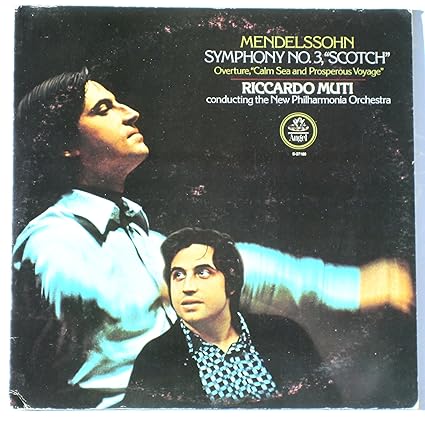
Riccardo Muti - Felix Mendelssohn - New Philharmonia Orchestra ‎– Symphony No. 3


This is my post from this week's Tuesday Blog.


We restart our bi-monthly Tuesday Blog shares with Vinyl’s Revenge, and an old all-Mendelssohn EMI recording featuring Riccardo Muti and the Philharmonia.

From the late 1950s to the early 1970s the Philharmonia Orchestra's chief conductor was Otto Klemperer, with whom the orchestra gave many concerts and made numerous recordings of the core orchestral repertoire.

In 1972, Klemperer announced his retirement from the directorship of the orchestra (briefly known as the New Philharmonia). The orchestra recognised that a strong chief conductor was needed to restore its standards and finances, but there was no immediately obvious candidate. The EMI executive Walter Legge no longer had any stake in the orchestra, though he watched its progress benevolently, and having spotted the potential of Riccardo Muti he recommended him to the New Philharmonia's general manager, Terence McDonald. Other potential candidates were considered, but Muti was appointed as the orchestra's chief conductor from 1973.

Muti, although he disclaimed such a description, was a firm disciplinarian, and under his conductorship the orchestra restored its standards. Critics at the time commented on the orchestra's "superb performance", "immense virtuosity", its "astoundingly delicate" string playing and "woodwind phrasing even more magical than their Berlin colleagues".
With Muti the orchestra recorded opera (Aida, 1974; Un ballo in maschera, 1975; Nabucco, 1977; I puritani, 1979; Cavalleria rusticana, 1979; La traviata, 1980; Orfeo ed Euridice, 1981; and Don Pasquale, 1982); a wide range of the symphonic repertoire including Schumann and Tchaikovsky cycles; concertos with soloists including Sviatoslav Richter, Andrei Gavrilov, Anne-Sophie Mutter and Gidon Kremer; and choral music by Cherubini and Vivaldi.

During Muti's tenure, the orchestra recovered its original title, after prolonged and complex negotiations From September 1977 the "New" was dropped, and the orchestra has been the Philharmonia since then.

One of our earliest shares in the Vinyl’s Revenge series was taken from the Muti/Philharmonia Tchaikovsky cycle, and today’s share is part of a partial Mendelssohn set (reissued and featured as a two-disk set per our YouTube link below). The specific LP in my collection includes the Scottish Symphony and the Calm Sea and Prosperous Voyage overture.

Fine performances all around.

Happy Listening!


Felix MENDELSSOHN-BARTHOLDY (1809-1847)
Symphony No. 3 In A Minor, Op.56 "Scotch"
Overture, "Calm Sea And Prosperous Voyage" Op. 27
New Philharmonia Orchestra
Riccardo Muti, conducting

Label: Angel Records ‎– S-37168
Format: Vinyl, LP, Album, Quadraphonic
Released: 1976

Details https://www.discogs.com/Riccardo-Mut...elease/5264986

YouTube https://youtube.com/playlist?list=OL...nPf7uJFHLpb22o

Friday, January 8, 2021

Joaquín Rodrigo (1901-1999)


This montage from our Podcast Vault revisits a post from January 3, 2020. It can be found in our archives at 
https://archive.org/details/pcast330


 =====================================================================

Our first foray into the Podcast Vault for the New Year is barely a year old, as we originally posted this as the first Friday post for 2020. Hard for me to propose a fresh take here, but here are some interesting tidbits taken from the composer’s official website

At the beginning of the 1920s Joaquín Rodrigo was already an excellent pianist and composition student familiar with the most important contemporary trends in the arts. His first compositions were written in small musical forms, and his first work for large orchestra, Juglares, was successfully premiered by the Valencia Symphony Orchestra conducted by Enrique Izquierdo in 1924. Rodrigo decided to move to France in 1927, since the French capital had been from the beginning of the century an important cultural centre for Spanish writers, painters and musicians. It was to be expected, therefore, that the young Joaquín Rodrigo would want to follow in the footsteps of Albéniz, Falla and Turina. By the end of the decade Joaquín was studying with his French master Paul Dukas in the École Normale de Musique in Paris.

In the spring of 1938 Joaquín Rodrigo and his wife had moved to Germany and was invited to teach on the summer courses at the University of Santander, which had just opened. The Rodrigos were thus able to renew their contacts with Spanish cultural life, in spite of the difficulties caused by the Civil War. A very significant encounter took place on the return journey to Paris, when during a lunch with the guitarist Regino Sainz de la Maza and the Marqués de Bolarque Joaquín enthusiastically agreed to the idea of writing a concerto for guitar. This work would be the Concierto de Aranjuez. During their last year of residence in the French capital Rodrigo gave piano recitals, undertook various orchestrations which were commissioned from him, and composed a number of songs in light-music style. But when winter arrived the Rodrigos began to consider a permanent return to Spain, once the country was finally at peace. Joaquín and Victoria finally returned to Spain on the 1st September 1939, two days before the outbreak of the Second World War, carrying with them in a suitcase the manuscript of the Concierto de Aranjuez.

During all these years the composer received many honours both in Spain and from abroad in recognition of his work. He was named Officier des Arts et des Lettres in 1960 and member of the Légion d'honneur in 1963 by the French government, Doctor of Music honoris causa by the University of Salamanca in 1964, and in 1966 he received the Gran Cruz del Mérito Civil and the Medalla de Oro al Mérito en el Trabajo. In 1963 he travelled to Puerto Rico to teach a course in the History of Music at the University of Río Piedras, where he remained until February 1964.

Our filler piece is one of five works Rodrigo composed for guitar and orchestra, his Concierto para una fiesta from 1982, premiered the following year at the Ridglea Country Club, Fort Worth, Texas (USA) by Pepe Romero and the Texas Little Symphony. Romero is featured here with The Academy of St-Martin-in-the-Fields with Sir Neville Marriner.


I think you will (still) love this music too.

Friday, January 1, 2021

Wien

No. 350 of the ongoing ITYWLTMT series of audio montages can be found in our archives at https://archive.org/details/pcast350


=====================================================================

Happy New Year!

This week's montage, our first for 2021 is an extended podcast - exceeding our self-imposed 90 minute limit by over 13 minutes.

New Year’s Eve is known as Silvester in Austria. It’s the Roman Catholic feast day of the same-named pope and saint, who died on December 31st, AD 335. None of which has any relevance, though, to how Vienna celebrates the turn of the year.

At midnight, the giant Pummerin bell of Vienna’s St Stephen’s cathedral rings in the New Year with the chimes broadcast across TV and radio. Once the last echoes of the Pummerin fade away, all hell breaks loose as fireworks across the city burst into action.

Broadcasters then switch to the Blue Danube waltz and everyone dances in the New Year as lights explode across the night sky.

All of the works featured today carry Vienna in their title - most of them by Austrian composers, including members of the \Strauss family. The lone exception is the final work - Ravel\s masterpiece La valse,

The idea of La valse began first with the title "Vienne", then Wien (French and German for "Vienna", respectively) as early as 1906, where Ravel intended to orchestrate a piece in tribute to the waltz form and to Johann Strauss II.  After his service in the French Army, Ravel returned to his original idea of the symphonic poem Wien, choosing to retile the work as anything German-sounding after the Great War had lost favour with audiences.

As Ravel would later put it,  "Whether or not it was intended as a metaphor for the predicament of European civilization in the aftermath of the Great War, its one-movement design plots the birth, decay and destruction of a musical genre: the waltz."

I think you will love this music too.