Showing posts with label Opera. Show all posts

Saturday, October 8, 2022

Verdi: Un ballo in maschera


This is my post from this week's Once or Twice a Fortnight.


We haven’t done one of these (outside of the Short Story format) for awhile. I plan at least ne more of these before the end of 2023.

As we continue our survey of the lyrical / operatic alphabet, we come to the leter “U”. I reached out to the community for some suggestions, and received a few interesting ones. However, in spite of the fact I’m not very pleased with the prominence of the “U” in the title, there are a pair of Verdi operas that use the indefinite article “Un” in its title, and here we are today.

A few years back, we shared Nielsen’s comic opera Maskarade, where romance and parties are part of the narrative and where a masked ball is the setting for its third act. Ditto for Johann Strauss’ Fledermaus.

Verdi, however, has a much darker premise for his masked ball: the assassination in 1792 of King Gustav III of Sweden who was shot while attending a masked ball. The subject matter was explored almost two decades earlier by French composer Daniel François Esprit Auber in his five-act opera Gustave III subtitled “Le bal masque”.

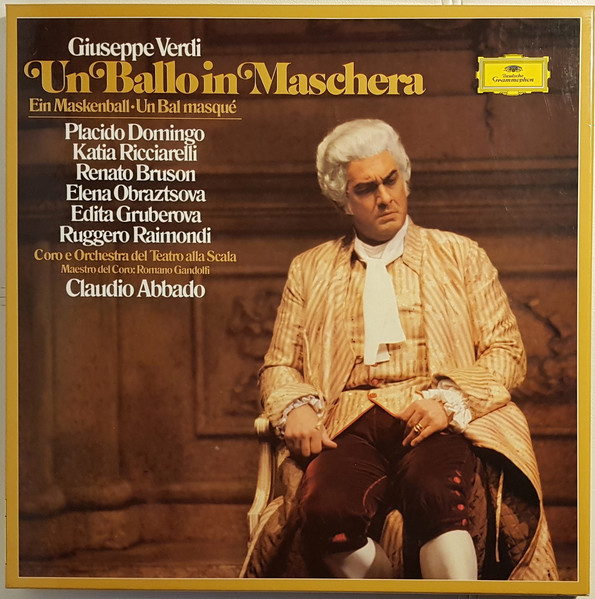
According to Wikipedia, the original project by Verdi and his librettist Antonio Somma was called Gustavo III. Never performed as written, the libretto was later revised (or proposed to be revised) several times under two additional names – Una vendetta in dominò and Adelia degli Adimari – during which the setting was changed to vastly different locations. Eventually, it was agreed that it could be called Un ballo in maschera, the one by which it is known today, but Verdi was forced to accept that the location of the story would have to be Colonial Boston. This setting became the "standard" one until the mid-20th Century. Most productions today locate the action in Sweden, though the recording I chose specifically identifies the main character as Riccardo and not Gustavo, thus it is set in Boston.

The main strength of this performance, I think, is Abbado's pacing and the DG engineers' success in doing justice to the textures.

Interestingly, Abbado and two of the principal voices in the cast (Placido Domingo as Riccardo and Katia Ricciarelli as Amelia) were part of another production at the Royal Opera House about five years earlier – it is available on YouTube as well.

Happy listening!

Giuseppe VERDI (1813-1901)

Un Ballo in maschera (1859)
Opera in three acts, Italian libretto by Francesco Maria Piave

PRINCIPAL CAST
Plácido Domingo – Riccardo, Earl of Warwick and governor of Boston
Katia Ricciarelli – Amelia, wife of Renato
Renato Bruson – Renato, Riccardo's secretary, best friend and confidant
Edita Gruberová – Oscar, Riccardo's page
Elena Obraztsova – Ulrica, a fortune-teller
Coro e Orchestra Del Teatro Alla Scala
Chorus Master – Romano Gandolfi
Conductor – Claudio Abbado
Deutsche Grammophon – 2740 251 (Released in 1981)

Synopsis - https://www.opera-arias.com/verdi/un...hera/synopsis/
Libretto - https://www.opera-arias.com/verdi/un...hera/libretto/
Discogs - https://www.discogs.com/release/9791...Gruberova-Rugg

YouTube – https://youtube.com/playlist?list=OL...KzU_tP9PGSdAg0

Archive Page - https://archive.org/details/guiseppe...bbado-acts-1-2

Tuesday, May 14, 2019

Roméo et Juliette (Gounod)

This is my post from this week's Once or Twice a Fortnight.


Written in 1597, Romeo and Juliet is probably William Shakespeare’s most celebrated play, and his pair of lovers have become a myth. Over the centuries, Romeo and Juliet has inspired all kinds of music. There are songs, ballets, symphonic poems, Broadway musicals and film scores… I have two posts planned for OTF this month, and both share a common thread – the timeless love story of Romeo and Juliet, in a pair of depictions from French composers.

According to an article on the World of Opera website, there are hundreds of Shakespeare operas, including about two dozen based on Romeo and Juliet. But what makes Gounod's opera a rare bird? It's that it's an opera based on Shakespeare that's actually a hit. Astonishingly, of those hundreds only a few are still seen regularly on today's stages. And of all the "R & J" operas, Gounod's is really the only one that has stuck in the repertory.

When Gounod turned his attention to Romeo and Juliet in 1867 he'd already had a big hit with another adaptation -- an opera based on Goethe's Faust. So for Romeo and Juliet, he collaborated with the same librettists he worked with on the earlier opera: Jules Barbier & Michel Carré.

The two writers stuck fairly close to the original play by Shakespeare, though there are some changes. Barbier and Carré cut a few scenes that didn't deal directly with the two lovers. They also tweaked the ending. In the play, when Juliet finally awakens in the tomb, Romeo is already dead. When she wakes up in the opera, Romeo still has a few flickers of life -- enough for the two to sing a final duet before Juliet stabs herself and they die together.

The recording I chose, from the LiberMusica collection, is one of the last recorded documents of the Old Order at the Palais Garnier and, as such, an interesting historical artifact.

One reviewer (unkindly, you might say), points to the signing of one of my favourite tenors of the era, Quebec City’s Raoull Jobin pointing out that “his ‘Comment?’ to Mercutio in Act I situates him a lot closer to the Jardin des Ursulines in Trois-Rivières than the Place de l' Opéra.” Later adding that “[he loves] Janine Micheau's Juliette. […] She gives forth many ravishingly beautiful phrases in the more lyric parts, with that uniquely lovely, burnished voice of hers. “

Happy Listening


Charles-François GOUNOD (1818 –1893)

Roméo et Juliette (1867)
Opera in five acts , French libretto by Jules Barbier and Michel Carré, based on Romeo and Juliet by William Shakespeare.

PRINCIPAL CAST
Le duc de Vérone André Philippe
Paris: Camille Rouquetty
Capulet: Charles Cambon
Juliette: Janine Micheau
Gertrude: Odette Ricquier
Thibaut: Louis Rialland
Roméo: Raoul Jobin
Mercutio: Pierre Mollet
Stéphano, a page: Claudine Collart
Grégorio André Philippe
Frère Laurent: Heinz Rehfuss
Choeurs et Orchestre du Théâtre National de l' Opéra de Paris
Arberto Erede, conducting
Recorded in Paris, 1953.

Synopsis – https://www.musicwithease.com/gounod...-juliet-2.html
Libretto – http://www.murashev.com/opera/Rom%C3...French_English
LiberMusica URL - https://www.liberliber.it/online/aut...o-et-juliette/


Friday, December 22, 2017

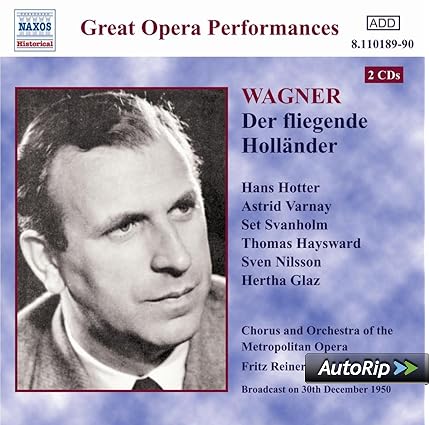
Der fliegende Holländer (Wagner)

This is my post from this week's Once or Twice a Fortnight.


I haven't been posting muchrecently - more like once or twice a quarter... Time is simply not on my side, but as I have a few days off work for the Holidays, I thought I'd finally get around to sharing this performance I downloaded a few years ago off the now defunct web site Public Domain Classic.

Let me (shamelessly) borrow from Paul Campion's fine notes for the NAXOS re-issue of this classic Met performance:

The tempestuous opening bars of the overture to Der fliegende Holländer throw us immediately into the passionate story of love, anguish and self-sacrifice that is to be played out in this, the first opera of Wagner’s musical maturity. Der fliegende Holländer was first performed on 2nd January 1843 at the Königliches Sächsisches Hoftheater in Dresden.

His initial conception was to present Der fliegende Holländer in one unbroken act, but shortly before the opening he reworked this into three separate acts, in which form it was customarily produced during the nineteenth century. (More recently, many directors and conductors have returned to Wagner’s first ideas and given the opera without any break; both are now regularly produced).

Among Wagner’s stage works, Der fliegende Holländer is the first great bridge between the Romantic operas of Weber, of whom he was an avid admirer, and his own Music Dramas, notably Tristan und Isolde and Der Ring des Nibelungen. Tellingly, it reveals his developing use of the leitmotif, which would be so significant in the creation of those later works. The most potent leitmotif, which returns repeatedly during the overture, is that of the Dutchman himself, who is fated to sail the seas until redeemed by the love of a faithful woman. Senta will herself make that sacrifice, and she relates the Dutchman’s haunting tale in her great second act ballad; at the climax of the third act she throws herself into the sea, finally to be seen embracing the Dutchman as his ship sinks beneath the merciless waves.

ABOUT THIS RECORDING

The 1950 production, at a later performance of which this recording was made, opened on the second night of Rudolf Bing’s first season as the Met’s general manager and was the occasion of two notable house débuts, those of Hotter and Nilsson, and two rôle débuts there, those of Varnay and Svanholm.

Hans Hotter was the supreme Wagnerian bass-baritone of his generation, and also sang rôles by MozartMussorgsky and Verdi. Born in Offenbach am Main in 1909, he studied in Munich, giving his first concert there in 1929. After his 1930 operatic début in Troppau, he sang in Prague, Hamburg and, most famously, Munich, where he remained for 35 years. Hotter appeared in two Strauss premières, Friedenstag in 1938, and Capriccio in 1942, the year he also first sang in Salzburg. In 1947 he was at Covent Garden with the Wiener Staatsoper, returning for eighteen seasons singing rôles including Wotan and Hans Sachs; Hotter appeared at the Met from 1950 to 1954 and first sang at Bayreuth in 1952. Long accomplished also as a lieder singer, he has more recently participated in performances of Lulu and Schoenberg’s Gurrelieder with continuing success.

Astrid Varnay was born in Stockholm in 1918; at an early age she moved with her parents to the United States, where she later studied singing. Varnay sang at Brooklyn Academy in 1937, but her sensational first Metropolitan performance, as Sieglinde (Naxos 8.110058-60), was in 1941; she appeared there during nineteen seasons, principally in Wagnerian rôles, including six performances as Senta. Varnay later sang in Chicago, San Francisco and South America and appeared in sixteen consecutive Bayreuth seasons, where she was Senta in 1955-6 and 1959. Varnay first sang at Covent Garden in 1948 and thereafter in many European cities, including Florence, Paris, Vienna and Milan; considered the most dramatically intense Isolde and Brünnhilde of her generation, she was a fine Lady Macbeth, Elektra, Marschallin and, later, Klytemnestra. In retirement Varnay moved to Munich, where she still lives.

Born in Västerås, Sweden in 1904, Set Svanholm originally trained as an organist and made his baritone début at the age of 25; his début as a tenor was in 1936, as Radames in Aïda, but he excelled in Wagner, particularly as Lohengrin, Parsifal, Siegmund and Tristan. Appearances in London, Salzburg, Berlin, Vienna, Bayreuth and La Scala preceded Svanholm’s 1946 début at the Met, where he sang for ten seasons; he appeared at Covent Garden from 1948 until 1957, displaying his robust, focused tenor to superb effect. In 1956 Svanholm was appointed director of the Royal Opera in Stockholm; he died in Sweden in 1964.

Sven Nilsson, too, was born in Sweden, in 1898; he studied in Stockholm, making his operatic début in 1930. As member of the Dresden Staatsoper (1930-1944), he sang at Covent Garden in 1936 and in the première of Strauss’s Daphne in 1938; he also appeared in Amsterdam, Brussels, Milan and Drottningholm. In 1946 Nilsson returned to Stockholm, singing there until his death in 1970. Nilsson assumed principally Wagnerian rôles, notably Daland, which he performed during his only Met season, Pogner and Gurnemanz; and also Sarastro, Osmin and Ochs.

Fritz Reiner, born in Budapest in 1888, studied under Bartók. He was Dresden Staatsoper’s musical director from 1914 to 1922, subsequently taking charge of the Cincinnati Symphony. From 1931 Reiner taught at the Curtis Institute in Philadelphia and was Director of the Pittsburgh Symphony from 1938 to 1948, scheduling performances at Covent Garden, La Scala, Vienna and South America into his energetic career. He later conducted at the Met and in Chicago, remembered for his wide musical interests, but principally for interpretations of the Romantics, Wagner, Strauss and twentieth century composers. Reiner died in New York in 1963.

The recording is very good, though it does show the technical limitations of recording live performances in those days.

Happy listening!


Richard WAGNER (1813 - 1883)
Der fliegende Holländer (The Flying Dutchman), WWV 63
Romantische Oper in three acts, with German libretto by the composer

PRINCIIPAL CAST
Der Holländer: Hans Hotter
Senta: Astrid Varnay
Erik: Set Svanholm
Daland: Sven Nilsson
Mary: Hertha Glaz
Der Steuermann Dalands: Thomas Hayward

New York Metropolitan Opera Chorus
New York Metropolitan Opera Orchestra
Fritz Reiner, conducting
Live performance, 30 December 1950

(Downloaded from Public Domain Classic, 2014)

Synopsis and Libretto - http://www.opera-arias.com/wagner/de...oll%C3%A4nder/
Details - https://www.naxos.com/catalogue/item...de=8.110189-90


Friday, May 12, 2017

L'heure Espagnole (Ravel)

This is my post from this week's Once or Twice a Fortnight.


Many times on OTF, I’ve tried to program one-act operas. I don’t mind monumental works (like Wagner’s Tristan we discussed last time) but since I do most of my music listening on the bus, I really like something that I can listen to from beginning to end during my commute – rather than doing it over two or three.


Ravel’s vocal output is surprisingly diverse – from settings of old Greek songs to a pair of short, one-act operas. L'heure espagnole is a one of those, best described as a musical comedy to a French libretto by Franc-Nohain, based on his 'comédie-bouffe' of the same name first staged in 1904.

Ravel was closely involved in every aspect of the production as it was prepared for its premiere at the Opéra-Comique in Paris. First performed at the Opéra-Comique on 19 May 1911 in a double-bill with Massenet’s Thérèse, it stood for nine performances and was not heard again for 10 years (5 December 1921 at the Paris Opera) when it enjoyed more success. The opera returned to the Opéra-Comique in 1945 where it entered the company’s repertoire.

Translated literally, the title in English is "The Spanish Hour", but the word "heure" more importantly means "time" – "Spanish Time", with the connotation "How They Keep Time in Spain". Time keeping, and in particular clocks, are used extensively as plot devices throughout the 21 scenes of this delightful work. Concepción, the clock-maker’s wife plans to use his weekly service rounds to entertain gentlemen at home, and her rendezvous’ are either aided or hampered by clocks that are used by her suitors to hide and get moved between her bedroom and her husband’s workshop.

Today’s musical share is from a 1965 recording supervised by Lorin Maazel, featuring local singers with varying name recognition.

Happy Listening!


Maurice RAVEL (1875-1937)
L'Heure Espagnole, MR 52
Musical Comedy in one act for 5 voices and orchestra, French libretto by Franc-Nohain


Concepcion – Jane Berbié
Don Inigo Gomez – José van Dam
Gonzalve – Michel Sénéchal
Torquemada – Jean Giraudeau
Ramiro – Gabriel Bacquier
Orchestre National de la R.T.F
Lorin Maazel, conducting
Recording: Paris, O.R.T.F., 2/1965

Synopsis - http://www.oberlin.edu/news-info/01jan/ravel_opera_synopsis.html

Libretto - http://www.operalib.eu/oraspagnola/pdf.html

Saturday, April 15, 2017

Wagner's Tristan und Isolde

This is my post from this week's Once or Twice a Fortnight.


In June 2016, Hugo Shirley wrote a very interesting article for Gramophone titled “The opera that changed music”. The article opens with quotes from Alma Mahler, Clara Schumann and Edward Elgar as they each react to Wagner's Tristan und Isolde; a quote from one of Grieg’s pen pals is especially “graphic”:

[T]he most enormous depravity I have ever seen or heard, but in its own crazy way it is so overwhelming that one is deadened by it as by a drug. […] Even more immoral…than the plot is this seasick music that destroys all sense of structure in its quest for tonal colour. In the end, one just becomes a glob of slime on an ocean shore, something ejaculated by that masturbating pig in an opiate frenzy!
The Gramophone article is a great read, especially for those of us who have mixed emotions about sitting through a Wagner opera from curtain rise to curtain fall – let alone try and sink their teeth into the material and make sense if it all. This is a commitment, to be sure!
Shirley writes that the past 150 years are littered with writers trying to express the fascination, revulsion (or both!) that Tristan inspires. Even today, Tristan remains a work that can inspire fierce devotion or baffled resistance: it eludes clear definition and explanation and encourages intemperate hyperbole at every turn. Maybe Michael Tanner’s thought-provoking description is one of the best: ‘Along with Bach’s St Matthew Passion,’ he writes, ‘it is one of the two greatest religious works of our culture.’

The Internet is littered with resources and authoritative (as well as authoritative-sounding) articles regarding Tristan, and I would hate to add more… To me, Tristan is in many ways a “regular day in the office” for Wagner: the creative convergence of Wagner’s devotion to the philosophy of Arthur Schopenhauer, the soap-opera that is his own love life and musical exploration that takes him away from established musical convention.

The re-discovery of mediaeval Germanic poetry, including Gottfried von Strassburg's version of Tristan, the Nibelungenlied and Wolfram von Eschenbach's Parzival, left a large impact on the German Romantic movements during the mid-19th century. Again, we note here subject matter that Wagner has mined to form the core of his epic operas.

Tristan took five years to compose with the bulk of the work between 1857 and 1859. Sections of the opera and libretto were composed in Switzerland and Italy, as Wagner’s 20-year marriage was disintegrating in large part because of his relationship with German poet and author Mathilde Wesendonck , the wife of a wealthy silk trader. (Wagner set five songs to her words, called the Wesendonck Lieder, in the same time period).

Staging an opera isn’t easy – and it is even less so when it comes to a Wagner opera! The completed work remained unstaged for several years and it’s only after King Ludwig II of Bavaria became Wagner’s sponsor that enough resources were secured to mount the premiere of Tristan und Isolde. Hans von Bülow was chosen to conduct the production at the Nationaltheater in Munich. This of course is happening at the time Wagner was having an affair with his wife Cosima which resulted in a daughter – Isolde – born about two months before the premiere on 10 June 1865.
The next production of Tristan was in Weimar in 1874. Wagner himself supervised another production of Tristan in Berlin in March 1876, but the opera was only performed at the Bayreuth Festival after his death; Cosima (now his widow) oversaw this widely acclaimed production in 1886.

Today’s 1953 performance is also from the Festspielhaus in Bayreuth. In a review by Webster Forrest for wagnerdiscography.com, he writes:

This recording of Tristan is especially valuable, as it is the only available recording featuring the Isolde of the great Astrid Varnay. The performance is led by one of the German repertoire's most competent if not most passionate conductors: Eugen Jochum […] and this Tristan emits more heat and commitment than many […] From the outset the key words for this performance are concentration, accuracy, and commitment. Jochum handles the orchestra with a beautiful skill that reminds one of the more sensitive and beautiful performances […] The pace is exciting - and measured. The conducting throughout keeps the drama moving very convincingly, though there is not very much in the way of sudden excitement where it might be wanted.
Varnay's Isolde is rather intelligent and proud, and where it counts, passionate. […] Varnay's was a voice of huge volume and a rather hot and heavy timbre; some found that she sat on words, using a peculiar pronunciation of consonants to pry her way into a note. This can be true in some of her recorded performances, but here […] she displays great vocal facility as well as incredible musicality. Her involvement in the entire night scene, ending with the great love duet in Act II is exceptionally rewarding both musically and dramatically. Her Liebestod must be regarded as one of the finest ever recorded.
[…] The much-loved and under-recorded Ramón Vinay sings Tristan, and he is a fine choice for the role. Vinay's tenor is one of fine baritonal strength and a robust and penetrating top. His approach to the role is full-blooded and martial without being at all strident. […] He certainly makes a great deal of the text in many ways and in most instances convinces us of his character. His dying words are a touching yet well-controlled expression of deranged love.
[…] The last forty minutes of the opera - from somewhere around Tristan's 'Ach Isolde ... wie schön bist du' there is a distortion in the sound at the upper dynamic levels. (This alone may perhaps account for the recording's rarity.) It's a crackling, as though the recording levels were a little too high, but it is a noise on top of the recorded music, and apart from it there is no distortion of the actual sound captured (no loss of detail, e.g., or no muffling - just this extra noise on top, like a scratch on a record.)

Richard WAGNER (1813-1883)
Tristan und Isolde, WWV 90
music drama in three acts
German libretto by the composer, based largely on the romance by Gottfried von Strassburg.


Tristan - Ramón Vinay
Isolde - Astrid Varnay
Brangäne - Ira Malaniuk
Kurwenal - Gustav Neidlinger
Marke - Ludwig Weber
Melot - Hasso Eschert
Ein Hirt - Gerhard Stolze
Ein Seemann - Gene Tobin
Ein Steuermann - Theo Adam
Chor und Orchester der Bayreuther Festspiele
Conductor: Eugen Jochum


Festspielhaus Bayreuth
July 30, 1953 (Live recording)


INFO - http://www.wagnerdiscography.com/rev...ri53jochum.htm
SOURCE - https://www.liberliber.it/online/aut...an-und-isolde/


Synopsis - http://www.opera-arias.com/wagner/tr...olde/synopsis/
Libretto - http://www.opera-arias.com/wagner/tr...olde/libretto/


Internet Archive URLs

Act 1 - https://archive.org/details/wagner_tristan_je_01_einlei_etc
Act 2 - https://archive.org/details/wagner_tristan_je_41_mir_di_etc
Act 3 - https://archive.org/details/wagner_tristan_je_51_muss_i_etc

Thursday, February 9, 2017

Il Trittico, Revisited

This is my post from this week's Once or Twice a Fortnight.


For those of you who have followed this series over the last five years, you will notice that Puccini’s Trittico was the subject of a four-part series of posts in November-December 2012. Why, when there is so much material to choose from, would I revisit a past topic?

To answer this question, let me begin by pointing to Project 366, a long-term project on my blog that explores the Western Repertoire. In gathering material for this project, I have been reviewing a lot of my past posts – here and elsewhere – as well as my music archive, ensuring that there are musical artifacts available to illustrate all of the topics covered in that project.

It should come as no surprise to those of us who leverage YouTube as a music library that material comes and goes without much notice, and in that sense my music archive plays a pivotal role in my endeavours, ensuring a dependable source of musical material. (In short, if the Internet Archive were to shut down, I would be in deep doo-doo!)

The March installment of my project will be entitled The Trifecta, where I will propose materials that “comes in threes”, and Puccini’s opera is an obvious “fit”. After reviewing my past posts on OTF discussing the triptych, I made the decision to future-proof the performances, as my YouTube links have come and gone. Thankfully, one of the three one-act operas, Gianni Schicchi, already was in my music archive, and over the years I managed to acquire the remaining two segments from the same overall performance, the Decca Trittico featuring soprano Renata Tebaldi (More on that later).

About the Opera

A triptych is a work of art (usually a panel painting) that is divided into three sections, or three carved panels that are hinged together and can be folded shut or displayed open. (I wonder if the old Mad Magazine back-page fold-in qualifies as a triptych…)


The middle panel is typically the largest and it is flanked by two smaller related works, although there are triptychs of equal-sized panels.


The Garden of Earthly Delights - Hieronymus Bosch (ca. 1500)

Puccini’s triptych isn’t necessarily an exploration of that art form in the rigid sense, though it did start off that way – Puccini wanted to write a trio of one-act operas that each reflected one of the parts of Dante's Divine Comedy. Ultimately, the opera deviated from that premise, though its final act, Schicchi, is based on Dante’s epic poem.

I think of Il Trittico more as an intense study of the Verismo style. The key ingredients of Verismo involve believable situations with often tragic twists of fate and Puccini’s trio of subjects fit the mold to a “T”. In Il tabarro, set in contemporary Paris, the Deus ex machina moment comes when Michele opens his opulent overcoat to Giorgetta’s horror; in Suor Angelica, it is both her terrorized realization that suicide will prevent a heavenly reunion with her child, followed by an 11th-hour intervention from a divine source that will ensure that ultimate reunion. Finally, Schicchi turns the tables on greedy relatives, making himself the sole heir of Donati’s fortune, and his “eyes wide open” affirmation that he knows he will be condemned to Hell for his dirty trick but was there a better way of making sure that wealth would be well spent?

Originally released in 1962, our musical shares come from the complete Trittico overseen by the Swedish conductor of Italian birth, Lamberto Gardelli conducting the Orchestra and Chorus of the Maggio Musicale Fiorentino. The operas feature Italian singers in all the roles – notably Miss Tebaldi in all three acts. The exception is Robert Merrill who sings Michele in Il tabarro. Fernando Corena, who sings the all-important title role in Gianni Schicchi, was born in Geneva to an Italian mother and a Turkish father - thus he was at least half-Italian

From a recording technology perspective, only Schicchi was recorded in stereo. They still sound excellent. As is often the case in our musical shares of opera, I snapped these from Capital Public Radio podcasts, and I included Sean Bianco’s spoken introductions to all three acts.


Giacomo PUCCINI (1858-1924)
Il trittico (The Triptych, 1918)
A collection of three one-act operas
Orchestra e coro del Maggio Musicale Fiorentino
Lamberto Gardelli, conducting
Discogs URL - https://www.discogs.com/Tebaldi-Simi...elease/5209162

Act One: Il Tabarro [Original OTF Post]
Italian libretto by Giuseppe Adami

Synopsis and Libretto – http://www.opera-arias.com/puccini/il-tabarro/


Act Two – Suor Angelica [Original OTF Post]
Italian libretto by Giovacchino Forzano

Synopsis and Libretto – http://www.opera-arias.com/puccini/suor-angelica/


Act Three – Gianni Schcchi [Original OTF Post]
Italian libretto by Giovacchino Forzano

Synopsis and Libretto – http://www.opera-arias.com/puccini/gianni-schicchi/


(These performances were edited from Capital Public Radio podcasts, available on the Internet Archive. All performances include a spoken introduction from commentator Sean Bianco.)

Tuesday, December 15, 2015

The Magic Flute

This is my post from this week's Once or Twice a Fortnight.


This year on OTF, we have featured our fair share of “complete” Mozart operas: Don Giovanni and Cosi fan Tuttecompleted the Mozart-Da Ponte trilogy we began a few years ago (and reprised this summer on ITYWLTMT) withLe Nozze di Figaro. A Mozart survey  incomplete without considering his penultimate opera Die Zauberflöte (The Magic Flute).

In preparing for this post, I stumbled onto an interesting opinion/appreciation piece from the London Telegraph, from which I will borrow unashamedly…

Though it is his ultimate work for the stage, few would argue that The Magic Flute was Mozart’s greatest opera. It was designed to be a popular hit in a form of theatre whose conventions have dated badly. And yet with such rough unpromising material he manages to evoke both child-like wonder and rational enlightenment – as well the darker pulsations of life. How does he pull it off?

Flute, first performed in 1791 in a suburban Viennese theatre, was dubbed a Singspiel - literally meaning Sing-speak – which combines spoken dialogue with arias and ensembles, and relies on spectacular visual effects to keep the crowd happy. Interestingly in his letters Mozart referred to it as an opera – he evidently had a more serious outlook on the piece. He wrote the music to the words of his friend Emanuel Schikaneder, an actor, impresario and fellow enthusiast for the freemasons – a group whose rational ideals had a powerful influence on the opera.

This brings me to a somewhat rhetorical (and maybe unimportant) question: is this opera a comedy or a drama. I won’t go and apply buffa or seria here, but rather whether the overall tone is light or dark…

The plot here is more akin to a fairy tale than to a romantic comedy: a noble prince is ordered by the mysterious Queen of the Night to rescue a beautiful princess who has been kidnapped. We are launched from the opening moments right in the thick of action. A serpent is attacking Prince Tamino, the hero, when three ladies appear from nowhere and save him. This scene, like many in the opera, could as easily be played for laughs or as genuinely scary.

And there are plot twists – who are the “good guys” and the “bad guys”? Sent on a chivalresque mission by the Queen, when Tamino eventually meets the kidnapper Sarastro and his temple-goers, they turn out to be anything but evil. In the opera’s iconic aria, the Queen orders her daughter to murder Sarastro, pushing the human voice to breaking point by climbing to the highest of high notes. This isn’t Mozart simply gunning for impressive effects: it’s meant to express anger beyond words.

Ultimately, for this stage work to be truly effective (and leave a lasting impression), it requires great staging. The comic parts have to be played comically, and the serious parts seriously. An audio performance (as the one I propose today) may not present the work “in full light” – we rely here on the projection and characterizations by the soloists and, of course, on the music’s nervous energy, oscillating between sadness and joy.

Here you go, my holiday gift for 2015!

Wolfgang Amadeus MOZART (1756-1791)
Die Zauberflote, K. 620
Opera in two acts, german libretto: Emanuel Schikaneder

PRINCIPAL CAST
Pamina: Julia Kleiter
Queen of the Night: Albina Shagimuratova
Tamino: Matthew Polenzani
Papageno: Nathan Gunn
Speaker: David Pittsinger
Sarastro: Hans-Peter König

Metropolitan Opera Orchestra
Adam Fischer, condicting
Met Opera live broadcast April 10, 2010

Synopsis - http://www.opera-arias.com/mozart/di...B6te/synopsis/
Libretto - http://www.opera-arias.com/mozart/di...B6te/libretto/


Sunday, November 15, 2015

Jon Vickers sings Otello

This is my post from this week's Once or Twice a Fortnight.


OTF returns with a full-length opera this month, but first a few words on the life and career of the late great Canadian Heldentenor Jon Vickers, who passed away this past July.


Jonathan Vickers was born in the prairie hamlet of Prince Albert, Saskatchewan, the suxth if eight children if a devoutly religious family. Jon's father was a teacher - a school principal no less - and the children were involved in their community, singing and performing music at church and in the local jail!

Coming of age in World War II, Jon chose to defer his studies and contribute to the labour workforce, which took him as far Easr as Winnipeg. He worked in Grocery stores and in Department stores, whilst still performing and singing as an amateur.

Finally, in 1950, he earned a scholarship to attend the Royal Conservatory in Toronto and, soon after, made his professional debut with the local opera company and, later, on the airwaves of the CBC. It must have been through performances at the Toronto Opera Festival that he was dispatched to London with a plane ticket - after a short audition - to be featured at Covent Garden productions of Un Ballo in Maschera and Carmen in the 1956-57 season.

When one compares Vickers to his peers of that era, one should not look at other opera singers, but rather at the great "method actors" of the time, folks like Marlon Brando, who not only take on a role, they inhabit it. And the range of characters is impressive - Tristan, Otello and Aeneas (Les Troyens); sining all of these (including five Otellos), in a six-week period at the Met in 1974.

As stated in a recent obituary, a Vickers performance in the opera house was a grand, sweeping, overriding affair, often a performance of extremes, 

Vickers' voice was recorded in dozens of performances. Many critics praised his interpretation of Verdi's Otello, which he recorded twice: in 1960 with Tullio Serafin and 1973 with Herbert von Karajan. As we remember the great tenor, I am sharing today a complete recording of the former (1960) recording.

Happy Listening!


Libretto - http://www.opera-arias.com/verdi/otello/libretto/


Wednesday, September 30, 2015

This Day in Music History, 30 September 1935

This is my post from this week's Once or Twice a Fortnight.


On this day, 80 years ago, the world premiere performance of George Gershwin’s Porgy and Bess took place at the Colonial Theatre in Boston—the try-out for a work intended initially for Broadway where the opening took place at the Alvin Theatre in New York City on October 10, 1935.

With an all-black cast headed by Todd Duncan (Porgy) and Anne Brown (Bess), and including Warren Coleman, Helen Dowdy, Georgette Harvey, Edward Matthews, and the Eva Jessye Choir, the original production of Porgy and Bess was a commercial disappointment when it opened on Broadway in 1935, running only 124 performances.

In an article for Jazz History Online, Thomas Cunniffe writes:


[Porgy and Bess] lives in two separate worlds. It is an opera, yet it premiered in a Broadway theatre. Its premiere run [of  124 performances could be viewed as]a flop by Broadway standards, but an impressive record for a contemporary American opera. Gershwin composed the work in the established style of European grand opera, but the music reflected the American genres he loved: jazz, blues, ragtime, folk songs, and black sacred music. He was criticized for including “hit songs” into a serious opera, but those songs became the work’s greatest legacy. In addition to creating an indigenous sound for American opera, the music from “Porgy and Bess” was performed by jazz and pop musicians all over the world, and it was loved by audiences who had never seen the opera in its stage or film versions.
Couldn’t have said it better myself…

In doing my research for this post, I stumbled onto this excellent article that provides a great overview of the work, the literary sources and the overall reception:

http://classicalnotes.net/opera/porgy.html

In another article, on Sound Fountain, there is a comprehensive look at “serious” recordings of the Gershwin opera. It confirms that, probably because it did poorly on Broadway, no formal original Broadway cast album was recorded. But in 1942, a Broadway revival was mounted that again featured Brown, Duncan, Coleman, Dowdy, Harvey, Matthews, original music director Alexander Smallens and the Eva Jessye Choir, with Avon Long replacing John W. Bubbles as Sportin' Life. This production was more successful than the original, running 286 performances and helping to establish the show as a classic.

Decca Records had cut some recordings using these performers in 1940 and added more tracks in 1942 for what was technically a studio cast album, even though it featured most of the key members of the original Broadway cast. I’m pleased to have uncovered a version on the Internet Archive, for you to listen to.

All and all, I find the recording to be pretty good - and the digital transfer as well – and hearing the original voices gives this a little bit of extra legitimacy.

Happy Listening!


George GERSHWIN (1898-1937)
Porgy and Bess (1935)
(Selected numbers)

Anne Brown (Soprano)
Todd Duncan (Baritone)
Eva Jessye and her Choir
Members of the original New York production,
Decca Symphony Orchestra
Alexander Smallens, conducting
DECCA "Personality Series"

Synopsis and Libretto - http://www.opera-arias.com/gershwin/porgy-and-bess/

Thursday, February 26, 2015

OTF - Don Giovanni

This is my post from a past Once or Twice a Fortnight.

According to the Encyclopedia BritannicaDon Juan is a fictitious character who is a symbol of libertinism. Originating in popular legend, he was first given literary personality in the tragic drama El burlador de Sevilla (1630; “The Seducer of Seville,” translated in The Trickster of Seville and the Stone Guest), attributed to the Spanish dramatist Tirso de Molina. Through Tirso’s tragedy, Don Juan became a universal character, as familiar as Don Quixote, Hamlet, and Faust.

The legend of Don Juan tells how, at the height of his licentious career, he seduced a girl of noble family and killed her father, who had tried to avenge her. Later, seeing a commemorative effigy on the father’s tomb, he flippantly invited it to dine with him, and the stone ghost duly arrived for dinner as a harbinger of Don Juan’s death. In the end he refuses to repent and is eternally damned.

(In their opera, Mozart and Da Ponte do not dispatch the father, but the statue of an old nobleman does visit Don Giovanni in the climactic ending…)

In the 17th century the Don Juan story became known to strolling Italian players, some of whom traveled to France with this theme in their repertoire of pantomime, and by the 19th century many foreign versions of the Don Juan legend existed. Along with Mozart’s opera, other famous non-Spanish versions are Molière’s play Dom Juan, ou le festin de pierre (first performed 1665; “Don Juan, or, The Stone Feast”), based on earlier French arrangements; and two works dealing with a similar but different Don Juan, Prosper Mérimée’s uncharacteristic short story “Les Âmes du Purgatoire” (1834; “Souls in Purgatory”) and the drama Don Juan de Marana (1836) by Alexandre Dumas père. Early English versions include Lord Byron’s long satiric poem Don Juan (1819–24) and in George Bernard Shaw’s drama Man and Superman (1903). Later Spanish versions retain Don Juan’s likable qualities and avoid the calculated cynicism of certain foreign versions.

The highly popular Don Juan Tenorio (1844) of José Zorrilla y Moral, still traditionally performed in Spain on the eve of All Soul’s Day (Halloween), borrowed lavishly from French sources. Zorrilla’s play is said to sentimentalize the legend by furnishing a pious heroine and a serious love interest and by procuring Don Juan’s repentance and salvation.

The city of Prague was known for having staged operas based on the Don Juan legend; the first eighteenth-century Don Juan opera produced in Europe was La pravità castigata (Prague, 1730), and the second one was Vincenzo Righini’s Il convitato di pietra (Prague, 1776). Some believe that Mozart chose Don Juan as the subject of this enduring work precisely because it had been commissioned by the Teatro di Praga. Da Ponte's libretto was billed, like many of its time, as dramma giocoso, a term that denotes a mixing of serious and comic action. Mozart entered the work into his catalogue as an opera buffa. Although sometimes classified as comic, it blends comedy, melodrama and supernatural elements.

THE PERFORMANCE


Franz Welser-Möst has led annual opera performances during his ongoing (13-year) tenure in Cleveland, re-establishing the Orchestra as an important operatic ensemble. Following six seasons of opera-in-concert presentations, he brought fully staged opera back to Severance Hall with a three-season cycle of Zurich Opera productions of the Mozart-Da Ponte operas ('Le Nozze di Figaro,' 'Don Giovanni,' and 'Cosi fan tutte').This podcast provided by WCLV in Cleveland, and features spoken introductions by Cleveland Orchestra radio hosrt Robert Conrad.
Baritone Simon Keenlyside sings the title role in his first American performance of the part, and other cast members are Eva Mei as Donna Anna; Malin Hartelius as Donna Elvira; and Ruben Drole as Leporello.

More on this performance - http://www.simonkeenlyside.info/inde...-don-giovanni/)

Wolfgang Amadeus MOZART (1756-1791)
Il dissoluto punito, ossia il Don Giovanni, K. 527
opera in two acts, Italian libretto by Lorenzo Da Ponte

CAST

Don Giovanni: Simon Keenlyside
Leporello: Ruben Drole
Donna Anna: Eva Mei
Donna Elvira: Malin Hartelius
Ottavio: Shawn Mathey
Commendatore: Alfred Muff
Zerlina Martina Janková
Masetto: Reinhard Mayr

Cleveland Orchestra
Conductor: Franz Welser-Möst
Severence Hall, Cleveland, 27 March 2011


Synopsis - http://www.metopera.org/metopera/sea...s/don-giovanni
Libretto – http://www.naxos.com/education/opera...Title_Page.htm
Performance URL - https://archive.org/details/02Act1

Tuesday, March 11, 2014

OTF – Handel’s Radamisto

This is my Once or Twice a Fortnight post from March 11, 2014.


On OTF, we have mostly explored operas of the mid- to late-19th century, from German, Italian and French traditions. We have sometimes bucked that trend, considering Twentieth Century works, or even Russian opera. Today, however, we are trying something different – baroque opera.

I am the first to admit that, although I don’t mind baroque music, I find its rigid form to be quite confining, and the styles and dance patterns that form the cornerstone of that genre don’t “yank my chain” as much as music of the last 200 years. This doesn’t mean that I dislike baroque music – and by extension baroque opera – but rather that it’s not a genre I naturally gravitate towards. One of the things that is also worth noting about baroque opera is how the voice types and characters are depicted – it is not uncommon that male heroes are rendered by higher pitched voices such as castrati and sopranos.

Opera was created in Italy around 1600 as courtly entertainment, intended for the elite and enjoyed in private settings. In 1637 the first truly public opera house opened in Venice and soon opera became hugely popular. The first baroque operas featured mythological stories (such as Orpheus and Eurydice) and the stories were often changed to have happy endings - tragedies did not become operatic staples until the 1800s. Because it pleased audiences, comic relief - and eventually comic operas - became more prevalent.

Around 1700 opera was “reformed” to separate comedy from tragedy – for the next 75 years, with few exceptions, operas were divided into two types: seria (serious opera) and buffa (comic opera). Not until the time of Mozart would the genres start to be mixed again, and the era of Baroque opera end. In a past OTF, we listened to Mozart’s Idomeneo, and we had there a prototypical opera seria – a tale based on history or mythology, with complex and sometimes confusing relationships between the protagonists. You definitely need a libretto to follow the action!

London’s Royal Academy of Music was formed in 1720, with sixty-two original subscribers, a place on the stock market, a royal subsidy from George I, and annual subscribers for each season. Their financial resources were secure and the directors sought to engage to best singers from Italy, and they hired composers in residence as well. George Frederic Handel was hired as master of the orchestra and given an annual salary. Between 1711 and 1740 Handel wrote upwards of 40 Italian operas, most of which are stunning masterpieces of the form. Among his masterpieces are Giulio Cesare in Egitto (1724), Rodelinda (1725), Ariodante (1734), and Alcina (1735).

Today’s opera, Radamisto, was Handel's first opera composed for the Academy. Of the two librettists working for the Academy, Handel turned to Nicola Haym, a scholar, orchestral musician, arranger, and author. Haym had an ability to bring out the best in Handel. He shows a flair for creating dramatic momentum, and a dynamic organization of musical text. He knew how to allow room for an aria, and how to integrate melodic set pieces into the flow of the story.

The first operas he composed for the academy were different than previous operas of Handel. Unlike Rinaldo and Amadigi, Radamisto contains no magic, mythology, or spectacle. It adheres much more closely to opera seria traditions. The source for Haym's libretto is a libretto by Domenico Lalli, one of the finer, more poetic opera seria authors. The historical context is found in Tacitus's Annals of Imperial Rome. The happily married Radamisto and Zenobia are besieged by Tiridate, ruler of a neighboring country. Despite his marriage to the faithful Polissena, Tiridate has fallen passionately in love with Zenobia and his attempts to secure and seduce her are the forces that drive the story. The "tyrannical love" which consumes Tiridate eventually gives way and he is reunited with Polissena, while Radamisto and Zenobia celebrate the "sweet refuge" they find in each other's arms.

The important relationships in the opera are familial; daughters, sisters and brothers, wives and husbands, all display varieties of love, fidelity, heroism, deception, and callousness. There is an unfeeling tyrant (Tindante) spurred to cruelty by his illicit passions, who repents in the end in part due to the virtues of his wife and the strengths of his friends. In many ways, Tindante is a stock character in opera seria, appearing in many operas of Handel, and hundreds of operas in the eighteenth century.

THE PERFORMANCE

Review of this performance @ http://www.operatoday.com/content/20...l_radamist.php


George Frideric HANDEL (1685 - 1759)
Radamisto, HWV 12
Opera in three acts
Italian libretto by Nicola Francesco Haym, based on L'amor tirannico, o Zenobia by Domenico Lalli and Zenobia by Matteo Noris.

PRINCIPAL CAST

Radamisto, son of Farasmane; Joyce DiDonato
Zenobia, his wife; Maite Beaumont
Tiridate, King of Armenia; Zachary Stains
Polissena, his wife, daughter of Farasmane; Patrizia Ciofi
Farasmane, King of Thrace; Carlo Lepore
Tigrane, Prince of Pontus; Laura Cherici
Fraarte, brother of Tiridate; ), Dominique LaBelle
Il Complesso Barocco under Alan Curtis

Synopsis @ https://www.operalogg.com/radamisto-opera-av-georg-friedrich-handel-synopsis/
Libretto @ http://www.haendel.it/composizioni/l...pdf/hwv_12.pdf
 

This opera was edited out of the Friday Night at the Opera podcast of 26 August 2011, and includes the spoken introductions by hoist Sean Bianco. Original link: https://archive.org/details/FNAO110826

Saturday, February 15, 2014

OTF - Der Freischütz

This is my Once or Twice a Fortnight post from February 15th, 2014. The content of this post was updated since ts initial publication.

Our OTF Opera spotlight feeds into our overall February theme on ITYWLTMT and the Tuesday Blog which discusses topics that have in common the letter “F”.

Carl Maria von Weber is considered one of the first significant composers of the Romantic school; he is remembered for his complex piano sonatas, his works for clarinet and his seminal operas. According to Wikipedia, Weber's operas Der FreischützEuryanthe and Oberon greatly influenced the development of the Romantic opera in Germany. Der Freischütz came to be regarded as the first German "nationalist" opera, Euryanthe developed the Leitmotif technique decades before Wagner and others took it to the greatest heights, while Oberon may have influenced Mendelssohn's music for A Midsummer Night's Dream and, at the same time, revealed Weber's lifelong interest in the music of non-Western cultures.

In German folklore, a Freischütz (loosely translated as "Freeshooter" or "Marksman Who Doesn't Need to Aim"),by contract with the devil, has obtained a certain number of bullets destined to hit without fail whatever object he wishes. As the legend is usually told, six of the magic bullets (German: Freikugeln, literally "free bullets"), are thus subservient to the marksman's will, but the seventh is at the absolute disposal of the devil himself.

Stories about the Freischütz were especially common during the 14th, 15th and 16th centuries, but the tale became widely circulated in 1811 when Johann August Apel included it as the first tale in the Gespensterbuch (or “Book of Ghosts”). Apel's tale formed the subject of Weber's opera, following his librettist Johann Friedrich Kind’s suggestion that this setting of the story would make an excellent plot for an opera.

And he was right - despite, or perhaps because of, its lack of musical pretension, the reception of Der Freischütz surpassed Weber's own hopes and it quickly became an international success, with productions in Vienna shortly after the Berlin premiere in 1821, followed by Leipzig, Karlsruhe, Prague, other German centres, and Copenhagen. Among the many artists influenced by Der Freischütz was a young Richard Wagner (one can see the rapprochement between Freischutz and Wagner’s use of the supernatural in his operas), and Berlioz prepared a French version with recitatives for a production at the Paris Opera in 1841, revived 170 years later at the Paris Opéra-Comique in 2011.

Sometimes, in retrospect, history doesn't tell the full story about a work of art. Today's audiences tend to be a bit more sophisticated, but those who relax and leave expectations behind can still enjoy this magical story. This melodramatic tale has the feel of a campfire story, the sort of crowd-pleasing thriller found throughout the dramatic 
arts.

Carl Maria von WEBER (1786 –1826)
Der Freischütz, op. 77 (J. 277)
Opera in three acts, German libretto by Friedrich Kind

PRINCIPAL CAST
Max         Hans Hopf
Kilian Kurt Marschner
Kuno Heiner Horn
Kaspar Max Proebstl
Ännchen Rita Streich
Agathe Elisabeth Grummer

WDR Rundfunkchor Köln
WDR Sinfonieorchester Köln 
Erich Kleiber, conducting
(WDR radio production, 1955)


Part 1 – Tracks 1-23 [Overture, Act 1, Act 2 (beginning)]


Part 2 – Tracks 24-41 [Act 2 (conclusion), Entr'acte, Act 3]


Saturday, August 31, 2013

This Day in Opera History: 31 August 1928

This is my Once o3r Twice a Fortnight post from August 31, 2013.

As I write this post, it dawns on me that, if he were still alive, my dad would have turned 85 this past month...

On this day 85 years ago, the premiere of The Threepenny Opera took place at Berlin's Theater am Schiffbauerdamm.

Dreigroschenoper is possibly the most famous collaboration by the duo made up of German dramatist Bertolt Brecht and composer Kurt Weill. It was adapted (with the help of translator Elisabeth Hauptmann) from John Gay's 1728 ballad opera The Beggar's Opera, and offers a Socialist critique of the capitalist world.

A milestone of 20th century musical theatre, The Threepenny Opera rolls on unstoppably into the 21st. In their opera "by and for beggars", Weill and Brecht transformed old-fashioned opera and operetta forms, incorporating a sharp political perspective and the sound of 1920s Berlin dance bands and cabaret. Weill's acid harmonies and Brecht's biting texts created a revolutionary new musical theatre that inspired such subsequent hits as CabaretChicago, and Urinetown.

The show was a brilliant hit, and Threepenny-fever spread throughout Europe, generating forty-six stage productions of the work in the first year after the Berlin premiere. In 1931, a film version directed by G.W. Pabst entitled Die 3-Groschenoper opened, making an international star of Weill's wife, Lotte Lenya, who repeated her portrayal of Jenny Diver from the show's first production.

The Threepenny Opera had already been produced 130 times worldwide and translated into 18 languages by 1933, before the rise of the Nazis forced Weill to flee to Paris in March of that year. So, my friends, this isn’t merely a musical comedy!

The show's opening number, "Mack the Knife," became one of the top popular songs of the century. Like most of us, I’m sure, my first encounter with this music was not in its original German staging, but rather in this renditions by Louis Armstrong, Ella Fitzgerald and Bobby Darin:


Shameless plug for an old haunt: I was sitting at the second floor of Hamilton’s Gown and Gavel pub (best Guinness in town, as I recall) during my Graduate School days, listening to a performance by local chanteuse Jude Johnson with some friends. Jude started singing “Mack the Knife” and saw me humming along uncontrollably. She took one look at me, and came by to say “You know, I sang in a musical once. You must’ve heard of the Threepenny Opera, right?” (or something like that, as I was in quite a tipsy mood that evening).

A few days later, here I was at the McMaster University Music and Arts library (Ther Mills library me thinks), and found the CBS 1958 vinyl album supervised by Weill’s widow Lotte Lenya. It is a complete recording of the music (in the original German), without any spoken dialogue. And there it was, the ballad of Mack the Knife, in context!

According to a quite comprehensive website dedicated to the work, Weill and Brecht were working on a setting of a Brecht play into an opera (Mahagonny would cause a scandal and lead to Nazi riots in 1930) when Brecht began tinkering with the text of The Beggar’s Opera which had been revived in London in 1920 and ran for years.

Josef Aufricht, a young actor who became a producer when he inherited a big chunk of money, acquired the Theater am Schiffbauerdamm early in 1928 and was looking for a show. He found Brecht in a Berlin watering hole, and asked if he had any possibilities. Finally the conversation came around to the Beggar’s Opera. Aufricht was hooked. When he heard Kurt Weill was writing the score, however, he balked–Weill was considered a difficult avant-garde composer of opera at that time, and Aufricht feared that audiences would stay away. (He went as far as to order his music director to locate the original Beggar’s Opera music, just in case!)

The show took about six months to adapt from Gay’s piece, although most of the work was done on the French Riviera in May and June. The opening night audience didn't quite know what to expect when the curtain rose on The Threepenny Opera on August 31, 1928, but after the first few musical numbers they began to cheer and call for encores!

Macheath (Harald Paulsen) in prison, with Mrs. Peachum
(Rosa Valletti) and Polly (Roma Bahn), Berlin, 1928.


Although The Threepenny Opera reappeared in theaters in Germany and the United States right after the end of World War II, the work's true renaissance did not get underway until a New York off-Broadway production at the Theater de Lys. Running from 1954 through 1961, the show had a total of 2,707 performances, at that time the longest running musical in history.

The Performance

Thirty years after its creation, and four years after its successful run off-Broadway (where she, again, sang the role of Jenny), Lenya supervised and performed in a complete recording of Threepenny in German, released on Philips and Columbia. Erich Schellow, Johanna von Koczian, Willy Trenk-Trebitsch, Wolfgang Neuss, and Trude Hesterberg also appear in the cast.

I am pleased today to offer the 1958 CBS recording, edited out of one of Sean Bianco’s great At The Opera podcasts.


Kurt WEILL (1900-1950)
Die Dreigroschenoper (The Threepenny Opera) (1928)
Play with music after John Gay's The Beggar's Opera; in three acts.
German translation by Elisabeth Hauptmann.
German Libretto by Bertolt Brecht.

CAST
[Frau Peachum] – Trude Hesterburg
[Herr Peachum] – Willy Trenk-Trebitsch
[Jenny] - Lotte Lenya
[Lucy] – Inge Wolffberg
[Macheath] – Erich Schellow
[Moritatensänger] – Wolfgang Neuss
[Polly Peachum] – Johanna Von Kóczian
[Tiger Brown] – Wolfgang Grunert
Chorus Master – Günther Arndt
Conductor – Wilhelm Brückner-Rüggeberg
Orchestra – Sender Freies Berlin
Recorded at the Afifa Studio in Templehof Berlin, January 11-15, 1958. Entire production supervised by Lotte Lenya.

Album info: http://www.discogs.com/Kurt-Weill-Lo...elease/1944517


Synopsis: http://www.threepennyopera.org/storySynopsis.php
Performance Link (Internet Archive): https://archive.org/details/03Intro