Our 2022 year-end post is likely the last blog post for me – at least for the foreseeable future.
As I stated in September, nearly 12 years into this experiment, I have concluded that it is time for me to take a step back. In that vein, our montage no. 400 featuring Tchaikovsky’s Sleeping Beauty will be my last in our Friday series.
When we began this experiment in 2011, few of us could see a fundamental change in the delivery of music, with the near-dominance of subscription streaming music services and digital media purchases rather than hard media like CDs and the boutique vinyl business. This is true in popular music, as it is in classical/concert music and opera.
I began bundling music in the form of podcasts as a way of filling a gap I perceived, that was created in Canada with dependable sources of on-demand music leaving terrestrial airwaves. Little did we know that the music listening public would make the transition so easily to newfangled media.
In short, what I do isn’t really required anymore, and the time I once thought I’d have in semi-retirement to dedicate to this venture is more scarce than I imagined it would be.
The future of “For Your Listening Pleasure”
I must remind you that ourInternet Archive has the bulk of our music shares readily available to listen to (with their built-in player) or for download. As long as that service is around, that music will be there for all to enjoy.
At this time, I still have a good number of past Tuesday shares and Operas that have not yet been posted on the Podcasting Channel, and in the spirit of curating our archived content I plan to do just that – post them in slow time as I curate the archive. Don't be surprised if the odd A la Carte post pops up every now and then as part of that exercise.
As a service to all of my listeners, I will maintain past episodes currently active until the end of January, slowly reducing our footprint down to the “basic” (free of charge to me) 500 MB storage level – which amounts to 5 - 7 episodes. There will be a commensurate download limit, but if I post to the archive concurrently, that won’t be too much of an issue.
As I post newly curated material, I’ll pull out oldest montages. When I’m done with that, I’ll take stock of the activity om the podcast and decide what happens next.
Before I leave you to enjoy our annual YouTube playlist of goodies, I wanted one last time to thank you for joining me in this experiment. It was fun while it lasted!
My last Tuesday Blog for 2021 follows the classic format we brought back this year.
My mom would have been 90 this year, and in some small way, this post is a wink in her direction. As an awkward teenager, my mom tried to teach me (and my brother before me) what she thought to be a basic life skill – ballroom dancing. She tried her best to get us to learn the basic steps to Latin dances, particularly the cha-cha and rumba. Her go-to vinyl record was an old Mercury disk featuring Xavier Cugat and his orchestra.
Xavier Cugat (1900-1990) was a Calatan musician and bandleader who spent his formative years in Havana, Cuba. A trained violinist and arranger, he was a leading figure in the spread of Latin music. In New York City he was the leader of the resident orchestra at the Waldorf–Astoria before and after World War II. One of his trademark gestures was to hold a chihuahua while he waved his baton with the other arm.
Cugat recorded for Columbia (1940s and 1950s, and Epic), RCA Victor (1930s and 1950s), Mercury (1951–52 and the 1960s), and Decca (1960s). Cugat followed trends closely, making records for the conga, the mambo, the cha-cha, and the twist when these dances were popular. In 1940 his recording of "Perfidia" became a hit. In 1943 "Brazil" was Cugat's most successful chart hit. It spent seven weeks at No. 2 on the Billboard magazine National Best Selling Retail Records chart.
Past members of his orchestra have included Desi Arnaz, Lina Romay, Abbe Lane, Tito Rodriguez, Yma Sumac, Miguelito Valdés, Frank Berardi, Gene Lorello, George Lopez, Glenn E. Brown, Henry Greher, Isabello Marerro, James English, John Haluko, Joseph Gutierrez, Luis Castellanos, Manuel Paxtot, Oswaldo Oliveira, Otto Bolívar, Otto Garcia, Rafael Angelo, Richard Hoffman, Robert De Joseph, and Robert Jones.
Today’s share features two specific Cugat albums: a “Best Of” compilation and the record that my mother used for her lessons, “Viva Cugat”.
The Best Of Xavier Cugat And His Orchestra
Sway [Norman Gimbel, Pablo Beltran Ruiz]
Tequila [Chuck Rio]
Fly Me To The Moon [Bart Howard]
Brazil (Aquareia Do Brasil) [Ary Barroso]
Desafinado [Antônio Carlos Jobim]
Witchcraft [Cy Coleman]
Green Eyes ("Aquellos Ojos Verdes") [Adolfo Utrera and Nilo Menéndez]
Besame Mucho [Consuelo Velázquez]
Yours (Quiéreme Mucho) [ Gonzalo Roig]
Amor [Gabriel Ruiz, Ricardo Lopez Mendez]
It Happened In Monterey [ William Rose, Mabel Wayne]
Tea For Two [Vincent Youmans]
What a Diff'rence a Day Made ("Cuando vuelva a tu lado") [María Grever]
Papa Loves Mambo [ Al Hoffman, Dick Manning, and Bix Reichner]
This week’s Tuesday Blog is a variation on our PTB Classic series, with a return to the Isabella Stewart Gardner Museum’s on-line library of chamber performances and three works for string quartet by Anonin Dvořák.
A viola player himself, Dvořák felt a natural affinity to writing for strings. His chamber work is heavily inspired by folk culture (Czech, and later American), while also maintaining his Czech roots. Over a period of thirty years, Dvořák composed over forty chamber music works. Like Schubert, Dvořák turned to the string quartet early in his career; both had one sound practical reason for choosing this medium at the start of their careers: it was relatively easy to get quartet music played.
The two quartets shared here are mature works; the tenth, subtitlesd “Slavonic”, owes its nickname to the dedicatee. Indeed Jean Becker, the leader of the Florentine Quartet, had asked specifically for a "Slavonic Quartet" in the wake of Dvořák's "Slavonic Dances" and "Slavonic Rhapsodies").
The String Quartet No. 14 was the last string quartet completed by Dvořák, finished his Fourteenth Quartet in 1895, when he had returned to Bohemia after his visit to America. This Quartet marked an important point in Dvořák's development because he would devote himself almost exclusively to writing explicit program music, namely symphonic poems and operas, afterwards.
Dvořák's String Quartet movements now bearing the title Cypresses (Czech: Cypřiše) are String Quartet versions of 12 of his 18 love songs, B11, of 1865 -also titled Cypresses. The 12 pieces he selected for arrangement from B. 11 are Nos. 2–4, 6–9, 12, 14, and 16–18; the original songs are for solo voice and piano, and are settings of poems by Gustav Pfleger-Moravsky from the collection "Cypresses" (hence the title).
In his ongoing survey of string quartets, Merl’s blog has discussed the three works we are sharing today. Here are the pertinent links:
For the third and final installment in our abbreviated look at Beethoven piano sonatas, let’s turn to a pianist who made the first-ever recording of the entire corpus, and evaluate how well these interpretations have stood the test of time.
Artur Schnabel (1882 –1951) was an Austrian-born classical pianist, composer and pedagogue. Among the 20th century's most respected and important pianists, Schnabel has few equals, especially in the Austro-German classics, particularly the works of Beethoven and Schubert.
Schnabel was the first pianist to record all of Beethoven's 32 piano sonatas The recordings were made in Abbey Road Studios in London on a C. Bechstein grand piano between 932 and 1935, seven years after electrical recording was invented.
Although Schnabel had refused to make recordings for years, he agreed to take on the project. The Beethoven Society began distributing Schnabel's recordings of the sonatas in March 1932, issuing a total of twelve volumes through 1937.
The recordings continue to amass universal recognition and have received numerous honors. In 1937, Gramophone wrote of the recordings: "To [his] technical mastery Schnabel adds and fuses an intensely intelligent, not merely 'intellectual' mind ... The result is a perfectly blended interpretation of the music as a spiritual expression and as a musical organism." In 2014, William Robin of The New Yorker wrote that Schnabel "remains the eminent Beethoven interpreter on record" when discussing his recordings of the piano sonatas. The recordings were inducted into the Grammy Hall of Fame in 1975 and into the National Recording Registry of the Library of Congress in 2018.
To my ear, you need to compare Schnabel to, say Wilhelm Kempff or Wilhelm Backhaus, near-contemporaries of his and certainly recognized Beethoven interpreters in the classic German style. Schnabel never resorts to “flash” in his performances – the music gets to take center stage, guided by a solid hand, never pretentious.
I was pleased to find the entire set on YouTube (link below), though I retained a few sonatas for your consideration, and posted them in a dedicated archive page.
Happy listening!
Ludwig van BEETHOVEN (1770-1827) Piano Sonatas:
No.13 in E-Flat Major, Op.27, No.1 ('Quasi una fantasia')
No.22 in F Major, Op.54
No.24 in F-Sharp Major, Op.78 ('For Therese')
No.25 in G Major, Op.79 ('Cuckoo')
No.26 in E-Flat Major, Op.81a ('Les Adieux')
No.27 in E Minor, Op.90
Artur Schnabel, piano
Warner Classics – 0190295975050 Format: 8 x CD, Compilation, Remastered, Mono Recorded 1932-35 in No. 3 Studio, Abbey Road, London. Remastered 2015-16
Today's PTB Classic post is the second set of Beethoven sonatas in out three part series, which we also trust to Glenn Gould. Last month, we considered five sonatas, this week three sonatas, recorded in 1973 and 1983, respectively.
The 1983 digital recording is that of the "Funeral March" sonata, amd the last two (from 1973) are two of the three sonatas from the op. 31 set.
As we discussed the aesthetic around Gould's approach on Beethoven as part of last month's post, I have nothing more to add. Simply enjoy the performances!
The YouTube link below incudes all of the works re-released and remastered under a single multiple-CD box. The three selections are also available on the included Internet Archive link.
Ludwig van BEETHOVEN (1770-1827) Piano Sonata No.12 in Ab, Op.26 ('Funeral March') Piano Sonata No.16 in G, Op.31, No.1 Piano Sonata No.17 in D-, Op.31, No.2 ('Tempest')
Today’s Tuesday Blog is the second of a three-part series where we consider the four symphonies of Robert Schumann. In this “PTB Classic” playlist, Sergiu Celibidache leads the Munich Philharmonic in a pair of live concert recordings featuring the second symphony and the piano concerto in A Minor.
In the year 1845, Schumann embarked into intensive study of counterpoint with his wife, Clara. He began to compose away from the piano, as he noted in his writing: “Not until the year 1845, when I began to conceive and work out everything in my head, did an entirely different manner of composition begin to develop”.
Schumann began to sketch his second symphony on December 12, 1845, and had a robust draft of the entire work by December 28 and spent most of the next year orchestrating it. The uplifting tone of the symphony is remarkable considering Schumann's health problems during the time of its composition — depression and poor health, including ringing in his ears.
Though begun a few years earlier, the composition of Schumann’s Piano Concerto in A minor drags into 1845 as well. The complete work was premiered in Dresden on December 4 of 1845. It is one of the most widely performed and recorded piano concertos from the Romantic period.
Today’s featured soloist, Arturo Benedetti Michelangeli is considered one of the greatest pianists of the twentieth century and was perhaps the most reclusive, enigmatic and obsessive among the handful of the world's legendary pianists. Our conductor today, Sergiu Celibidache, considered Michelangeli the "greatest living artist" and saw in him a colleague, stating that “Michelangeli makes colors; he is a conductor."
Celibidache's career in music spanned over five decades, including tenures as principal conductor of the Munich Philharmonic, Berlin Philharmonic, Sicilian Symphony Orchestra and several other European orchestras. Celibidache frequently refused to release his performances on commercial recordings during his lifetime, claiming that a listener could not have a "transcendental experience" outside the concert hall. Many of the recordings of his performances were released posthumously. He has nonetheless earned international acclaim for his interpretations of the classical repertoire and was known for a spirited performance style informed by his study and experiences in Zen Buddhism.
Enjoy!
Robert SCHUMANN (1810-1856) Piano Concerto in A minor, Op. 54 Arturo Benedetti Michelangeli, piano Live recording: 26 September 1992
Symphony No.2, in C Major, Op.61 Live recording, 29 November 1994
This week's musing, another installment in our "Classic" series leveraging mash-up playlists as we did in the early days of the Tuesday Blog, was intended as an early St-Patrick's day present, featuring a composer of Irish descendance.
As it turns out, I was wrong - and so was the composer for the longest time, apparently.
According to my research, Victor Herbert's mother told him that he had been born in Dublin, and he believed this all his life, listing Ireland as his birthplace on his 1902 American naturalization petition and on his 1914 American passport application. It turns out that his mother's romantic life was, well, very complicated and that was born on the English channel island of Guernsey and baptized Freiburg, Baden, Germany. From 1853, Fanny was separated from her first husband, Frederic Muspratt, who divorced her in 1861 when he found out that she had conceived Herbert by another man.
Whether Herbert was Irish, English, French or German he certainly was a man of the world. Herbert and his mother lived with his maternal grandfather, the Irish novelist, playwright, poet and composer, Samuel Lover, from 1862 to 1866 in Sevenoaks, Kent, England. Herbert joined his mother in Stuttgart, Germany in 1867, a year after she had married a German physician, Carl Theodor Schmid of Langenargen. In Stuttgart he received a strong liberal education at the Eberhard-Ludwigs-Gymnasium, which included musical training. He studied the piano, flute and piccolo but ultimately settled on the cello. He then attended the Stuttgart Conservatory, studying cello, music theory and composition under Max Seifritz, Herbert graduated with a diploma in 1879.
Upon graduation, he worked steadily, joining the court orchestra in Stuttgart and in 1885 Herbert became romantically involved with Therese Förster (1861–1927), a soprano who had recently joined the court opera. After a year of courtship, the couple married on August 14, 1886. On October 24, 1886, they moved to the United States, as they both had been hired by Walter Damrosch and Anton Seidl to join the Metropolitan Opera in New York City. Herbert was engaged as the opera orchestra's principal cellist, and Förster was engaged to sing principal roles with the Met.
Herbert had a long and successful career in the US as a cellist, composer for the stage and concert hall, and conductor, notably with the Pittsburgh Symphony.
The works featured to day span his orchestral and chamber repertoire, with a prominent place to the cello, his instrument of predilection.
Happy Listening!
Victor August HERBERT (1859 – 1924)
Serenade for string orchestra, Op.12 Los Angeles Chamber Orchestra Gerard Schwarz, conducting
Arrangement from Sam Dennison and Orchestrations by Lynn Harrell:
Yesterthoughts, Op.37
Puchinello, Op.38
La Ghazel: Improvisation (1900)
The Mountainbrook: Imitative (1900)
Lynn Harrell, cello Academy of St. Martin in the Fields Sir Neville Marriner, conducting
Three pieces (1900–1906) Légende (1893) The Little Red Lark (an arrangement of an old Irish melody) Jerry Grossman, cello William Hicks, piano
Three pieces for string orchestra (1912–1922) Los Angeles Chamber Orchestra Gerard Schwarz, conducting
To mark the Tuesday Blog’s Tenth Anniversary year, I intend to bring back throughout the year an old post format – which I have dubbed PTB Classic – that threads together works off a YouTube playlist to mark a theme (today, a pair of works from one composer) that may not fit any of our recurring series.
The main work today is Mahler’s Fourth Symphony, the last of the so-called Wunderhorm symphonies as it is inspired from that very collection of poems, and repurposes one of the texts Mahler set to music within that larger 1890’s encyclical, "Das himmlische Leben", that presents a child's vision of Heaven. It is sung by a soprano in the work's fourth and final movement.
I own several versions of this symphony, and the one I retained as my selection this week is something of a rarity. Back in 1958, when this recording was made, Mahler's greatness as a composer was not the foregone conclusion that it is today. Fritz Reiner himself had gone on a figurative voyage of discovery before realizing that this was music worth conducting and recording. He made two Mahler LPs with the Chicago Symphony Orchestra: this, and Das Lied von der Erde. Both have stood the test of time well.
Mahler began work on a Piano Quartet in A minor towards the end of his first year at the Vienna Conservatory, when he was around 15 or 16 years of age. The piece had its first performance on July 10, 1876, at the conservatory with Mahler at the piano, but it is unclear from surviving documentation whether the quartet was complete at this time. Following this performance the work was performed at the home of Dr. Theodor Billroth, who was a close friend of Johannes Brahms.
Following the rediscovery of the manuscript by Mahler's widow Alma Mahler in the 1960s, the work was premiered in the United States on February 12, 1964, at the Philharmonic Hall in New York City by Peter Serkin and the Galimir Quartet. The performance retained is a live performance from the Lugano Festival in 2012.
Happy Listening!
Gustav MAHLER (1860-1911)
Piano Quartet Movement in A Minor (ca. 1876) Sascha Maisky - violin Lyda Chen – viola Mischa Maisky - cello Lily Maisky - piano
Symphony No.4 in G Major (1899-1900) Lisa della Casa, Soprano Chicago Symphony Orchestra Fritz Reiner, conducting
Let me pop out of my summer hiatus for one OTF post, this one in the “Old Switch-a-roo” tradition, looking at operas that are adapted in other languages.
Some of us are familiar with Don Carlo, a Verdi’s longest opera with an enduring duet
It turns out the opera was commissioned and produced by the Paris Opera and given its premiere at the Salle Le Peletier on 11 March 1867. Developed with both a French and an Italian libretto, the first performance in Italian was given at Covent Garden in London in June 1867. The first Italian version given in Italy was in Bologna in October 1867. Over the following twenty years, cuts and additions were made to the opera, resulting in a number of versions being available to directors and conductors.
Revised again by Verdi, it was given in Naples in November/December 1872. Finally, two other versions were prepared: the first was seen in Milan in January 1884 (in which the four acts were based on some original French text which was then translated). That is now known as the "Milan version", while the second—also sanctioned by the composer—became the "Modena version" and was presented in that city in December 1886. It restored the "Fontainebleau" first act to the Milan four-act version.
No other Verdi opera exists in so many versions.
The version I’m sharing today is from the BBC Opera Rara series, originally broadcast in the 1970s. In some ways it is the most important: it comes closest to what Verdi had in mind for his extended masterpiece. What is more, it is given by a cast of largely Francophone singers, who make it sound – at last – like the truly French work it is.
According to a detailed review of the text sung in this broadcast version, we have the complete Fontainebleau scene, a short solo for Posa at the beginning of Scene 2, a longer version of the Posa-Philippe scene in Act 2, the costume-changing of Elisabeth and Eboli, their duet before “O don fatal” in Act 3, the whole of the ballet, the full Insurrection scene, and the longest version of the finale.
That adds up to almost four hours. No wonder Verdi either made or sanctioned cuts!
The principal singers, as I stated in a post a few weeks ago, are French-Canadian. The musical direction is poised but the sound quality is uneven.
The links below are to both the YouTube clips of the disc and my own montages (for later use) into two large tracks.
Happy summer listening!
Giuseppe VERDI (1813-1901) Don Carlos (1867) Opera in five acts, French Libretto: Joseph Méry and Camille Du Locle on Schiller’s dramatic poem ‘Don Carlos, Infant von Spanien’ (1785-86)
1867 Paris version sung in French and complete with music unused at the first production
CAST Philippe II (King of Spain), Joseph Rouleau (bass); Don Carlos (Infante of Spain), André Turp (ten); Rodrigue (Marquis de Posa), Robert Savoie (bar); Le Grand Inquisiteur, Richard Van Allan (bass); Elisabeth de Valois (Philip's Queen), Edith Tremblay (sop); Princesse Eboli (Elisabeth's lady-in-waiting), Michelle Vilma (mezzo); Thiabault (Elisabeth's page), Gillian Knight (sop); Le Comte de Lerme (A Royal Herald), Emile Belcourt (ten); An Old Monk, Robert Lloyd (bass); A Voice from Heaven, Prudence Lloyd (sop) BBC Singers; BBC Concert Orchestra/John Matheson
rec. 22 April 1972 before invited audience, Camden Theatre, London. First broadcast: BBC, 10 June 1973
Our second post in our series marking the Berlioz year considers a little programmed work (although it has been the subject of several concerts in this special year).
The Berlioz discography, as I discussed briefly in the previous post, counts his Symphonie Fantastique as one of the composer's essential works. As some have pointed out, this "program-based" symphony defies the traditional stranglehold of the "classical" symphony, using musical imagery and making particularly noteworthy use of the leitmotiv as a device, or the idée fixe (which loosely translates to “obsession”)
The Berlioz catalog identifies this symphony as opus 14 (work number 48 in the Holoman catalog). Opus 14b (or Holoman 55b) is reserved for the operatic monodrama Lélio or the return to life. This numerical assignment further feeds the established folklore that Lélio is the "sequel" to the said Fantastique. Berlioz writes that the work "must be heard immediately after Symphonie Fantastique, of which it is the end and the complement. ". The name "Lélio" is taken from the hero of George Sand's novel, The Last Aldini, published in 1832 - all this time, I thought it was a sort of nickname derived from "Berlioz". You learn something new every day!
Composed in Italy in 1831, Lélio was premiered at the Paris Conservatoire on December 9, 1832. It was revised for a performance in Weimar at the request of Franz Liszt in 1855 and published the following year. Lélio is presented by an actor standing on stage in front of a curtain hiding the orchestra. The actor's dramatic monologues explain the meaning of music in the artist's life.
The work begins and ends with the theme of the idée fixe, linking Lélio to the Symphonie fantastique and, like the symphony, Lélio is inspired by Berlioz's tragic loves - with Harriet Smithson for the symphony, with Camille Moke for Lélio , women who broke their engagement with the composer, then making him think of suicide. Subsequently, Berlioz gave a different interpretation, saying that the symphony and Lélio speak of Harriet Smithson (who later became his wife). While the Fantastique describes the desperate artist trying to kill himself by overdose of opium, this creates a series of more and more terrifying visions. Lélio talks about the artist waking up from his dreams, meditating on Shakespeare, his sad life and not having a wife; he then decides that if he can not forget this unrequited love, he will immerse himself in the music; he then successfully directs an orchestra on one of his new compositions and the story "ends well".
This work is in six parts:
Le pêcheur. Ballad, based on Goethe’sDer Fischer.
Chœur d'ombres – Evokes Shakespeare’s Hamlet and its use of ghostly spirits. Berlioz reuses music from his cantata Cléopâtre (H. 36)
Chanson de brigands - A celebration of freedom, gangster of sorts.
Chant de bonheur – Remembrances, reusing music from La mort d’Orphée (H. 25).
La harpe éolienne, a purely orchestral passage, and a reference to the wind harp – a common image from the Romantic period
Fantaisie sur la "Tempête" de Shakespeare - Sung in Italian, and reuses some more of Berlioz’s music (H. 52 and 36)
Unlike the Symphonie fantastique, Lélio's discography is much less extensive. The selected version, which dates back a dozen years, is narrated in French by the lyric baritone Jean-Philippe Lafont, accompanied by the Danish Radio Orchestra under Thomas Dausgaard. Other soloists and choirs are Danish.
Happy listening!
Hector BERLIOZ (1803-1869) Lélio ou le retour à la vie, op. 14b [H. 55b] monodrame lyrique en six parties (1831, rev. 1855)
Gert Henning-Jensen, tenor (Horatio) Sune Hjerrild, tenor (La Voix imaginaire de Lélio) Jean-Philippe LaFont, baritone (Le Capitaine) and narrator
DR KoncertKoret Fredrick Malmberg, chorus master DR SymfoniOrkestret Thomas Dausgaard, conducting
The great 19th century French composer Hector Berlioz holds a unique place in musical history. Far ahead of his time, he was one of the most original of great composers, but also an innovator as a practical musician, and a writer and critic whose literary achievement is hardly less significant than his musical output. Few musicians have ever excelled in all these different fields at once.
2019 marks the 150th anniversary of Berlioz’s passing, and I have a pair of OTF posts planned to mark the anniversary, starting with this week’s seco d of two looks at music inspired by the Bard’s famous play.
Which of the two powers, Love or Music, can elevate man to the sublimest heights??It is a great problem, and yet it seems to me that this is the answer: ?Love can give no idea of music; music can give an idea of love??Why separate them? They are the two wings of the soul.? - Hector Berlioz
Classical music lovers familiar with Symphonie fantastique will know of the supposed genesis of the symphony: the young composer’s infatuation for Harriet Smithson, the Irish Shakespearean actress. Yet this passion was only part of the transformation that Berlioz experienced when he first saw Harriet as Ophelia in the performance of Hamlet at the Odéon Theatre, Paris, in 1827. As he relates in his memoirs, “This sudden revelation of Shakespeare overwhelmed me. The lightning flash of his genius revealed the whole heaven of art to me, illuminating its remotest depths in a single flash?” From then on the dramatic works of Shakespeare shaped his musical imagination in the creation of such works as the dramatic symphony Roméo et Juliette, the comic opera Béatrice et Bénédict, and shorter works - Le roi Lear, Fantasy on The Tempest and the memorial to his love for Harriet, La Mort d’Ophélie.
In their excellent website Michel Austin and Monir Tayeb point out that Roméo et Juliette is one of Berlioz’s greatest and most original works, and reflects a number of influences. We already discussed the Shakespeare influence; the work is also a homage to Beethoven, in particular the Ninth Symphony, which provided Berlioz with one of his starting points in developing the possibilities of symphonic music. It also reflects, like his previous symphony Harold in Italy, the impact of Berlioz’s stay in Italy in 1831-1832 – including a hearing in Florence of Bellini’s I Montecchi ed i Capuletti which only encouraged him to do better. Finally, the exceptional virtuosity deployed in the orchestral writing seems particularly appropriate for the dedicatee of the work, Paganini, who was never able to hear it, much to Berlioz’s regret - The composition in 1839 was made possible by the generous gift of 20 000 francs by Paganini to Berlioz.
The work was first performed in 3 concerts conducted by Berlioz at the same Conservatoire, on 24 November, 1st December and 15th December 1839, before an audience that comprised much of the Parisian intelligentsia of the time and included none other than Richard Wagner, whose Tristan und Isolde of 1859 bears evident traces of the impact that the music had on him. The work did not reach its final form until several years after its composition: after a performance of the complete work in Vienna on 2 January 1846, the first since 1839 and the first abroad, Berlioz decided to make several important cuts and changes to the Prologue, Queen Mab Scherzo, and the Finale, and the full score was not published till 1847.
As it turns out, the work is rarely heard from beginning to end in concert, and we typically only hear the Love Scene and the Queen Mab scherzo as stand-alone bonbons. Charles Dutoit and Sir Colin Davis, in their respective Berlioz anthologies, both recorded the work in its entirety and it is the former’s interpretation (from the Montreal Symphony London/Decca recordings made at the old Church of St-Eustache North of Montreal) that is featured today.
(The YouTube playlist I found also includes a performance of the Symphonie Funèbre et Triomphale as filler)
Happy Listening!
Hector BERLIOZ (1803-1869) Roméo et Juliette, op. 17 [Ĥ 79]
Symphonie dramatique avec Chœurs, Solos de chant et Prologue en récitatif choral, composée d’après la Tragédie de Shakespeare French libretto by Émile Deschamps, after Shakespeare
Florence Quivar, Mezzo-soprano Alberto Cupido, Tenor Tom Krause, bass Chœurs de L'Orchestre Symphonique de Montréal, Tudor Signers Of Montréal Jean-François Sénart, chorus master Orchestre Symphonique de Montreal Charles Dutoit, conductung
London Records – 417 302-1 Format: 2 × Vinyl, LP, Stereo, Box
Today’s OTF music share considers a second Mahler song cycle; last month, I shared the Kindertottenlieder and this week, it’s a broader cycle, composed in dribs and drabs over almost two decades and whose subject matter – and music – permeates some of Mahler’s early symphonic output.
According to Wikipedia, Des Knaben Wunderhorn: Alte deutsche Lieder (literally; "The boy's magic horn: old German songs") is a collection of German folk poems and songs edited by Achim von Arnim and Clemens Brentano, and published in Heidelberg, Baden. The book was published in three editions: the first in 1805 followed by two more volumes in 1808. The collection of love, soldier's, wandering and children's songs was an important source of idealized folklore in the Romantic nationalism of the 19th century. Selected poems from this collection have been set to music by a number of composers, including Weber, Mendelssohn, Schumann, Brahms, Zemlinsky, Schoenberg, and Webern, but it’s Mahler’s settings that have endured. He numbered the collection among his favourite books and set its poems to music throughout much of his career. The text of the first of his four Lieder eines fahrenden Gesellen, begun in 1884, is based directly on the Wunderhorn poem "Wann [sic] mein Schatz".
His first genuine settings of Wunderhorn texts, however, are found in the Lieder und Gesänge ('Songs and Airs'), published in 1892 and later renamed by the publisher as Lieder und Gesänge aus der Jugendzeit ('Songs and Airs from Days of Youth'). The nine Wunderhorn settings therein were composed between 1887 and 1890, and occupied the second and third volumes of this three-volume collection of songs for voice and piano.
Mahler began work on his next group of Wunderhorn settings in 1892. A collection (not a 'cycle') of 12 of these was published in 1899, under the title Humoresken ('Humoresques'), and formed the basis of what is now known simply (and somewhat confusingly) as Mahler's 'Songs from "Des Knaben Wunderhorn"'.
Today’s share includes 14 songs that are – shall I say – commonly grouped and performed in concert as a cycle, though some lieder are sometimes omitted as they are already included (in sometimes more elaborate ways) in Mahler symphonies. For instance, Urlicht was rapidly incorporated (with expanded orchestration) into the SecondSymphony as the work's fourth movement; Es sungen drei Engel, by contrast, was specifically composed as part of the Third Symphony, requiring a boys' chorus in addition to an alto soloist. Other songs found themselves serving symphonic ends in other ways: a singer-less version of Des Antonius von Padua Fischpredigt forms the basis of the Scherzo in the 2nd Symphony, and Ablösung im Sommer is adopted in the same way by the 3rd.
An additional setting from this period was Das himmlische Leben; by the year of the collection's publication (1899) this song had been re-orchestrated and earmarked as the finale of the Fourth Symphony.
Belgian conductor Philippe Herreweghe and his Orchestre des Champs Élysées, founded in 1991 are known for playing Romantic and pre-Romantic repertoire on original instruments. I found it interesting that they chose to record many of the lieder from Des Knaben Winderhorn for Harmonia Mundi in 2006; this is the recording I am sharing with you this week.
A four-star Amazon review of this recording summarizes well my opinion of this fine reading by Herreweghe, a well-travelled HIP specialist much influenced by Nikolaus Harnoncourt and Gustav Leonhardt. His Des Knaben Wunderhorn yanks this music out of the refined interior of the concert hall, back to its rough and rustic roots.
Dietrich Henschel is the picture of a sunburnt peasant and battle-worn grenadier. He avoids any hint of sophisticated smoothness, which some listeners won't find entirely appealing. (The sly humor is stripped from St. Anthony's sermon to the fishes, for example.) Sarah Conolly's voice is also countryfied; she is a believable peasant woman who has experienced the harshness of life and yet yearns for romance wherever she can find it. Because the two singers are so consistent, you feel them as the same characters form song to song. On every other recording that I know, the soloists try to do the opposite, shifting color and mood to suit each song. The fact that this version is different makes for a refreshing alternative.
Happy Listening
Gustav MAHLER (1860-1911) Songs from "Des Knaben Wunderhorn" (1892-1901) Selected lieder, as presented in this recording:
"Revelge" – Reveille (July 1899) "Verlor'ne Müh" – Labour Lost (February 1892) "Des Antonius von Padua Fischpredigt" – St. Anthony of Padua's Sermon to the Fish (July/August 1893) "Das irdische Leben" – The Earthly Life (after April 1892) "Trost im Unglück" – Solace in Misfortune (April 1892) "Wo die schönen Trompeten blasen" – Where the Fair Trumpets Sound (July 1898) "Wer hat dies Liedlein erdacht?" – Who Thought up this Song? (April 1892) "Lob des hohen Verstandes" – Praise of Lofty Intellect (June 1896) "Der Tamboursg'sell" – The Drummer Boy (August 1901) "Das himmlische Leben" - The Heavenly Life ( February 1892) "Lied des Verfolgten im Turm" – Song of the Persecuted in the Tower (July 1898) "Rheinlegendchen" – Little Rhine Legend (August 1893) "Der Schildwache Nachtlied" – The Sentinel's Nightsong (January/February 1892) "Urlicht" – Primeval Light (1893)
Sarah Connolly, Mezzo-Soprano Dietrich Henschel, Baritone Orchestre des Champs-Élysées Philippe Herreweghe, conducting Harmonia Mundi 290192
Many years ago, the CBC broadcasted an Edmonton Opera performance of the Marriage of Figaro sung in English.
Pause
That what I thought, exactly!
I won’t call it a cottage industry, but there are many operas that have had their libretti adapted or translated in other languages. Some of them by design – Dialogues des Carmélites was first performed in an Italian translation at its La Scala première before its Paris debut in the original French libretto by the composer.
In my record collection I have a fine version of Pagliacci sung in German (A Munich performance conducted by Wolfgang Sawallisch) It takes some getting used to, but it kind of works.
All this to say that there’s something to be said for opera sung in the local language for local audiences. Maybe some of the “big staples” (like my example of Mozart’s Figaro) are harder to warm up to, but less traveled repertoire, and especially light opera or operetta work well. This is why this vintage performance I found on LiberMusica of Auber’s Fra Diavolo I think is worthwhile.
The opera was Auber's greatest success, one of the most popular works of the 19th century and was in the standard repertory in its original French as well as German and Italian versions. It is loosely based on the life of the Itrani guerrilla leader Michele Pezza, active in southern Italy in the period 1800-1806, who went under the name of Fra Diavolo ("Brother Devil").
Expanding and renaming the roles of Beppo and Giacomo (two accomplices of Fra Diavolo) Laurel and Hardy starred as "Stanlio" and "Ollio" in the 1933 feature film Fra Diavolo (sometimes titled as The Devil's Brother or Bogus Bandits) based on Auber's opera. There is not a great deal of singing in the film. Much of the chorus material is intact, and Diavolo has three numbers; however, Zerline gets to sing only the small bit necessary to the plot (singing when she undresses), Stanlio and Ollio only repeat songs heard by others, and no one else sings.
For comparison, a YouTube performance of the original French version can be found here.
The audio quality here is at times suspect, but once you get used to the sound, you'll like this!
Daniel François Esprit AUBER (1782 - 1871) Fra Diavolo, ou L'hôtellerie de Terracine, opéra comique in three acts (1830) Original French libretto by Eugène Scribe; Italian translation by Manfredo Maggioni
PRINCIPAL ROLES Fra Diavolo - Giuseppe Campora, Zerline - Alda Noni, Lord Cockburn - Gino Orlandini, Lady Pamela - Mitì Truccato Pace, Lorenzo - Nino Adami, Giacomo - Fernando Corena, Beppo - Giuseppe Nessi, Mathéo - Pier Luigi Latinucci,
Coro della RAI di Milano (Roberto Benaglio, chorus master) Orchestra sinfonica della RAI di Milano Alfredo Simonetto, conducting HOPE 237 Recorded : 5/3/1952
2016 is
coming to a close, and as I do each year at this time, I will indulge in a
long-winded editorial about what happened in our many platforms this past year,
and discuss what I plan for next year. At the end, as a pale form of
compensation for my readers, I will share my yearly YouTube mashup of
quips and quirks amassed throughout the year.
2016
Highlights
Under my
new “reduced workload policy”, we provided our fewest number of Friday montages
yet for a calendar year – 24 in total. As many of you noticed (I hope)
though there weren’t specific “thematic arcs” exploited this year in any of our
platforms, we did introduce montages and playlists that “fed” our long-term Project
366.
As I will
get into later, this long-term project serves as “prime motivation” behind the
montages and playlists I assemble. By doing so, in an admittedly biased way, I
am trying to provide a more “holistic” view of the repertoire, rather than
focus on more spontaneous offerings.
The reduced
workload has meant cutting back on Tuesday blogs, reducing those to twice a
month and mostly focused on two main “series”: Once Upon the Internet
and Vinyl’s Revenge. This formula will morph somewhat over the next
year, primarily because I am running out of OUTI material.
Opera (and
lyric selections) has made a return in the fall, and for the foreseeable
future, I plan to issue monthly OTF posts on OperaLively. For those, I
will continue “mining” the Public Domain sites LiberMusica and the MQCD-Musique-Classique
library of old vinyl recordings.
In terms of
readership, listenership and social media feedback, I can tell we have a few
“avid followers” because I can recognize the names on Facebook! Our page
views and plays/downloads on our different platforms are consistent, which is
heartening to me. I’m always humbled and at times surprised by the response to
posts and music shares, and I thank all of you for taking the time to sample
our wares as it were, and provide your reactions.
A couple of
noteworthy (and surprising) things I stumbled upon… One of our montages from
2016 was used as background music for a lengthy YouTube video (LINK) and I saw
one of my posts “recycled” on one of the sites I often consult, discogs (LINK).
There may be more, but these are a pair I am aware of. Don’t be shy to spread
our material, that’s what it is meant for! All I do ask is to get some form of
“attribution” for the material…
Coming
in 2017
As I said
earlier, Project 366 serves as the main motivation for most of the stuff we
have planned for this coming year. For the record, I have planned out the
entire series, which will take us all the way to December 2018 – that is, of
course, if I hang on doing this for a couple more years…
I plan on
sharing more montages this year, and to do so, I will be trying something new:
on months where there are 5 Tuesdays (four times a year), I plan to post a
first-run montage as part of the Tuesday Blog. I’ve always posted
those on Fridays (with very few exceptions) but never on the TalkClassical
site. However, since I’ve been doing dual-posts of Tuesday Blog contents for
the last couple of years, I think this isn’t something I consider out of
character… My first such “Fifth Tuesday” podcast will be in January.
Going back
to Project 366 for a moment, we are well-into our first 122 “Listener Guides”.
There are about 60 remaining to that first set, and these are planned to be
dispatched by September 2017. As was the case this year, I plan a pause for the
Tuesday Blog over the summer, but montages will continue, at the typical
bi-weekly pace throughout the year.
It has
been long-held policy to avoid “repeat works” in montages we share. There have been few exceptions to
this policy – providing single movements vice the entire work being one that
comes to mind. As we feed our long-term project, and since we’ve been at this
for over 5 years and 230+ montages, I think I will be less strict in applying
this policy in the future, especially if we haven’t programmed a work for a
couple of tears. In the coming months some “repeat works” will find their way
into montages – I hope you won’t mind…
Before I
get any further into my musings, I wanted to share some of my more recent
“adventures in music collecting”. I discussed earlier the fact I am mining LiberMusica
for all its worth, having already posted some of the music I uncovered this
past year. As I look for material for Vinyl’s Revenge, I do stumble from time
to time on some surprising material on YouTube, performances from legendary
performers or composers I am discovering. It should come as no surprise to many
of you that there is a ton of material posted on YouTube – sometimes
flagged and removed through Copyright Police intervention – and certainly
worthy of discussion in these pages. I may introduce a series on “Mining
YouTube” and share some of these discoveries. That may be a worthy
“replacement” for Once Upon the Internet. This is just an idea, let’s see where
that goes!
As I
prepare Vinyl’s Revenge material, I plan to turn a few of these into a series
on Mozart’s “Last Piano Concertos”, folding in some Podcast Vault
selections and at least one of my 5th Tuesday montages.
Video
Favourites for 2016
Before I
step aside for our YouTube mashup, I wanted to thank all of you once again for
reading and sharing the music we love so much. Please continue providing me
your comments and reactions here and on social media!
Happy New
Year 2017 from your friendly music blogger
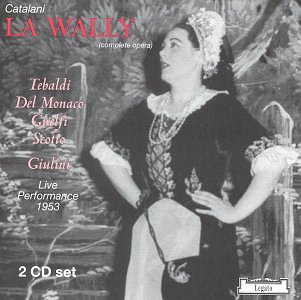
From a flood to an avalanche! This installment of OTF looks at Alfredo Catalani’s opera La Wally, in a recording I moined off the LiberMusicasite. More on the performance later in this post. Unless you’re an above-average opera devotee, you probably know but a few things about La Wally. One is that the hero and heroine both die in an extremely-difficult-to-stage avalanche in the final scene. Another thing may be that this was a favorite opera of conductor Arturo Toscanini. In fact, he loved it so much he named his daughter after Wally (his other two children, Wanda and Walter, were given names that began with “Wa” for the same reason). Finally, this opera boasts a hugely famous aria for soprano, “Ebben, ne Andro Lontana?” a concert favorite of many sopranos.
La Wally is about a beautiful girl in a small German town. Wally (short for Walburga) reminds us of Minnie from Puccini’s La Fanciulla del West because she’s pure, pretty tough and all the men in town are in love with her. Wally is secretly in love with a man from another town named Giuseppe Hagenbach who is also her father Stromminger’s enemy. As in most operas, impossible love is a complicated thing, and when circumstances make it possible for Wally to be with Hagenbach, he’s no longer available. After an episode Wally views as betrayal, she turns to a long-time suitor Gellner and insists that if he loves her he must kill Hagenbach. The plot gets a little complicated from here – Gellner stalks Hagenbach and in the deep darkness of a winter night, he hurls him into a ravine. Wally, disturbed and guilt ridden, goes to save Hagenbach by repelling down a mountain. Later, she returns to the mountainside (most likely with suicide on her mind) and encounters Hagenbach, recovered from his injuries. Finally, they profess their love to one another. Hagenbach goes to find a path down the mountains but as he calls for Wally, he sets off an avalanche sweeping him away to his death. Unable and unwilling to continue to safety, she cries “Here is the wife of Giuseppe!” and hurls herself down into the avalanche, killing herself. La Wally was a hit when it had its La Scala premiere in 1892, but began a descent into obscurity - along with the rest of Catalani's works - soon after the composer's death the next year. In the days before CGI and multi-media, it would be quite a feat to mount an opera with such a climax - the avalanche plays such an important role in the denouement, it would be impossible not to create something that passes for one for a stage production. This probably explains why it’s not been performed much – in the United States, La Wally has been a rarity since the last Metropolitan Opera staging in 1909. But recordings pirated from Italian performances and a commercial set starring Renata Tebaldi have made it a cult classic, high on many an operaphile's list of unjustly neglected works. The performance I am sharing today is of the live 1953 Opening Night at La Scala with Renata Tebaldi, Mario Del Monaco and Giangiacomo Guelfi (three immense voices in their prime; no wonder there was an avalanche!) as well as the Scala debut of Renata Scotto, all conducted by the excellent, late, lamented Carlo Maria Giulini. And God bless the Milanese who simply cannot contain themselves in the final scene and applaud the avalanche.
Alfredo CATALANI (1854 –1893) La Wally (1889-91) opera in four acts, Italian libretto by Luigi Illica after Die Geier-Wally: Eine Geschichte aus den Tyroler Alpen(The Vulture Wally: A Story from the Tyrolean Alps), by Wilhelmine von Hillern PRINCIPAL CAST Renata Tebaldi, (Soprano; Wally) Mario Del Monaco, (Tenor; Giuseppe Hagenbach) Gian Giacomo Guelfi (Baritone; Vincenzo Gellner) Renata Scotto, (Soprano; Walter) Coro del Teatro alla Scala (Vittore Veneziani, Chorus Master) Orchestra del Teatro alla Scala Carlo Maria Giulini, conducting (Live performance: Milan, 7 Dec 1953) Synopsis – http://www.opera-arias.com/catalani/la-wally/synopsis/ Libretto - http://www.opera-arias.com/catalani/la-wally/libretto/ Performance URL - http://www.liberliber.it/online/auto...lani/la-wally/


:format(jpeg):mode_rgb():quality(90)/discogs-images/R-1762958-1241781209.jpeg.jpg)
:format(jpeg):mode_rgb():quality(90)/discogs-images/R-6147218-1412256396-6772.jpeg.jpg)

:format(jpeg):mode_rgb():quality(90)/discogs-images/R-8896381-1471010394-3071.jpeg.jpg)


:format(jpeg):mode_rgb():quality(90)/discogs-images/R-6992623-1431198100-2149.jpeg.jpg)