Showing posts with label Vinyl's Revenge. Show all posts

Tuesday, September 20, 2022

Mahler: Symphony No. 9 - Bruno Walter Conducts the Columbia Symphony Orchestra


This is my post from this week's Tuesday Blog.
On our podcasting channel, we’ve been featuring past (and new) shares of Gustav Mahler’s symphonies. Today’s Vinyl’s Revenge shares a re-issue of Mahler’s Ninth symphony, featuring Bruno Walter and the “Columbia Symphony Orchestra”.

First, let’s establish the orchestra. According to data I gathered, this performance was recorded 26th Jan. 1961 at the American Legion Hall in Hollywood. Thus, this is a California-based incarnation of the Columbia Symphony – probably using the same musicians Stravinsky would use locally for his legendary 80th birthday recordings for the same record label. I’d expect many were members of the Los Angeles Philharmonic and local movie studio contract musicians.

As we know from music history, Mahler’s Ninth is his last “complete” symphony (that is, with full orchestration) and was never performed in Mahler’s lifetime; Walter, Mahler’s longtime assistant and colleague to whom the work is dedicated, conducted its first performance on 26 June 1912, at the Vienna Festival.

Although the symphony follows the usual four-movement form, it is unusual in that the first and last are slow rather than fast. As is often the case with Mahler, one of the middle movements is a ländler. Though the work is often described as being in the key of D major, the tonal scheme of the symphony as a whole is progressive; while the opening movement is in D major, the finale is in D-flat major. As is the case with his latter symphonies, the work not only requires a large orchestra (including clarinets in A, B-Flat and E-Flat, two harps, and a large array of percussion instruments), it lasts well over an hour.

Walter’s discography features at least two recordings of the Ninth – a 1938 concert performance with the Vienna Philharmonic and this 1962 studio recording. There may well be other live recorded performances along the way too.

As a reviewer says, Mahler’s ninth is a bit like Hamlet - there is vast room for varying interpretations Bruno Walter's stereo recording is indispensable for a clear view of the non-neurotic approach to the work.

The recording has been released numerous times – the one in my own collection is part of the Odyssey “budget priced” re-issue series – and more recently on Sony's complete Walter edition. This is a superlative release that belongs in the collection of any and all Mahler enthusiasts; the sound of the original was astonishing in its day, and still is.

Happy listening!
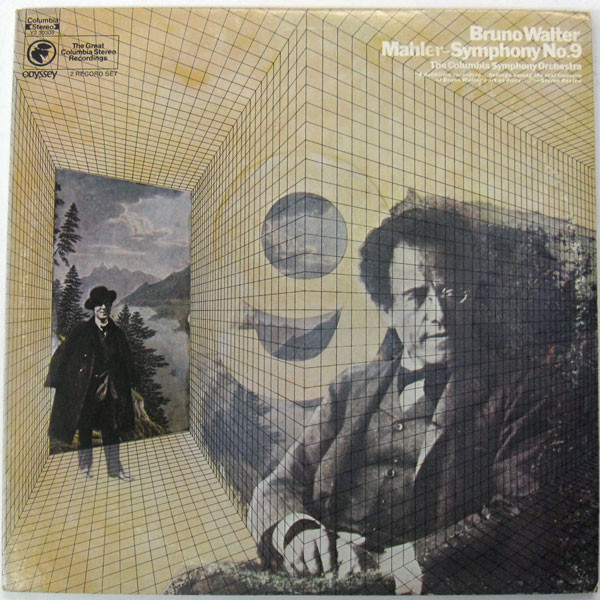

Gustav MAHLER (1860-1911)

Symphony no. 9 in D Major (1908- 09)

Columbia Symphony Orchestra

Bruno Walter, conducting

Recorded 26th Jan. 1961; American Legion Hall, Hollywood, California

Odyssey – Y2 30308

Format: 2 x Vinyl, LP, Album, Reissue, Stereo (1971)

Discogs - https://www.discogs.com/release/3399002-Mahler-Columbia-Symphony-Orchestra-Bruno-Walter-Symphony-No-9


Tuesday, May 17, 2022

Igor Stravinsky, Neville Marriner, Academy Of St. Martin-in-the-Fields – Pulcinella (Complete Ballet) / Suites Nos. 1 & 2 For Small Orchestra


This is my post from this week's Tuesday Blog.

This week’s Tuesday Blog is a new installment in our Vinyl’s Revenge series featuring works by Igos Stravinsky performed by the Academy of St-Martin-in-te-Fields, a pair of soloists, all under the direction of Sir Neville Marriner.

The main work on this Angel ADD release is Stravinsky’s one-act ballet ballet Pulcinella, one of two ballets inspired by the works of earlier composers. It is a based on an 18th-century play, Quatre Polichinelles semblables ("Four identical Pulcinellas"). The ballet premiered at the Paris Opera on 15 May 1920 under the baton of Ernest Ansermet. The dancer Léonide Massine created both the libretto and choreography, and Pablo Picasso designed the original costumes and sets. 

Pulcinella is a classical character that originated in commedia dell'arte of the 17th century and became a stock character in Neapolitan puppetry. Pulcinella's versatility in status and attitude has captivated audiences worldwide and kept the character popular in countless forms since his introduction to commedia dell'arte by Silvio Fiorillo in 1620. Many regional variants of Pulcinella were developed as the character diffused across Europe In many later adaptations, Pulcinella was portrayed as a puppet, as commedia dell'arte-style theatre did not continue to be popular throughout all of the continent over time. He was said to evolve into "Mr. Punch" in England. The key half of Punch and Judy, he is recognized as one of the most important British icons in history.

Not unlike The Fairy’s Kiss (1928) where Stravinsky elaborated several melodies from early piano pieces and songs by Tchaikovsky in his score, Diaghilev wanted a ballet based on an early 18th-century commedia dell'arte libretto and music then believed to have been composed by Giovanni Battista Pergolesi. This attribution has since been proved to be spurious. Some of the music may have been by Domenico Gallo, Unico Wilhelm van Wassenaer, Carlo Ignazio Monza and Alessandro Parisotti. Stravinsky adapted the older music to a more modern style by borrowing specific themes and textures, but interjecting his modern rhythms, cadences, and harmonies.

Pulcinella marked the beginning of Stravinsky's second phase as a composer, his neoclassical period.

As filler, the disk includes Stravinsky’s two suites for small orchestra. These enchanting, gently satirical Suites are orchestrations made by Stravinsky of the eight piano duets he had written for his children, Theodore and Mika, the first three in 1914-1915 and then five more in 1917. 
Note the YouTube link is to a compilation set of Stravinsky music. Clips 29-47 are the contents of today’s disc.

Happy listening!


Igor STRAVINSKY (1882-1971)

Pulcinella, Ballet with Song in One Act (1920)
Bass Vocals – Robert Lloyd 
Soprano Vocals – Yvonne Kenny 
Tenor Vocals – Robert Tear 

Two Suites (Nos. 1 and 2) for Small Orchestra (1921, 1926)

 
Academy Of St. Martin-in-the-Fields
Neville Marriner, conducting
Angel Records Digital – DS-37899
Format: Vinyl, LP, Album, Stereo
Released: 1982


Tuesday, February 15, 2022

Rossini/Respighi – La Boutique Fantasque - Suite Rossiniana


This is my post from this week's Tuesday Blog.

This week’s Vinyl’s Revenge digs out an old cassette I acquired in the early 1980’s featuring the music of Ottorino Respighi inspired by music composed by his compatriot, Gioacchino Rossini.

Respighi had written the ballet La Boutique fantasque for Léonide Massine and Diaghilev’s Ballets Russes in 1919, basing it on short piano pieces from Rossini's collection Péchés de vieillesse (Sins of Old Age).

Massine described how, in Rome for a ballet season, Respighi brought the score of Rossini's Péchés de vieillesse to Diaghilev. Toulouse-Lautrec was an influence on the period setting and style of La Boutique fantasque, and Massine envisaged the principal character "quite Lautrec-like".

The story of the ballet has similarities to Die Puppenfee ("The Fairy Doll") of Josef Bayer, an old German ballet that had been performed by Jose Mendez in Moscow in 1897 and by Serge and Nicholas Legat in Saint Petersburg in 1903. Others note the similarities to Hans Christian Andersen's The Steadfast Tin Soldier. Massine's scenario centers on the love story between two can-can dancer dolls in a toyshop, incorporating elements of comedy, national folk dance and mime, as well as classical choreography.

In 1925, Respighi returned to Rossini's music, but not as a ballet, simply as concert music. He again used Sins of Old Age, specifically Quelques riens (Various nothings) from Volume XII, and applied what he called a trascrizione libera (free transcription) to them.

The four-movement score is brilliant, but also dark and evocative. Although not written for ballet, Rossiniana has been choreographed as a dance performance work.

Antal Dorati recorded many of Respighi’s seminal orchestral music for Mercury with the Minneapolis and London symphonies in the 1950’s, and his recording of the Ancient Airs and Dances with the Philharmonia Hungarica (again for Mercury, featured here a few years ago) is a reference recording. This coupling of the two Rossini-inspired scores comes much later, in the mid-1970’s for Decca, with the Royal Philharmonic. I note that the Boutique score is labelled a “ballet suite”, meaning some sections of the complete ballet are omitted in this performance – it still remains crisp and enjoyable.

Happy Listening!


Ottorino RESPIGHI (1879-1936)
La boutique fantasque (ballet after Rossini), P.120 – ballet suite
Rossiniana, P.148 (after Rossini)
Royal Philharmonic Orchestra
Antal Dorati, conducting

Decca Jubilee Series – KJBC 79

Discogs https://www.discogs.com/release/1068...ite-Rossiniana


Tuesday, January 25, 2022

Ormandy Conducts Sibelius


This is my post from this week's Tuesday Blog.

This week's Vinyl's Revenge post is the first of two Tuesday musings featuring the symphonies o Jean Sibelius.

It is fair to say that Eugene Ormandy had the good fortune of performing the music of some great Late Romantic composers he had the pleasure of meeting himself: Bela Bartok, Sergey Rachmaninov, and Jean Sibelius figure especially in his repertoire.

Eugene Ormandy talks about Sibelius:

Meeting Sibelius for the first time, I had the impression of being in the presence of someone almost superhuman. Here was a being I had admired and looked up to all my life — and suddenly I was in his presence. He was a towering man, a towering personality, with a magnificent head and powerful face. His beautiful home was full of records, many of which we had sent him from America throughout the years.

Sibelius’ First Symphony was the “first” for me in another sense — it was the first of the master’s symphonies I ever conducted. This was in 1932, with the Minneapolis Symphony Orchestra — and we recorded it for RCA Victor in that year. I think perhaps it was the first Sibelius symphony to be recorded outside of Scandinavia. Of course the great Finnish conductor, Sibelius’ friend Kajanus, had broken ground for Sibelius years before, and so had Koussevitzky, Stokowski and Beecham. I have played the First Symphony many times in the intervening thirty years, and it never loses its fascination for me. Recordings have changed a great deal since 1932, and so have interpretations of his works to the end, and he always had admiration for the work of my colleagues Stokowski and Koussevitzky. I will risk immodesty to add that he praised my readings too. His enthusiasm is a source of great pride to me.
The below YouTube link is a compilation of Sibelius symphonies recorded by Ormandy for RCA, one of which featuring the First Symphony I own in my vinyl collection and share on the specific Archive link.

Happy Listening!


Jean SIBELIUS (1865-1957)
Symphony No.1 in E Minor, Op.39
Valse Triste, from Kuolema, Op. 44
The Swan of Tuonela, Op. 22 no. 2

Philadelphia Orchestra
Eugene Ormandy, conducting

RCA Red Seal – ARL1-4901
Format: Vinyl, LP, Album
Released: 1984

Discogs https://www.discogs.com/release/5222...wan-Of-Tuonela

YouTube - https://youtube.com/playlist?list=OL...ieV1KBl6xT46K8

Internet Archive - https://archive.org/details/symphony...nor-op.-39-iv.

Tuesday, December 7, 2021

Bizet, Seiji Ozawa, Orchestre National – Carmen / L'Arlésienne Suites


This is my post from this week's Tuesday Blog.

This week’s Vinyl’s Revenge is one of many available couplings of Georges Bizet’s most popular suites from his stage works, notably his two suites from the incidental music he wrote for Alphonse Daudet's play L'Arlésienne and musical selections from his final opera, Carmen.

The incidental music Bizet composed for L'Arlésienne consists of 27 numbers (some only a few bars) for voice, chorus, and small orchestra, ranging from short solos to longer entr'actes. Bizet himself played the harmonium backstage at the premiere performance, which took place 1 October 1872 at the Théâtre du Vaudeville in Paris.

The play itself was not successful, closing after only 21 performances. The incidental music has survived and flourished, however. It is most often heard in the form of two suites for orchestra. Assembled by Bizet himself, L'Arlésienne Suite No. 1 uses a full symphony orchestra but without the chorus. The first performance was at a Pasdeloup concert on 10 November 1872. L'Arlésienne Suite No. 2, also written for full orchestra, was arranged and published in 1879, four years after Bizet's death, by Ernest Guiraud, using Bizet's original themes.

Ernest Guiraud, born in New Orleans, Louisiana, is also responsible for the remaining music on this Ozawa recording; Guiraud arranged twelve numbers from Bizet's opera Carmen into two orchestral Suites. Guiraud is perhaps most famous for constructing the recitatives—both beloved and criticized—that replaced the spoken dialogue in performances of Carmen for more than a century.

The original jacket notes suggest that the numbers from the Carmen suite were assembled by Mr. Ozawa himself.

Happy Listening!


Georges BIZET (1838-1875)
L' Arlésienne Suite No.1 (from the incidental music), op. 23bis
L' Arlésienne Suite No.2 (assembled by Ernest Guirard, 1879), GB 121b
Carmen Suites for orchestra No.1 and 2 (assembled by Ernest Guirard, 1885-86) Selections
  • Les Toréadors - Act I, Prélude (bars 1-119)
  • Prélude - Act I, Prélude (bars 121–48)
  • Aragonaise - Entr'acte before Act IV
  • Intermezzo - Entr'acte before Act III
  • Habanera - Act I, Aria (Carmen): L'amour est un oiseau rebelle
  • Danse Bohème - Act II, Gypsy Dance: Les tringles des sistres tintaient


Orchestre National de France
Seiji Ozawa, conducting
Label: Angel Records – DS-538096
Format: Vinyl, LP
Recorded: 25 & 26 June 1983, Salle Wagram, Paris

Discogs https://www.discogs.com/release/3989...Suites-Nos-1-2


Internet Archive https://archive.org/details/01-l-arlesienne-suite-no.-1-op.-23


Tuesday, October 5, 2021

The Complete Gershwin (Siegel/Slatkin/St-Louis SO)


This is my post from this week's Tuesday Blog.
Our Vinyl’s Revenge for October is this VOX BOX collection issued in 1974 featuring all the major concert works for orchestra and piano and orchestra by George Gershwin.

The title of the 3-LP box set is a bit of an oversell, as these are not “all” the works for orchestra and piano and orchestra attributed to Mr. Gershwin. Absent in this set are his musical comedy overtures, orchestral settings from the Gershwin songbook and a version of Rialto Ripples for piano and orchestra. All of these were featured in other recordings which may be featured in future discussions.

Two works in this set are more rarely recorded. The Lullaby is a student work originally set for string quartet, and whose main theme gets reused in his 1922 one-act opera Blue Monday. I’ve heard this work in concert in 1987-88 and it was part of Erich Kunzel’s “Gershwin Centennial” anthology. The same goes for Catfish Row, the only “official” suite assembled and published by Gershwin himself from Porgy and Bess. The more recorded suite is the “Symphonic picture” which was arranged by his long-time orchestrator, Robert Russell Bennett.

At the time of this recording, Leonard Slatkin was Walter Susskind’s assistant in Saint-Louis. He would return to the orchestra a few years later as music director (1979–1996). Slatkin in a recent interview explained Susskind asked him to take on the project as he was better suited for American repertoire.

Born into a musical family, Internationally acclaimed pianist Jeffrey Siegel studied with Rudolf Ganz in his native Chicago, with the legendary Rosina Lhévinne at The Juilliard School and, as a Fulbright Scholar, with Ilona Kabos in London. Siegel has been soloist with the world’s great orchestras. A passionate communicator as well as a performer, he hosts Keyboard Conversations, a travelling concert-with-commentary, in major American cities.

For those who follow our podcasting channel, this musical share will be deployed in two parts: today (Sides A, B and D) and next Tuesday (Octiber 12, sides C, E and F).

Happy Listening


George GERSHWIN (1898-1937)

Concerto in F, (1925) *
Trumpet – Susan Slaughter

Lullaby (1919) [Version for string orchestra]
Cello – Yuan Tung
Violin – John Korman

Cuban Overture (1932)
Catfish Row: Symphonic Suite from Porgy and Bess (1935-36)
Piano – Barbara Lieberman
Banjo – David Mortland

An American in Paris (1928)
Clarinet – George Silfies


Shall We Dance (1937 film) - Promenade (Walking the Dog)
Clarinet – George Silfies

Rhapsody in Blue, (1924) *
Second Rhapsody (1931) *
Variations on "I Got Rhythm" (1934) *

* Piano – Jeffrey Siegel
Saint Louis Symphony Orchestra
Leonard Slatkin, conducting

VoxBox – QSVBX 5132
Format: 3 x Vinyl, LP, Stereo, Quadraphonic
Box Set, Album, Quadraphonic
Year – 1974
Discogs - https://www.discogs.com/release/6913...or-Orchestra-F


Tuesday, May 11, 2021

Schumann, New Philharmonia Orchestra, Otto Klemperer – Symphony No. 3


This is my post from this week's Tuesday Blog.


To conclude our three-part look at Schumann’s symphonies, I chose my favorite of his, the Rheinish. It was composed in1850, the same year that he completed his Cello Concerto (which was published four years later).

Schumann was inspired to write the symphony after a trip to the Rhineland with his wife Clara. This journey was a happy and peaceful trip; he incorporated elements of the journey and portrayed other experiences from his life in the music.

There are two forces at work in the Symphony – an essential formal conservatism and an exuberant rhythmic and melodic inventiveness. These two forces combine to give the opening movement tremendous swagger and swing. The three central movements function as interludes, capturing different moods and suggesting different scenes, while simultaneously fulfilling the requirements of the symphony for a scherzo and a slow movement.

With the finale, the animation of the first movement returns. Here, Schumann emphasizes rhythm and clarity of articulation (much of the music is marked to be played staccato), giving the music a propulsive lightness that drives the Symphony to its exhilarating, noble close.

This vintage performance by Klemperer and his “new” Philharmonia is capped off with the overture Schumann wrote for what we should think of as a “Faust oratorio;”. Schumann's music suggests the struggle between good and evil at the heart of Goethe's work, as well as Faust's tumultuous search for enlightenment and peace.

Happy listening!


Robert SCHUMANN (1810-1856)
Symphony No. 3 In E Flat Major, Op. 97 ("Rhenish")
Overture To Goethe's "Faust", A3, no. 0

Orchestra – New Philharmonia Orchestra
Conductor – Otto Klemperer

Angel Records – RL-32064
Format: Vinyl, LP, Reissue

DISCOGS - https://www.discogs.com/Schumann-New...lease/13714543


Tuesday, March 2, 2021

Schumann - Berlin Philharmonic, Rafael Kubelik – Symphonies No.1 & 4


This is my post from this week's Tuesday Blog.


I plan three posts for this five-Tuesday month, the first of which launches a three-part monthly set that will share all four of Robert Schumann's symphonies, beginning with the "Spring" symphony, as an early harbinger of the spring equinox a mere three weeks away.

By age 30, Robert Schumann was already a successful composer of chamber music, including piano music and lieder. But in order to be able to make a living from composing he needed to achieve success in what was then regarded as the epitome of the composer's art: the symphony. As a pianist, Schumann had little experience in this area, nor had he received the appropriate training.

He composed his first symphony in January 1841 in Leipzig, sketching it out in just four days. The Symphony No. 4 was first completed in 1841 as well. Schumann heavily revised the symphony in 1851, and it was this version that reached publication.

Clara Schumann, Robert's widow, later claimed that the symphony had merely been sketched in 1841 but was only fully orchestrated ("vollständig instrumentiert") in 1851. However, this was untrue, and Johannes Brahms, who greatly preferred the earlier version of the symphony, published that version in 1891 despite Clara's strenuous objections.

Today's album is part of an early-1960's complete cycle of the Schumann symphonies by Rafael Kubelik and the Berlin Philharmonic. The YouTube playlist below has the complete set, though the album referenced below as the coupling of the first and fourth that I have in my vinyl collection.

Happy listening!


Robert SCHUMANN (1810-1856)
Symphony No.1 In B Flat Major, Op. 38 "Spring Symphony"
Symphony No. 4 In D Minor, Op.120
Berliner Philharmoniker
Rafael Kubelik, conducting

Deutsche Grammophon Resonance 2535 116
Format – Vinyl LP
Year – 1974 (original issue 1963)

Discogs https://www.discogs.com/Robert-Schum...elease/4351230


Tuesday, January 12, 2021

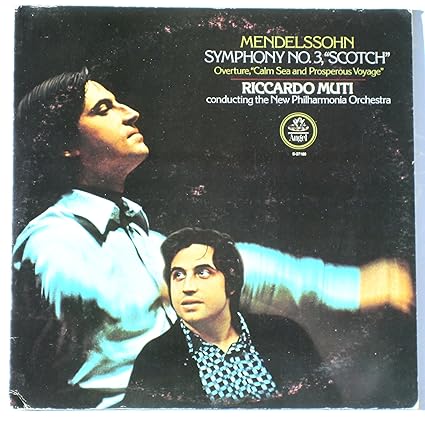
Riccardo Muti - Felix Mendelssohn - New Philharmonia Orchestra ‎– Symphony No. 3


This is my post from this week's Tuesday Blog.


We restart our bi-monthly Tuesday Blog shares with Vinyl’s Revenge, and an old all-Mendelssohn EMI recording featuring Riccardo Muti and the Philharmonia.

From the late 1950s to the early 1970s the Philharmonia Orchestra's chief conductor was Otto Klemperer, with whom the orchestra gave many concerts and made numerous recordings of the core orchestral repertoire.

In 1972, Klemperer announced his retirement from the directorship of the orchestra (briefly known as the New Philharmonia). The orchestra recognised that a strong chief conductor was needed to restore its standards and finances, but there was no immediately obvious candidate. The EMI executive Walter Legge no longer had any stake in the orchestra, though he watched its progress benevolently, and having spotted the potential of Riccardo Muti he recommended him to the New Philharmonia's general manager, Terence McDonald. Other potential candidates were considered, but Muti was appointed as the orchestra's chief conductor from 1973.

Muti, although he disclaimed such a description, was a firm disciplinarian, and under his conductorship the orchestra restored its standards. Critics at the time commented on the orchestra's "superb performance", "immense virtuosity", its "astoundingly delicate" string playing and "woodwind phrasing even more magical than their Berlin colleagues".
With Muti the orchestra recorded opera (Aida, 1974; Un ballo in maschera, 1975; Nabucco, 1977; I puritani, 1979; Cavalleria rusticana, 1979; La traviata, 1980; Orfeo ed Euridice, 1981; and Don Pasquale, 1982); a wide range of the symphonic repertoire including Schumann and Tchaikovsky cycles; concertos with soloists including Sviatoslav Richter, Andrei Gavrilov, Anne-Sophie Mutter and Gidon Kremer; and choral music by Cherubini and Vivaldi.

During Muti's tenure, the orchestra recovered its original title, after prolonged and complex negotiations From September 1977 the "New" was dropped, and the orchestra has been the Philharmonia since then.

One of our earliest shares in the Vinyl’s Revenge series was taken from the Muti/Philharmonia Tchaikovsky cycle, and today’s share is part of a partial Mendelssohn set (reissued and featured as a two-disk set per our YouTube link below). The specific LP in my collection includes the Scottish Symphony and the Calm Sea and Prosperous Voyage overture.

Fine performances all around.

Happy Listening!


Felix MENDELSSOHN-BARTHOLDY (1809-1847)
Symphony No. 3 In A Minor, Op.56 "Scotch"
Overture, "Calm Sea And Prosperous Voyage" Op. 27
New Philharmonia Orchestra
Riccardo Muti, conducting

Label: Angel Records ‎– S-37168
Format: Vinyl, LP, Album, Quadraphonic
Released: 1976

Details https://www.discogs.com/Riccardo-Mut...elease/5264986

YouTube https://youtube.com/playlist?list=OL...nPf7uJFHLpb22o

Tuesday, December 8, 2020

Rachmaninov - Andrei Gavrilov ‎– Piano Concerto Number 3


This is my post from this week's Tuesday Blog.


December’s Vinyl’s Revenge post is a record I acquired when I was a member of the Columbia Record and Tape Club. It is a performance of Rachmaninov’s Third Piano Concerto featuring Andrei Gavrilov as soloist. The disc was originally released in the Soviet Union under its flagship Melodiya label, but reissued by CBS Masterworks.

Melodiya was established in 1964 as the "All-Union Gramophone Record Firm of the USSR Ministry of Culture Melodiya". By 1973, Melodiya released some 1,200 gramophone records with a total circulation of 190-200 million per year, in addition to 1 million cassettes per year, was exporting its production to more than 70 countries.

The label's production was dominated by classical music, music by Soviet composers and musicians, performances by Soviet theatre actors, and fairy tales for children. For example, Melodiya notably released performances of works by Tchaikovsky and Shostakovich.

In the 1970s and 1980s, Melodiya recordings of classical and folk music appeared on the Melodiya/Angel (USA) and Melodiya/HMV labels as the result of an exclusive contract with EMI, the owner of both labels. A smaller number of recordings were distributed on other labels, particularly after 1989, before Melodiya granted exclusive rights to BMG in 1994. After expiry of the BMG contract in 2003, the company re-opened under new management and in 2006 started re-releasing recordings through its own label.

Andrei Gavrilov was born into a family of artists in Moscow; his mother was the Armenian pianist Assanetta Eguiserian (December 20, 1925 – November 29, 2006), who had studied with Heinrich Neuhaus and gave Gavrilov his first piano lessons at age 2. By the age of 18, after one semester at the conservatory, he won the International Tchaikovsky Competition in 1974 and rose to international fame when, at the Salzburg Festival the same year, he substituted for Sviatoslav Richter. Until 1979, Gavrilov performed in all the major music centers of the world performing up to 90 concerts a year, while continuing his studies at the university.

There are some intriguing bits about this 1976 recording. Reissued by EMI, Eurodisc and distributed elsewhere by Neodiya, the orchestra’s name changes from the Moscow Philharmonic, to USSR State Academic Symphony Orchestra to USSR Symphony Orchestra… As recordings and performances go, this is solid and quite enjoyable.

In 1979, at the first peak of Gavrilov's career, Herbert von Karajan, who had heard him in Tchaikovsky's First Concerto in Berlin, offered recordings of all the Rachmaninoff concertos, despite the fact that Karajan only rarely conducted them. In December 1979, recordings were scheduled in Berlin with the Berlin Philharmonic for the 2nd concerto, but Gavrilov did not appear for the rehearsals. It was discovered that due to his critical remarks about the Soviet regime, the USSR had seized Gavrilov's passport.

Wonder how that would have sounded…

Happy listening!


Sergey RACHMANINOV (1873-1943)
Concerto No. 3 In D Minor for Piano And Orchestra, Op. 30
Recorded At – Grand Hall Of The Moscow Conservatoire, April 1976

Andrei Gavrilov, Piano
USSR State Academic Orchestra
Alexander Lazarev, conducting

Label: CBS Masterworks ‎– M 36685
Format: Vinyl, LP, Album
Country: US
Released: 1981
(Original Melodiya release, 1976)

Discogs - https://www.discogs.com/Rachmaninoff...elease/3213621

YouTubehttps://www.youtube.com/playlist?lis...nS09LbCsCTfpIS

Tuesday, November 10, 2020

Igor Stravinsky, Israel Philharmonic Orchestra, Leonard Bernstein ‎– Symphony In Three Movements • Symphony In C


This is my post from this week's Tuesday Blog.


We usually take time in November to remember great artists we have lost, and it is in that context that we remember the thirtieth anniversary of the passing of Leonard Bernstein.

Further, this is also “Remembrance Week” (tomorrow being Remembrance Day) and the 75th anniversary of the end of World War II. It is in that context that I am sharing a pair of works by Igor Stravinsky that were composed during the 1939-45 timeframe.

Stravinsky wrote a symphony at the very beginning of his career—it’s his op. 1—but he quickly became famous as the composer ballet scores, and he spent the next few years composing for the theater and the opera house. When, in 1920, he finally returned to writing music for an orchestra on the concert stage, he composed the Symphonies of Wind Instruments, which omits strings entirely and is no symphony in the conventional sense of the word. Throughout the ’20s, Stravinsky began to put his personal stamp on the traditional forms of orchestral music—these scores are the earliest of his so-called neoclassical period.

Stravinsky began the Symphony in C in Paris in the autumn of 1938 and completed the score on August 19, 1940, in Beverly Hills, California. Stravinsky admitted that he had scores of Haydn’s and Beethoven’s symphonies at his side when he began his own. Stravinsky’s understanding of symphonic style is very much his own. As he told a Boston interviewer:

My new symphony is going to be classical in spirit, more concise in its form than Beethoven […] Instead of all the chords gravitating toward one final tonic chord, all notes gravitate toward a single note. Thus this symphony will be neither a symphony in C major nor a symphony in C minor but simply a symphony in C.
The Symphony in Three Movements is considered as Stravinsky's first major composition after emigrating to the United States. It uses material written by Stravinsky for aborted film projects. Stravinsky, who rarely acknowledged extramusical inspirations for his music, referred to the composition as his 'war symphony'. He claimed the symphony as a direct response to events of the Second World War in both Europe and Asia. The first movement was inspired by a documentary on Japanese scorched earth tactics in China. The third movement deals with footage of German soldiers goosestepping and the Allied forces' mounting success.

Bernstein recorded extensively from the mid-1940s until just a few months before his death. His typical pattern of recording at that time was to record major works in the studio immediately after they were presented in the orchestra's subscription concerts. He recorded primarily for Columbia Masterworks Records, especially when he was music director of the New York Philharmonic between 1958 and 1971; his later recordings (starting with Bizet's Carmen in 1972) were mostly made for Deutsche Grammophon. Unlike his studio recordings for Columbia Masterworks, most of his later DGG recordings were taken from live concerts (or edited together from several concerts with additional sessions to correct errors). Today’s 1985 recording of the two Stravinsky symphonies follows that pattern, featuring the Israel Philharmonic.

Happy Listening!


Igor STRAVINSKY (1880 - 1971)

Symphony In C (1940)
Symphony In Three Movements (1945)

Orchestra – Israel Philharmonic Orchestra
Conductor – Leonard Bernstein
(Live recordings)

Deutsche Grammophon ‎– 415 128-1
Format: Vinyl, LP, Stereo (ADD)
Released: 1985

Discogs https://www.discogs.com/Igor-Stravin...elease/4406135


Tuesday, October 27, 2020

Beethoven Two-For: Overtures and Emperor Concerto


This is my post from this week's Tuesday Blog.


This month's installment of our #Beethoven2020 series (the penultimate installment) shares two vinyl albums from my collection - one of them completes the "piano concerto" cycle we undertook when er launched this series earlier this year.

Let's start there - Rudolf Serkin recorded all of the Beethoven concertos - some of them more than once, under Eugene Ormandy, Bruno Walter and Leonard Bernstein, The Bernstein collaboration on the Emperor concerto was reissued several times, including under the "Great Performances" series, which is how I acquired it.

Manu conductors have recorded the Beethoven overtures - either as filler for their symphony cycles like Bernstein, von Dohnanyi and Leibowitz did or as stand-alone releases. This "Resonance" reissue combines overtures recorded by Karl Böhm with the Vienna Philharmonic with a pair of Fidelio overtures from his landmark recording of the opera with Staatskapelle Dresden.

Happy Listening!


Ludwig van BEETHOVEN (1770-1827)
Overture To Goethe's Tragedy "Egmont", Op. 84
Overture To H.J. V. Collin's Tragedy "Coriolanus", Op. 62
Overture To The Ballet "The Creatures Of Prometheus", Op. 43
Wiener Philharmoniker
Overture "Fidelio", Op. 72b
Overture "Leonora No. 3", Op. 72a
Staatskapelle Dresden
Conductor – Karl Böhm
Deutsche Grammophon ‎ Resonance – 2535 135
Format: Vinyl, LP, Reissue
DISCOGS - https://www.discogs.com/Beethoven-Ka...lease/10018255

Concerto No. 5 In E-Flat Major For Piano & Orchestra, Op. 73 "Emperor"
Piano – Rudolf Serkin
Orchestra –New York Philharmonic
Conductor – Leonard Bernstein

CBS Great Performances ‎– MY 37223
Format: Vinyl, LP, Album
DISCOGS - https://www.discogs.com/Ludwig-van-B...elease/1436994


Tuesday, September 22, 2020

Beethoven - Sviatoslav Richter, Piano Concerto No. 3


This is my post from this week's Tuesday Blog.


This week's post on our ongoing #Beethoven2020 series is a Vinyl program featuring Sviatoslav Rchter playing Beethoven's third piano concerto.

Beethoven composed his Piano Concerto No. 3 at the time when he still performed himself, his increasing deafness would soon end his career as a piano virtuoso.

A quick review of Richter's Beethoven output on record has him performing cello sonatas as accompanist, and as soloist on the piano sonatas (he probably recorded them all in the USSR over a span of 30 years) but no "complete" concerto cycle. From what I could find, he recorded this concerto three times, twice with Kurt Sanderling (in Russia with the Moscow Youth Symphony and with the Vienna Symphony for DGG) and this recording (conveniently reissued for Melodiya in the Russia) for EMI with the Philharmona under Riccardo Muti.

The filler piece, the Andante Favori, is another Richter specialty, found in a few of his recordings.

Happy listening


Ludwig van BEETHOVEN (1770- 1827)
Piano Concerto No. 3 in C Minor, Op. 37
Andante Favori Wo0 57 In F Major

Piano – Sviatoslav Richter
Orchestra – Philharmonia Orchestra
Conductor – Riccardo Muti
Recorded: 19 & 20. IX. 1977, Abbey Road Studios, London.
Angel Records ‎– AM-534717
Series: Angel Master Series –
Format: Vinyl, LP, Reissue, Remastered (ADA)
Reissued: 1985

DETAILS - https://www.discogs.com/Beethoven-Sv...elease/8638699


Tuesday, June 23, 2020

Mendelssohn - Berliner Philharmoniker - Lorin Maazel ‎– Symphony No. 4 & 5


This is my post from this week's Tuesday Blog.


This week’s Vinyl’s Revenge – the last for the next few months as we embark into our summer schedule – shares an early recording by Lorin Maazel of two Mendelssohn symphonies.

Maazel’s conducting roots were as a wunderkind conductor. At the age of 13, Lorin Maazel took the podium at a pension fund concert at Public Hall in Cleveland on March 14, 1943. He conducted a selection of pieces that included the overture from Wagner’s opera Rienzi and Schubert’s “Unfinished” symphony. Earlier in his young career, Maazel had already guest conducted the NBC Symphony, New York Philharmonic, Los Angeles Philharmonic, and Pittsburgh Symphony.

At age 30, Maazel became the first American to conduct at the Bayreuth Festspielhaus. He was chief conductor of the Deutsche Oper Berlin from 1965 to 1971 and the RSO Berlin (formerly known as the Berlin RIAS Symphony Orchestra) from 1964 to 1975, succeeding its founding conductor, Ferenc Fricsay.

Today’s recording dates from that same early 1960’s period, this time conducting the Berlin Philharmonic in Mendelssohn’s Italian and Reformation symphonies. This recording was part of a compilation reissue from 2004 “Complete Early Berlin Philharmonic Recordings 1957 — 1962” , though I acquired it originally as a vinyl reissue in the late 1970’s on the DG Resonance series.

This is a typical Maazel recording – a worthy recording, but not my favourite. All the notes are there, but the warmth doesn’t shine through. To boot, there are no repeats.

Tell me what you think!


Felix MENDELSSOHN-BARTHOLDY (1809-1847)

Symphony No. 4 in A major, Op. 90 "Italian"
Symphony No. 5 in D major, Op. 107 "Reformation"

Berliner Philharmoniker
Lorin Maazel, conducting

Deutsche Grammophon Resonance – 2535 171
Format: Vinyl, LP, Album, Stereo
Recorded April 1960 (op. 90) and January 1961 (op. 107)

Discogs https://www.discogs.com/Mendelssohn-...elease/5050747

Internet Archive 

https://archive.org/details/05-symphony-no.-5-in-d-major-op.-10

Tuesday, May 26, 2020

Liszt, Ivan Davis , Royal Philharmonic, Edward Downes ‎– Piano Concertos #1 & 2


This is my post from this week's Tuesday Blog.


This week’s edition of Vinyl’s revenge features a coupling of the two Liszt piano concertos featuring American pianist Ivan Davis (1932-2018).

As a teenager, Franz Liszt created at least two virtuosic concertos for piano and orchestra, scores which are now lost. The two numbered concertos were composed during the 1830's when Liszt’s career as a young, travelling virtuoso was at its height. Liszt revised them extensively before letting them be published some 25 years after their conception.

Ivan Davis, who studied under Silvio Scionti, Carlo Zecchi and Vladimir Horowitz, won the Franz Liszt Competition in New York City in April 1960. He recorded for London Records in the 1970s. From 1965, Davis was a professor of music at the University of Miami in Coral Gables, Florida.

Sir Edward Downes (1924 –2009) was an English conductor, specialising in opera. He was associated with the Royal Opera House from 1952, and with Opera Australia from 1970. He was also well known for his long working relationship with the BBC Philharmonic and for working with the Netherlands Radio Orchestra.

Happy listening.


Franz LISZT (1811-1886)

Piano Concerto No.1 In E Flat Minor S.124
Piano Concerto No.2 In A Major S. 125

Orchestra – The Royal Philharmonic Orchestra
Piano – Ivan Davis
Conductor – Edward Downes

Label: Decca ‎– VIV 11
Series: Decca Viva!
Format: Vinyl, LP, Reissue

Released: 1982 (Canada)

Discogs - https://www.discogs.com/Liszt-Ivan-D...elease/8683759


Internet Archivehttps://archive.org/details/02-liszt-piano-concerto-no.-1-in-e-fl


Tuesday, March 10, 2020

Beethoven - Radu Lupu • Zubin Mehta • Israel PO ‎– Piano Concertos No.1 & 2


This is my post from this week's Tuesday Blog.


This week’s Vinyl’s Revenge is part of our #Beethoven2020 series and features Romanian pianist Radu Lupu in a pair of Beethoven piano concertos, taken from his Beethoven cycle recorded with the Israel Philharmonic in the early days of the DIgital era.

Beethoven’s early career in Vienna, where he settled in 1792 after leaving his native Bonn, established him first of all as a pianist. He had already tackled a piano concerto in 1784, at the age of fourteen, but Piano Concerto No.1 in C major, the third attempted and the second completed, was ready for the composer’s own use by 1795. It was revised in 1800, but is thought by some to have had its first performance either in March or December 1795.

There is, however, some disagreement on the identification of the concerto played on these occasions. Piano Concerto No.2 in B flat major was in existence at the time, having been started in the later 1780s in Bonn, but underwent various further revisions in the following years, reaching its final form, it would seem, in 1798.

As am Amazon reviewer puts it, “Radu Lupu is a once in a lifetime musician, meaning someone like he only appears to us mere mortals briefly allowing us to hear his genius and the beauty of that genius.” Hard to disagree!

Happy listening!


Ludwig van BEETHOVEN (1770- 1827)
Piano Concerto no. 1 in C Major, Op. 15
Piano Concerto no. 2 in B Flat Major, Op. 19
Radu Lupu, piano
Israel Philharmonic Orchestra
Zubin Mehta, conducting
Recorded March 1979 in the Mann Auditorium, Tel Aviv

London Records ‎– LDR 10006
Format: Vinyl, LP, Stereo (DDA)
Released: 1980

Discogs https://www.discogs.com/Beethoven-Ra...elease/6330274


Internet Archivehttps://archive.org/details/101pianoconcertono.1incmajor

Tuesday, February 25, 2020

Sir Adrian Boult / LPO ‎– Brahms: Serenade In A / Variations On A Theme Of Haydn


This is my post from this week's Tuesday Blog.


This week’s Vinyl’s Revenge looks at an Angel Red Label re-issue I purchased in the early 1980’s featuring Sir Adrian Boult and the music of Johannes Brahms.

Adrian Boult followed musical studies in England and at Leipzig, Germany, with early conducting work in London for the Royal Opera House and Sergei Diaghilev's ballet company.

When the British Broadcasting Corporation appointed him director of music in 1930, he established the BBC Symphony Orchestra and became its chief conductor. In 1950, after being forced into retirement by the BBC, Boult took on the chief conductorship of the LPO (retiring from that position in 1957). Although in the latter part of his career he worked with other orchestras, it was the LPO with which he was primarily associated, conducting it in concerts and recordings until 1978.

A modest man who disliked the limelight, Boult felt as comfortable in the recording studio as on the concert platform, making recordings throughout his career. His recording career stretched from the days of acoustic recording until the beginning of the digital era. Although widely recognized as a champion of British music, the exceptional breadth of Boult's repertoire has left some well-regarded recordings of works not immediately associated with him; in the core continental orchestral repertoire, Boult's recordings of the four symphonies of Brahms, and the Great C major Symphony of Schubert were celebrated in his lifetime and have remained in the catalogues during the years after his death.

Today’s share is contemporaneous to the Brahms cycle – a coupling of the Second Serenade and the Haydn Variations.

Happy Listening


Johannes BRAHMS (1833-1897)
Serenade for Orchestra No.2 in A Major, Op. 16
Variations on a Theme of Haydn in B-Flat Major (Orchestra setting, Op. 56a)

London Philharmonic Orchestra
Sir Adrian Boult, conducting

Angel Records ‎– RL-32091
Format: Vinyl, LP, Album, Stereo
Released: 1979

Discogs https://www.discogs.com/Sir-Adrian-B...elease/8752973


Internet Archive -  https://archive.org/details/variationsonathemebyhaydnop.