Showing posts with label OTF. Show all posts

Saturday, October 8, 2022

Verdi: Un ballo in maschera


This is my post from this week's Once or Twice a Fortnight.


We haven’t done one of these (outside of the Short Story format) for awhile. I plan at least ne more of these before the end of 2023.

As we continue our survey of the lyrical / operatic alphabet, we come to the leter “U”. I reached out to the community for some suggestions, and received a few interesting ones. However, in spite of the fact I’m not very pleased with the prominence of the “U” in the title, there are a pair of Verdi operas that use the indefinite article “Un” in its title, and here we are today.

A few years back, we shared Nielsen’s comic opera Maskarade, where romance and parties are part of the narrative and where a masked ball is the setting for its third act. Ditto for Johann Strauss’ Fledermaus.

Verdi, however, has a much darker premise for his masked ball: the assassination in 1792 of King Gustav III of Sweden who was shot while attending a masked ball. The subject matter was explored almost two decades earlier by French composer Daniel François Esprit Auber in his five-act opera Gustave III subtitled “Le bal masque”.

According to Wikipedia, the original project by Verdi and his librettist Antonio Somma was called Gustavo III. Never performed as written, the libretto was later revised (or proposed to be revised) several times under two additional names – Una vendetta in dominò and Adelia degli Adimari – during which the setting was changed to vastly different locations. Eventually, it was agreed that it could be called Un ballo in maschera, the one by which it is known today, but Verdi was forced to accept that the location of the story would have to be Colonial Boston. This setting became the "standard" one until the mid-20th Century. Most productions today locate the action in Sweden, though the recording I chose specifically identifies the main character as Riccardo and not Gustavo, thus it is set in Boston.

The main strength of this performance, I think, is Abbado's pacing and the DG engineers' success in doing justice to the textures.

Interestingly, Abbado and two of the principal voices in the cast (Placido Domingo as Riccardo and Katia Ricciarelli as Amelia) were part of another production at the Royal Opera House about five years earlier – it is available on YouTube as well.

Happy listening!
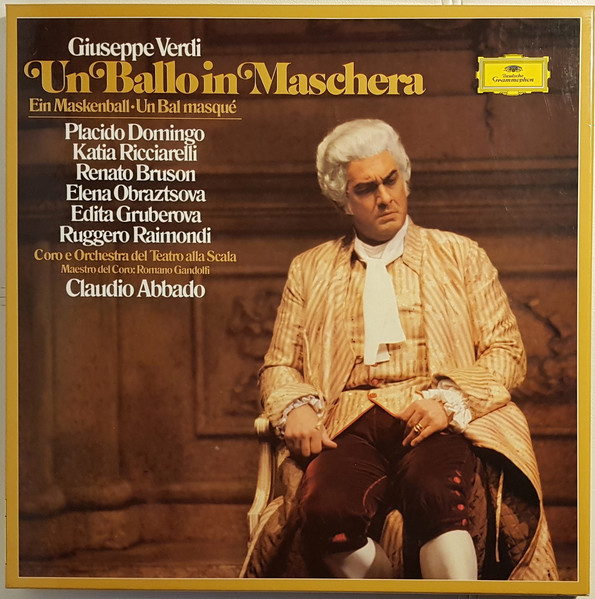

Giuseppe VERDI (1813-1901)

Un Ballo in maschera (1859)
Opera in three acts, Italian libretto by Francesco Maria Piave

PRINCIPAL CAST
Plácido Domingo – Riccardo, Earl of Warwick and governor of Boston
Katia Ricciarelli – Amelia, wife of Renato
Renato Bruson – Renato, Riccardo's secretary, best friend and confidant
Edita Gruberová – Oscar, Riccardo's page
Elena Obraztsova – Ulrica, a fortune-teller
Coro e Orchestra Del Teatro Alla Scala
Chorus Master – Romano Gandolfi
Conductor – Claudio Abbado
Deutsche Grammophon – 2740 251 (Released in 1981)

Synopsis - https://www.opera-arias.com/verdi/un...hera/synopsis/
Libretto - https://www.opera-arias.com/verdi/un...hera/libretto/
Discogs - https://www.discogs.com/release/9791...Gruberova-Rugg

YouTube – https://youtube.com/playlist?list=OL...KzU_tP9PGSdAg0

Archive Page - https://archive.org/details/guiseppe...bbado-acts-1-2

Sunday, August 4, 2019

Verdi: Don Carlos (Sung in the original French)

This is my post from this week's Once or Twice a Fortnight.


Let me pop out of my summer hiatus for one OTF post, this one in the “Old Switch-a-roo” tradition, looking at operas that are adapted in other languages.

Some of us are familiar with Don Carlo, a Verdi’s longest opera with an enduring duet


It turns out the opera was commissioned and produced by the Paris Opera and given its premiere at the Salle Le Peletier on 11 March 1867. Developed with both a French and an Italian libretto, the first performance in Italian was given at Covent Garden in London in June 1867. The first Italian version given in Italy was in Bologna in October 1867.
Over the following twenty years, cuts and additions were made to the opera, resulting in a number of versions being available to directors and conductors.

Revised again by Verdi, it was given in Naples in November/December 1872. Finally, two other versions were prepared: the first was seen in Milan in January 1884 (in which the four acts were based on some original French text which was then translated). That is now known as the "Milan version", while the second—also sanctioned by the composer—became the "Modena version" and was presented in that city in December 1886. It restored the "Fontainebleau" first act to the Milan four-act version.

No other Verdi opera exists in so many versions.

The version I’m sharing today is from the BBC Opera Rara series, originally broadcast in the 1970s. In some ways it is the most important: it comes closest to what Verdi had in mind for his extended masterpiece. What is more, it is given by a cast of largely Francophone singers, who make it sound – at last – like the truly French work it is.

According to a detailed review of the text sung in this broadcast version, we have the complete Fontainebleau scene, a short solo for Posa at the beginning of Scene 2, a longer version of the Posa-Philippe scene in Act 2, the costume-changing of Elisabeth and Eboli, their duet before “O don fatal” in Act 3, the whole of the ballet, the full Insurrection scene, and the longest version of the finale.

That adds up to almost four hours. No wonder Verdi either made or sanctioned cuts!

The principal singers, as I stated in a post a few weeks ago, are French-Canadian. The musical direction is poised but the sound quality is uneven.

The links below are to both the YouTube clips of the disc and my own montages (for later use) into two large tracks.

Happy summer listening!


Giuseppe VERDI (1813-1901) 

Don Carlos (1867)
Opera in five acts, French Libretto: Joseph Méry and Camille Du Locle on Schiller’s dramatic poem ‘Don Carlos, Infant von Spanien’ (1785-86)

1867 Paris version sung in French and complete with music unused at the first production

CAST
Philippe II (King of Spain), Joseph Rouleau (bass);
Don Carlos (Infante of Spain), André Turp (ten);
Rodrigue (Marquis de Posa), Robert Savoie (bar);
Le Grand Inquisiteur, Richard Van Allan (bass);
Elisabeth de Valois (Philip's Queen), Edith Tremblay (sop);
Princesse Eboli (Elisabeth's lady-in-waiting), Michelle Vilma (mezzo);
Thiabault (Elisabeth's page), Gillian Knight (sop);
Le Comte de Lerme (A Royal Herald), Emile Belcourt (ten);
An Old Monk, Robert Lloyd (bass);
A Voice from Heaven, Prudence Lloyd (sop)
BBC Singers; BBC Concert Orchestra/John Matheson

rec. 22 April 1972 before invited audience, Camden Theatre, London.
First broadcast: BBC, 10 June 1973

OPERA RARA ORCV 305

Synopsis – https://www.opera-arias.com/verdi/don-carlo/synopsis/
Libretto - http://kareol.es/obras/doncarlos/acto1f.htm (This may not completely fi the opera dialogue as the performance reintroduces missing portions)


Internet Archive - https://archive.org/details/part1_201908

Saturday, June 15, 2019

Lélio ou le retour à la vie (Berlioz)

This is my post from this week's Once or Twice a Fortnight.


Our second post in our series marking the Berlioz year considers a little programmed work (although it has been the subject of several concerts in this special year).

The Berlioz discography, as I discussed briefly in the previous post, counts his Symphonie Fantastique as one of the composer's essential works. As some have pointed out, this "program-based" symphony defies the traditional stranglehold of the "classical" symphony, using musical imagery and making particularly noteworthy use of the leitmotiv as a device, or the idée fixe (which loosely translates to “obsession”)

The Berlioz catalog identifies this symphony as opus 14 (work number 48 in the Holoman catalog). Opus 14b (or Holoman 55b) is reserved for the operatic monodrama Lélio or the return to life. This numerical assignment further feeds the established folklore that Lélio is the "sequel" to the said Fantastique. Berlioz writes that the work "must be heard immediately after Symphonie Fantastique, of which it is the end and the complement. ". The name "Lélio" is taken from the hero of George Sand's novel, The Last Aldini, published in 1832 - all this time, I thought it was a sort of nickname derived from "Berlioz". You learn something new every day!

Composed in Italy in 1831, Lélio was premiered at the Paris Conservatoire on December 9, 1832. It was revised for a performance in Weimar at the request of Franz Liszt in 1855 and published the following year.
Lélio is presented by an actor standing on stage in front of a curtain hiding the orchestra. The actor's dramatic monologues explain the meaning of music in the artist's life.

The work begins and ends with the theme of the idée fixe, linking Lélio to the Symphonie fantastique and, like the symphony, Lélio is inspired by Berlioz's tragic loves - with Harriet Smithson for the symphony, with Camille Moke for Lélio , women who broke their engagement with the composer, then making him think of suicide. Subsequently, Berlioz gave a different interpretation, saying that the symphony and Lélio speak of Harriet Smithson (who later became his wife).
While the Fantastique describes the desperate artist trying to kill himself by overdose of opium, this creates a series of more and more terrifying visions. Lélio talks about the artist waking up from his dreams, meditating on Shakespeare, his sad life and not having a wife; he then decides that if he can not forget this unrequited love, he will immerse himself in the music; he then successfully directs an orchestra on one of his new compositions and the story "ends well".

This work is in six parts:

  1. Le pêcheur. Ballad, based on Goethe’sDer Fischer.
  2. Chœur d'ombres – Evokes Shakespeare’s Hamlet and its use of ghostly spirits. Berlioz reuses music from his cantata Cléopâtre (H. 36)
  3. Chanson de brigands - A celebration of freedom, gangster of sorts.
  4. Chant de bonheur – Remembrances, reusing music from La mort d’Orphée (H. 25).
  5. La harpe éolienne, a purely orchestral passage, and a reference to the wind harp – a common image from the Romantic period
  6. Fantaisie sur la "Tempête" de Shakespeare - Sung in Italian, and reuses some more of Berlioz’s music (H. 52 and 36)

Unlike the Symphonie fantastique, Lélio's discography is much less extensive. The selected version, which dates back a dozen years, is narrated in French by the lyric baritone Jean-Philippe Lafont, accompanied by the Danish Radio Orchestra under Thomas Dausgaard. Other soloists and choirs are Danish.

Happy listening!


Hector BERLIOZ (1803-1869)
Lélio ou le retour à la vie, op. 14b [H. 55b]
monodrame lyrique en six parties (1831, rev. 1855)


Gert Henning-Jensen, tenor (Horatio)
Sune Hjerrild, tenor (La Voix imaginaire de Lélio)
Jean-Philippe LaFont, baritone (Le Capitaine) and narrator


DR KoncertKoret
Fredrick Malmberg, chorus master
DR SymfoniOrkestret
Thomas Dausgaard, conducting


Recorded in July and August 2004
Chandos 10416


Details - https://www.chandos.net/products/catalogue/CHAN%2010416


Internet Archive - https://archive.org/details/16LelioOuLeRetourALaVieOp.

Wednesday, May 29, 2019

Roméo et Juliette (Berlioz)

This is my post from this week's Once or Twice a Fortnight.


The great 19th century French composer Hector Berlioz holds a unique place in musical history. Far ahead of his time, he was one of the most original of great composers, but also an innovator as a practical musician, and a writer and critic whose literary achievement is hardly less significant than his musical output. Few musicians have ever excelled in all these different fields at once.

2019 marks the 150th anniversary of Berlioz’s passing, and I have a pair of OTF posts planned to mark the anniversary, starting with this week’s seco d of two looks at music inspired by the Bard’s famous play.

Which of the two powers, Love or Music, can elevate man to the sublimest heights??It is a great problem, and yet it seems to me that this is the answer: ?Love can give no idea of music; music can give an idea of love??Why separate them? They are the two wings of the soul.?
- Hector Berlioz

Classical music lovers familiar with Symphonie fantastique will know of the supposed genesis of the symphony: the young composer’s infatuation for Harriet Smithson, the Irish Shakespearean actress. Yet this passion was only part of the transformation that Berlioz experienced when he first saw Harriet as Ophelia in the performance of Hamlet at the Odéon Theatre, Paris, in 1827. As he relates in his memoirs, “This sudden revelation of Shakespeare overwhelmed me. The lightning flash of his genius revealed the whole heaven of art to me, illuminating its remotest depths in a single flash?” From then on the dramatic works of Shakespeare shaped his musical imagination in the creation of such works as the dramatic symphony Roméo et Juliette, the comic opera Béatrice et Bénédict, and shorter works - Le roi LearFantasy on The Tempest and the memorial to his love for Harriet, La Mort d’Ophélie.

In their excellent website Michel Austin and Monir Tayeb point out that Roméo et Juliette is one of Berlioz’s greatest and most original works, and reflects a number of influences. We already discussed the Shakespeare influence; the work is also a homage to Beethoven, in particular the Ninth Symphony, which provided Berlioz with one of his starting points in developing the possibilities of symphonic music. It also reflects, like his previous symphony Harold in Italy, the impact of Berlioz’s stay in Italy in 1831-1832 – including a hearing in Florence of Bellini’s I Montecchi ed i Capuletti which only encouraged him to do better. Finally, the exceptional virtuosity deployed in the orchestral writing seems particularly appropriate for the dedicatee of the work, Paganini, who was never able to hear it, much to Berlioz’s regret - The composition in 1839 was made possible by the generous gift of 20 000 francs by Paganini to Berlioz.

The work was first performed in 3 concerts conducted by Berlioz at the same Conservatoire, on 24 November, 1st December and 15th December 1839, before an audience that comprised much of the Parisian intelligentsia of the time and included none other than Richard Wagner, whose Tristan und Isolde of 1859 bears evident traces of the impact that the music had on him. The work did not reach its final form until several years after its composition: after a performance of the complete work in Vienna on 2 January 1846, the first since 1839 and the first abroad, Berlioz decided to make several important cuts and changes to the Prologue, Queen Mab Scherzo, and the Finale, and the full score was not published till 1847.

As it turns out, the work is rarely heard from beginning to end in concert, and we typically only hear the Love Scene and the Queen Mab scherzo as stand-alone bonbons. Charles Dutoit and Sir Colin Davis, in their respective Berlioz anthologies, both recorded the work in its entirety and it is the former’s interpretation (from the Montreal Symphony London/Decca recordings made at the old Church of St-Eustache North of Montreal) that is featured today.

(The YouTube playlist I found also includes a performance of the Symphonie Funèbre et Triomphale as filler)

Happy Listening!


Hector BERLIOZ (1803-1869)
Roméo et Juliette, op. 17 [Ĥ 79]

Symphonie dramatique avec Chœurs, Solos de chant et Prologue en récitatif choral, composée d’après la Tragédie de Shakespeare
French libretto by Émile Deschamps, after Shakespeare

Florence Quivar, Mezzo-soprano
Alberto Cupido, Tenor
Tom Krause, bass
Chœurs de L'Orchestre Symphonique de Montréal, Tudor Signers Of Montréal
Jean-François Sénart, chorus master
Orchestre Symphonique de Montreal
Charles Dutoit, conductung

London Records ‎– 417 302-1
Format: 2 × Vinyl, LP, Stereo, Box

Recording details - https://www.discogs.com/Berlioz-Char...elease/6992623

YouTube https://www.youtube.com/playlist?lis...j6j3G430BvWGd5


Friday, April 26, 2019

Des Knaben Wunderhorn (Mahler)

This is my post from this week's Once or Twice a Fortnight.


Today’s OTF music share considers a second Mahler song cycle; last month, I shared the Kindertottenlieder and this week, it’s a broader cycle, composed in dribs and drabs over almost two decades and whose subject matter – and music – permeates some of Mahler’s early symphonic output.

According to WikipediaDes Knaben Wunderhorn: Alte deutsche Lieder (literally; "The boy's magic horn: old German songs") is a collection of German folk poems and songs edited by Achim von Arnim and Clemens Brentano, and published in Heidelberg, Baden. The book was published in three editions: the first in 1805 followed by two more volumes in 1808.


The collection of love, soldier's, wandering and children's songs was an important source of idealized folklore in the Romantic nationalism of the 19th century. Selected poems from this collection have been set to music by a number of composers, 

including WeberMendelssohnSchumannBrahmsZemlinskySchoenberg, and Webern, but it’s Mahler’s settings that have endured. He numbered the collection among his favourite books and set its poems to music throughout much of his career. The text of the first of his four Lieder eines fahrenden Gesellen, begun in 1884, is based directly on the Wunderhorn poem "Wann [sic] mein Schatz".

His first genuine settings of Wunderhorn texts, however, are found in the Lieder und Gesänge ('Songs and Airs'), published in 1892 and later renamed by the publisher as Lieder und Gesänge aus der Jugendzeit ('Songs and Airs from Days of Youth'). The nine Wunderhorn settings therein were composed between 1887 and 1890, and occupied the second and third volumes of this three-volume collection of songs for voice and piano.

Mahler began work on his next group of Wunderhorn settings in 1892. A collection (not a 'cycle') of 12 of these was published in 1899, under the title Humoresken ('Humoresques'), and formed the basis of what is now known simply (and somewhat confusingly) as Mahler's 'Songs from "Des Knaben Wunderhorn"'.

Today’s share includes 14 songs that are – shall I say – commonly grouped and performed in concert as a cycle, though some lieder are sometimes omitted as they are already included (in sometimes more elaborate ways) in Mahler symphonies. For instance, Urlicht was rapidly incorporated (with expanded orchestration) into the SecondSymphony as the work's fourth movement; Es sungen drei Engel, by contrast, was specifically composed as part of the Third Symphony, requiring a boys' chorus in addition to an alto soloist. Other songs found themselves serving symphonic ends in other ways: a singer-less version of Des Antonius von Padua Fischpredigt forms the basis of the Scherzo in the 2nd Symphony, and Ablösung im Sommer is adopted in the same way by the 3rd.

An additional setting from this period was Das himmlische Leben; by the year of the collection's publication (1899) this song had been re-orchestrated and earmarked as the finale of the Fourth Symphony.

Belgian conductor Philippe Herreweghe and his Orchestre des Champs Élysées, founded in 1991 are known for playing Romantic and pre-Romantic repertoire on original instruments. I found it interesting that they chose to record many of the lieder from Des Knaben Winderhorn for Harmonia Mundi in 2006; this is the recording I am sharing with you this week.

A four-star Amazon review of this recording summarizes well my opinion of this fine reading by Herreweghe, a well-travelled HIP specialist much influenced by Nikolaus Harnoncourt and Gustav Leonhardt. His Des Knaben Wunderhorn yanks this music out of the refined interior of the concert hall, back to its rough and rustic roots.

Dietrich Henschel is the picture of a sunburnt peasant and battle-worn grenadier. He avoids any hint of sophisticated smoothness, which some listeners won't find entirely appealing. (The sly humor is stripped from St. Anthony's sermon to the fishes, for example.) Sarah Conolly's voice is also countryfied; she is a believable peasant woman who has experienced the harshness of life and yet yearns for romance wherever she can find it. Because the two singers are so consistent, you feel them as the same characters form song to song. On every other recording that I know, the soloists try to do the opposite, shifting color and mood to suit each song. The fact that this version is different makes for a refreshing alternative.

Happy Listening


Gustav MAHLER (1860-1911)

Songs from "Des Knaben Wunderhorn" (1892-1901)
Selected lieder, as presented in this recording:

"Revelge" – Reveille (July 1899)
"Verlor'ne Müh" – Labour Lost (February 1892)
"Des Antonius von Padua Fischpredigt" – St. Anthony of Padua's Sermon to the Fish (July/August 1893)
"Das irdische Leben" – The Earthly Life (after April 1892)
"Trost im Unglück" – Solace in Misfortune (April 1892)
"Wo die schönen Trompeten blasen" – Where the Fair Trumpets Sound (July 1898)
"Wer hat dies Liedlein erdacht?" – Who Thought up this Song? (April 1892)
"Lob des hohen Verstandes" – Praise of Lofty Intellect (June 1896)
"Der Tamboursg'sell" – The Drummer Boy (August 1901)
"Das himmlische Leben" - The Heavenly Life ( February 1892)
"Lied des Verfolgten im Turm" – Song of the Persecuted in the Tower (July 1898)
"Rheinlegendchen" – Little Rhine Legend (August 1893)
"Der Schildwache Nachtlied" – The Sentinel's Nightsong (January/February 1892)
"Urlicht" – Primeval Light (1893)

Sarah Connolly, Mezzo-Soprano
Dietrich Henschel, Baritone
Orchestre des Champs-Élysées
Philippe Herreweghe, conducting
Harmonia Mundi 290192


Sunday, March 17, 2019

Le docteur Miracle (Bizet)

This is my post from this week's Once or Twice a Fortnight.


This time on OTF I’m sharing a recording I acquired a few years back, that was a bit of a mystery, turning out to be a pleasant surprise.


For a few years, I subscribed to eMusic, an online provider of “99-cent tracks”, and downloaded what I thought was an album of Beethoven stage music - including the Ah, Perfido! aria, only to discover that the music was not at all from Mr. Ludwig. I understood the music was sung in French, but couldn’t for the life of me identify the pieces. After I got over my disappointment, I paid close attention to the dialog, and tried to google some of it and finally established I had a recording of Bizet’s one-act opera Le docteur Miracle, with selections from other Bizet stage works.

The libretto of the opera (or operetta, depending on your sources) by Léon Battu and Ludovic Halévy, is based on R.B. Sheridan's play Saint Patrick's Day. Bizet wrote the work when he was just 18 years old for a competition organized by Jacques Offenbach. He shared first prize with Charles Lecocq. His reward was to have the piece performed 11 times at Offenbach's Bouffes-Parisiennes.

The general plot revolves around a common premise, that of forbidden love. Silvio, a young officer, courts the mayor’s daughter Laurette, with whom he has fallen in love. The mayor, who has an aversion to the military, has got wind of their relationship and had forbidden Laurette to have anything to do with soldiers. The plot twists and turns: Silvio poses as hired help, concocts a disgusting omelette – which is later claimed to be poisoned. The mayor is terrified, and in comes Doctor Miracle to the rescue with an antidote; he (Silvio in disguise) offers to cure the mayor in return for Laurette’s hand in marriage. As you probably guessed, the omelette wasn’t poisoned after all. Thoroughly outwitted, the mayor offers Laurette to Silvio and the opera ends in an ensemble in which they all agree that the phony doctor did after all have the cure for everything, which is Love.

Based on my research, the discography of this youthful work is quite sparse; in my opinion, this recording provides an honest performance of this rarely heard operetta.

Happy Listening


Georges BIZET (1838-1875)
Le docteur Miracle (1856-57)
Operetta in one act, French libretto by L. Battu and L. Halévy based on R.B. Sheridan

CAST
Olga Pasichnyk (Laurette)
Yannis Christopoulos (Silvio / Pasquin / Docuteur)
Hjördis Thébault (Véronique)
Pierre-Yves Pruvot (Le podestat)
Filharmonia Lubelska
Didier Talpain, conducting

(No on-line libretto found)


Friday, February 8, 2019

Plaisir d'amour

No. 303 of the ongoing ITYWLTMT series of audio montages, which can be found in our archives at https://archive.org/details/pcast303


** UPDATE ** Shared on OperaLively on 13 Feb 2019.

=====================================================================

This week’s Blog and Podcast is an early Valentine’s Day montage of love-themed songs spanning 300 years – from lieder, to opera/stage to popular repertoires.

The opening piece, "Plaisir d'amour" (literally "The pleasure of love") takes its text from a poem by Jean-Pierre Claris de Florian (1755–1794), which appears in his novel Célestine. The refrain probablty summarizes every love song ever written:

Plaisir d'amour ne dure qu'un moment, chagrin d'amour dure toute la vie.
(The pleasure of love lasts only a moment, the grief of love lasts a lifetime.)

The song was greatly successful in Martini's version; Hector Berlioz arranged it for orchestra in 1859 and it has been arranged and performed in various pop music settings. For instance, a version of the melody has been used in Elvis Presley's Can't Help Falling In Love, from the soundtrack of his 1961 romantic comedy Blue Hawaii.


The one Elvis Presley song I retained on the podcast, his solo ballad Love Me Tender, is also from the 1956 film of the same name.

Hymne à l'amour is a signature Edith Piaf standard, which she first sang at the Cabaret Versailles in New York City on September 14, 1949. It was written to her lover and the love of her life, the French boxer, Marcel Cerdan. Tragically, on October 28, 1949, Cerdan was killed in a plane crash on his way from Paris to New York to come to see her. She recorded the song on May 2, 1950.

Crying is a ballad written by Roy Orbison and Joe Melson that was a hit for Roy Orbison in 1961. In 1987, Orbison rerecorded the song as a duet with k.d. lang. Their collaboration won the Grammy Award for Best Country Collaboration with Vocals – that is the version featured today.

The main work in the podcast, Dichterliebe, "A Poet's Love" (composed 1840), is the best-known song cycle of Robert Schumann. The texts for the 16 songs come from the Lyrisches Intermezzo of Heinrich Heine, written 1822–23. Dichterliebe is a hothouse of nuanced responses to the delicate language of flowers, dreams and fairy-tales. Schumann adapts the words of the poems to his needs for the songs, sometimes repeating phrases and often rewording a line to supply the desired cadence. Dichterliebe is therefore an integral artistic work apart from the Lyrisches Intermezzo, though derived from it and inspired by it. Contrast in context, Schubert’s Die Liebe hat gelogen (”Love has lied”) the loss of love is as inevitable as death itself, a terrible shock and yet somehow expected as part of the sufferer’s life-sentence.

Interspersed in the montage are selections from opera and musical theatre – works by Gershwin, Verdi, Bizet, Offenbach, Rodgers and Kern.

Carole King’s (You Make Me Feel Like) A Natural Woman was a 1967 single originally released by "The Queen of Soul", Aretha Franklin. King later covered the song on her milestone album Tapestry, as have many other vocalists – including my good friend Steve Longmoor at a karaoke bar in Fort Wayne, Indiana (at my urging, as I recall). At the 2015 Kennedy Center Honors, Aretha Franklin performed the song to honor award-recipient Carole King. It is that version which concludes today’s podcast.


I think you will love this music too.

Friday, March 23, 2018

Sir Andrew Davis conducts Richard Strauss

No. 274  of the ongoing ITYWLTMT series of audio montages, which can be found in our archives at https://archive.org/details/pcast274


=====================================================================

UPDATE - OTF Link https://operalively.com/forums/showthread.php/3200-OTF-%E2%80%93-Strauss%E2%80%99-Four-Last-Songs

There are many angles that I can use to introduce today’s podcast dedicated to Richard Strauss:
  • Two albums from my personal Vinyl collection shared cover to cover;
  • Works that exemplify two of Strauss’ main genres: lieder and tone poems
  • Works all conducted by Sir Andrew Davis.


The two principal works showcased today are Strauss’ Four Last Songs, and Ein heldenleben (A Hero’s Life), which as a tone poem provides sections where the solo violin plays a key role.
Strauss produced Lieder throughout his career. The Four Last Songs are among his best known, along with "Ruhe, meine Seele!", "Cäcilie", "Morgen!", "Heimliche Aufforderung", "Traum durch die Dämmerung", and others (some of these are featured as “filler tracks” from the album I selected for today’s podcast). Richard Strauss’ wife, soprano Pauline de Ahna , was a great source of inspiration to him. Throughout his life, he preferred the soprano voice to all others, and all his operas contain important soprano roles. Strauss's songs have always been popular with audiences and performers, and are generally considered by musicologists—along with many of his other compositions—to be masterpieces.

In 1948, Strauss wrote his last work, the Four Last Songs for soprano and orchestra. He reportedly composed them with Kirsten Flagstad in mind and she gave the first performance, which was recorded. Today’s soloist, Dame Kiri Te Kanawa, has recorded this song cycle with Davis and later with Georg Solti.

At the time of this Strauss/LSO recording, Sir Andrew was in the midst of his longstanding association with the Toronto Symphony (1975-1988, now its Conductor Laureate). Midway through his Toronto tenure, CBC Records began commercial venture, the SM-5000 series, digital recordings featuring mainly the orchestras in Toronto, Vancouver and Calgary as well as its in-house CBC Radio orchestra.

In 1986, Davis and the TSO released their version of Heldenleben, featuring its then-concertmaster, Steven Staryk. Generally agreed to be autobiographical in nature, Heldenleben contains more than thirty quotations from Strauss's earlier works, including Also sprach Zarathustra, Till Eulenspiegel, and Death and Transfiguration. Davis re-recorded the work 30 years later with the Melbourtne Symphony Orchestra (an ensemble under his tutelage since 2013).

Interesting footnote, Steven  Staryk was one of the “Symphony Six” – members of the Toronto Symphony  who were denied permission to enter the United States for a concert tour in November 1951. He later came to prominence when chosen by Sir Thomas Beecham as concertmaster and soloist of the Royal Philharmonic Orchestra, at age 24 and was the youngest musician, at that time, to fill the dual role. He later held the position with the Concertgebouw Orchestra and the Chicago Symphony. His discography of over 190 compositions ranks him as one of the most recorded classical Canadian musicians.


I think you will love this music too.


Friday, December 22, 2017

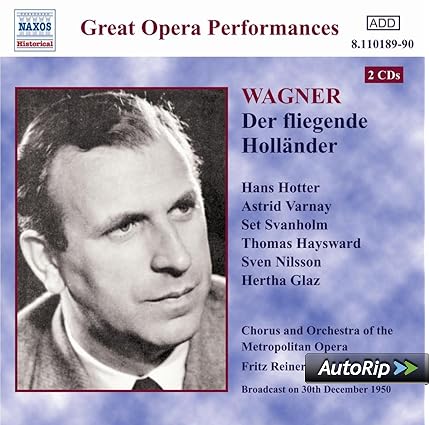
Der fliegende Holländer (Wagner)

This is my post from this week's Once or Twice a Fortnight.


I haven't been posting muchrecently - more like once or twice a quarter... Time is simply not on my side, but as I have a few days off work for the Holidays, I thought I'd finally get around to sharing this performance I downloaded a few years ago off the now defunct web site Public Domain Classic.

Let me (shamelessly) borrow from Paul Campion's fine notes for the NAXOS re-issue of this classic Met performance:

The tempestuous opening bars of the overture to Der fliegende Holländer throw us immediately into the passionate story of love, anguish and self-sacrifice that is to be played out in this, the first opera of Wagner’s musical maturity. Der fliegende Holländer was first performed on 2nd January 1843 at the Königliches Sächsisches Hoftheater in Dresden.

His initial conception was to present Der fliegende Holländer in one unbroken act, but shortly before the opening he reworked this into three separate acts, in which form it was customarily produced during the nineteenth century. (More recently, many directors and conductors have returned to Wagner’s first ideas and given the opera without any break; both are now regularly produced).

Among Wagner’s stage works, Der fliegende Holländer is the first great bridge between the Romantic operas of Weber, of whom he was an avid admirer, and his own Music Dramas, notably Tristan und Isolde and Der Ring des Nibelungen. Tellingly, it reveals his developing use of the leitmotif, which would be so significant in the creation of those later works. The most potent leitmotif, which returns repeatedly during the overture, is that of the Dutchman himself, who is fated to sail the seas until redeemed by the love of a faithful woman. Senta will herself make that sacrifice, and she relates the Dutchman’s haunting tale in her great second act ballad; at the climax of the third act she throws herself into the sea, finally to be seen embracing the Dutchman as his ship sinks beneath the merciless waves.

ABOUT THIS RECORDING

The 1950 production, at a later performance of which this recording was made, opened on the second night of Rudolf Bing’s first season as the Met’s general manager and was the occasion of two notable house débuts, those of Hotter and Nilsson, and two rôle débuts there, those of Varnay and Svanholm.

Hans Hotter was the supreme Wagnerian bass-baritone of his generation, and also sang rôles by MozartMussorgsky and Verdi. Born in Offenbach am Main in 1909, he studied in Munich, giving his first concert there in 1929. After his 1930 operatic début in Troppau, he sang in Prague, Hamburg and, most famously, Munich, where he remained for 35 years. Hotter appeared in two Strauss premières, Friedenstag in 1938, and Capriccio in 1942, the year he also first sang in Salzburg. In 1947 he was at Covent Garden with the Wiener Staatsoper, returning for eighteen seasons singing rôles including Wotan and Hans Sachs; Hotter appeared at the Met from 1950 to 1954 and first sang at Bayreuth in 1952. Long accomplished also as a lieder singer, he has more recently participated in performances of Lulu and Schoenberg’s Gurrelieder with continuing success.

Astrid Varnay was born in Stockholm in 1918; at an early age she moved with her parents to the United States, where she later studied singing. Varnay sang at Brooklyn Academy in 1937, but her sensational first Metropolitan performance, as Sieglinde (Naxos 8.110058-60), was in 1941; she appeared there during nineteen seasons, principally in Wagnerian rôles, including six performances as Senta. Varnay later sang in Chicago, San Francisco and South America and appeared in sixteen consecutive Bayreuth seasons, where she was Senta in 1955-6 and 1959. Varnay first sang at Covent Garden in 1948 and thereafter in many European cities, including Florence, Paris, Vienna and Milan; considered the most dramatically intense Isolde and Brünnhilde of her generation, she was a fine Lady Macbeth, Elektra, Marschallin and, later, Klytemnestra. In retirement Varnay moved to Munich, where she still lives.

Born in Västerås, Sweden in 1904, Set Svanholm originally trained as an organist and made his baritone début at the age of 25; his début as a tenor was in 1936, as Radames in Aïda, but he excelled in Wagner, particularly as Lohengrin, Parsifal, Siegmund and Tristan. Appearances in London, Salzburg, Berlin, Vienna, Bayreuth and La Scala preceded Svanholm’s 1946 début at the Met, where he sang for ten seasons; he appeared at Covent Garden from 1948 until 1957, displaying his robust, focused tenor to superb effect. In 1956 Svanholm was appointed director of the Royal Opera in Stockholm; he died in Sweden in 1964.

Sven Nilsson, too, was born in Sweden, in 1898; he studied in Stockholm, making his operatic début in 1930. As member of the Dresden Staatsoper (1930-1944), he sang at Covent Garden in 1936 and in the première of Strauss’s Daphne in 1938; he also appeared in Amsterdam, Brussels, Milan and Drottningholm. In 1946 Nilsson returned to Stockholm, singing there until his death in 1970. Nilsson assumed principally Wagnerian rôles, notably Daland, which he performed during his only Met season, Pogner and Gurnemanz; and also Sarastro, Osmin and Ochs.

Fritz Reiner, born in Budapest in 1888, studied under Bartók. He was Dresden Staatsoper’s musical director from 1914 to 1922, subsequently taking charge of the Cincinnati Symphony. From 1931 Reiner taught at the Curtis Institute in Philadelphia and was Director of the Pittsburgh Symphony from 1938 to 1948, scheduling performances at Covent Garden, La Scala, Vienna and South America into his energetic career. He later conducted at the Met and in Chicago, remembered for his wide musical interests, but principally for interpretations of the Romantics, Wagner, Strauss and twentieth century composers. Reiner died in New York in 1963.

The recording is very good, though it does show the technical limitations of recording live performances in those days.

Happy listening!


Richard WAGNER (1813 - 1883)
Der fliegende Holländer (The Flying Dutchman), WWV 63
Romantische Oper in three acts, with German libretto by the composer

PRINCIIPAL CAST
Der Holländer: Hans Hotter
Senta: Astrid Varnay
Erik: Set Svanholm
Daland: Sven Nilsson
Mary: Hertha Glaz
Der Steuermann Dalands: Thomas Hayward

New York Metropolitan Opera Chorus
New York Metropolitan Opera Orchestra
Fritz Reiner, conducting
Live performance, 30 December 1950

(Downloaded from Public Domain Classic, 2014)

Synopsis and Libretto - http://www.opera-arias.com/wagner/de...oll%C3%A4nder/
Details - https://www.naxos.com/catalogue/item...de=8.110189-90


Saturday, September 23, 2017

The Old switch-a-roo

This is my post from this week's Once or Twice a Fortnight.


Many years ago, the CBC broadcasted an Edmonton Opera performance of the Marriage of Figaro sung in English.

Pause

That what I thought, exactly!

I won’t call it a cottage industry, but there are many operas that have had their libretti adapted or translated in other languages. Some of them by design – Dialogues des Carmélites was first performed in an Italian translation at its La Scala première before its Paris debut in the original French libretto by the composer.

In my record collection I have a fine version of Pagliacci sung in German (A Munich performance conducted by Wolfgang Sawallisch) It takes some getting used to, but it kind of works.

All this to say that there’s something to be said for opera sung in the local language for local audiences. Maybe some of the “big staples” (like my example of Mozart’s Figaro) are harder to warm up to, but less traveled repertoire, and especially light opera or operetta work well. This is why this vintage performance I found on LiberMusica of Auber’s Fra Diavolo I think is worthwhile.

The opera was Auber's greatest success, one of the most popular works of the 19th century and was in the standard repertory in its original French as well as German and Italian versions. It is loosely based on the life of the Itrani guerrilla leader Michele Pezza, active in southern Italy in the period 1800-1806, who went under the name of Fra Diavolo ("Brother Devil").

Expanding and renaming the roles of Beppo and Giacomo (two accomplices of Fra Diavolo) Laurel and Hardy starred as "Stanlio" and "Ollio" in the 1933 feature film Fra Diavolo (sometimes titled as The Devil's Brother or Bogus Bandits) based on Auber's opera. There is not a great deal of singing in the film. Much of the chorus material is intact, and Diavolo has three numbers; however, Zerline gets to sing only the small bit necessary to the plot (singing when she undresses), Stanlio and Ollio only repeat songs heard by others, and no one else sings.

For comparison, a YouTube performance of the original French version can be found here.

The audio quality here is at times suspect, but once you get used to the sound, you'll like this!

Daniel François Esprit AUBER (1782 - 1871)
Fra Diavolo, ou L'hôtellerie de Terracine, opéra comique in three acts (1830)
Original French libretto by Eugène Scribe; Italian translation by Manfredo Maggioni

PRINCIPAL ROLES
Fra Diavolo - Giuseppe Campora,
Zerline - Alda Noni,
Lord Cockburn - Gino Orlandini,
Lady Pamela - Mitì Truccato Pace,
Lorenzo - Nino Adami,
Giacomo - Fernando Corena,
Beppo - Giuseppe Nessi,
Mathéo - Pier Luigi Latinucci,

Coro della RAI di Milano (Roberto Benaglio, chorus master)
Orchestra sinfonica della RAI di Milano
Alfredo Simonetto, conducting
HOPE 237
Recorded : 5/3/1952

Synopsis - http://www.opera-arias.com/auber/fra-diavolo/synopsis/
Libretto - http://musicologia.unipv.it/collezio...f/ghisi097.pdf
LiberMusica URL - https://www.liberliber.it/online/aut...r/fra-diavolo/

Friday, May 12, 2017

L'heure Espagnole (Ravel)

This is my post from this week's Once or Twice a Fortnight.


Many times on OTF, I’ve tried to program one-act operas. I don’t mind monumental works (like Wagner’s Tristan we discussed last time) but since I do most of my music listening on the bus, I really like something that I can listen to from beginning to end during my commute – rather than doing it over two or three.


Ravel’s vocal output is surprisingly diverse – from settings of old Greek songs to a pair of short, one-act operas. L'heure espagnole is a one of those, best described as a musical comedy to a French libretto by Franc-Nohain, based on his 'comédie-bouffe' of the same name first staged in 1904.

Ravel was closely involved in every aspect of the production as it was prepared for its premiere at the Opéra-Comique in Paris. First performed at the Opéra-Comique on 19 May 1911 in a double-bill with Massenet’s Thérèse, it stood for nine performances and was not heard again for 10 years (5 December 1921 at the Paris Opera) when it enjoyed more success. The opera returned to the Opéra-Comique in 1945 where it entered the company’s repertoire.

Translated literally, the title in English is "The Spanish Hour", but the word "heure" more importantly means "time" – "Spanish Time", with the connotation "How They Keep Time in Spain". Time keeping, and in particular clocks, are used extensively as plot devices throughout the 21 scenes of this delightful work. Concepción, the clock-maker’s wife plans to use his weekly service rounds to entertain gentlemen at home, and her rendezvous’ are either aided or hampered by clocks that are used by her suitors to hide and get moved between her bedroom and her husband’s workshop.

Today’s musical share is from a 1965 recording supervised by Lorin Maazel, featuring local singers with varying name recognition.

Happy Listening!


Maurice RAVEL (1875-1937)
L'Heure Espagnole, MR 52
Musical Comedy in one act for 5 voices and orchestra, French libretto by Franc-Nohain


Concepcion – Jane Berbié
Don Inigo Gomez – José van Dam
Gonzalve – Michel Sénéchal
Torquemada – Jean Giraudeau
Ramiro – Gabriel Bacquier
Orchestre National de la R.T.F
Lorin Maazel, conducting
Recording: Paris, O.R.T.F., 2/1965

Synopsis - http://www.oberlin.edu/news-info/01jan/ravel_opera_synopsis.html

Libretto - http://www.operalib.eu/oraspagnola/pdf.html

Saturday, April 15, 2017

Wagner's Tristan und Isolde

This is my post from this week's Once or Twice a Fortnight.


In June 2016, Hugo Shirley wrote a very interesting article for Gramophone titled “The opera that changed music”. The article opens with quotes from Alma Mahler, Clara Schumann and Edward Elgar as they each react to Wagner's Tristan und Isolde; a quote from one of Grieg’s pen pals is especially “graphic”:

[T]he most enormous depravity I have ever seen or heard, but in its own crazy way it is so overwhelming that one is deadened by it as by a drug. […] Even more immoral…than the plot is this seasick music that destroys all sense of structure in its quest for tonal colour. In the end, one just becomes a glob of slime on an ocean shore, something ejaculated by that masturbating pig in an opiate frenzy!
The Gramophone article is a great read, especially for those of us who have mixed emotions about sitting through a Wagner opera from curtain rise to curtain fall – let alone try and sink their teeth into the material and make sense if it all. This is a commitment, to be sure!
Shirley writes that the past 150 years are littered with writers trying to express the fascination, revulsion (or both!) that Tristan inspires. Even today, Tristan remains a work that can inspire fierce devotion or baffled resistance: it eludes clear definition and explanation and encourages intemperate hyperbole at every turn. Maybe Michael Tanner’s thought-provoking description is one of the best: ‘Along with Bach’s St Matthew Passion,’ he writes, ‘it is one of the two greatest religious works of our culture.’

The Internet is littered with resources and authoritative (as well as authoritative-sounding) articles regarding Tristan, and I would hate to add more… To me, Tristan is in many ways a “regular day in the office” for Wagner: the creative convergence of Wagner’s devotion to the philosophy of Arthur Schopenhauer, the soap-opera that is his own love life and musical exploration that takes him away from established musical convention.

The re-discovery of mediaeval Germanic poetry, including Gottfried von Strassburg's version of Tristan, the Nibelungenlied and Wolfram von Eschenbach's Parzival, left a large impact on the German Romantic movements during the mid-19th century. Again, we note here subject matter that Wagner has mined to form the core of his epic operas.

Tristan took five years to compose with the bulk of the work between 1857 and 1859. Sections of the opera and libretto were composed in Switzerland and Italy, as Wagner’s 20-year marriage was disintegrating in large part because of his relationship with German poet and author Mathilde Wesendonck , the wife of a wealthy silk trader. (Wagner set five songs to her words, called the Wesendonck Lieder, in the same time period).

Staging an opera isn’t easy – and it is even less so when it comes to a Wagner opera! The completed work remained unstaged for several years and it’s only after King Ludwig II of Bavaria became Wagner’s sponsor that enough resources were secured to mount the premiere of Tristan und Isolde. Hans von Bülow was chosen to conduct the production at the Nationaltheater in Munich. This of course is happening at the time Wagner was having an affair with his wife Cosima which resulted in a daughter – Isolde – born about two months before the premiere on 10 June 1865.
The next production of Tristan was in Weimar in 1874. Wagner himself supervised another production of Tristan in Berlin in March 1876, but the opera was only performed at the Bayreuth Festival after his death; Cosima (now his widow) oversaw this widely acclaimed production in 1886.

Today’s 1953 performance is also from the Festspielhaus in Bayreuth. In a review by Webster Forrest for wagnerdiscography.com, he writes:

This recording of Tristan is especially valuable, as it is the only available recording featuring the Isolde of the great Astrid Varnay. The performance is led by one of the German repertoire's most competent if not most passionate conductors: Eugen Jochum […] and this Tristan emits more heat and commitment than many […] From the outset the key words for this performance are concentration, accuracy, and commitment. Jochum handles the orchestra with a beautiful skill that reminds one of the more sensitive and beautiful performances […] The pace is exciting - and measured. The conducting throughout keeps the drama moving very convincingly, though there is not very much in the way of sudden excitement where it might be wanted.
Varnay's Isolde is rather intelligent and proud, and where it counts, passionate. […] Varnay's was a voice of huge volume and a rather hot and heavy timbre; some found that she sat on words, using a peculiar pronunciation of consonants to pry her way into a note. This can be true in some of her recorded performances, but here […] she displays great vocal facility as well as incredible musicality. Her involvement in the entire night scene, ending with the great love duet in Act II is exceptionally rewarding both musically and dramatically. Her Liebestod must be regarded as one of the finest ever recorded.
[…] The much-loved and under-recorded Ramón Vinay sings Tristan, and he is a fine choice for the role. Vinay's tenor is one of fine baritonal strength and a robust and penetrating top. His approach to the role is full-blooded and martial without being at all strident. […] He certainly makes a great deal of the text in many ways and in most instances convinces us of his character. His dying words are a touching yet well-controlled expression of deranged love.
[…] The last forty minutes of the opera - from somewhere around Tristan's 'Ach Isolde ... wie schön bist du' there is a distortion in the sound at the upper dynamic levels. (This alone may perhaps account for the recording's rarity.) It's a crackling, as though the recording levels were a little too high, but it is a noise on top of the recorded music, and apart from it there is no distortion of the actual sound captured (no loss of detail, e.g., or no muffling - just this extra noise on top, like a scratch on a record.)

Richard WAGNER (1813-1883)
Tristan und Isolde, WWV 90
music drama in three acts
German libretto by the composer, based largely on the romance by Gottfried von Strassburg.


Tristan - Ramón Vinay
Isolde - Astrid Varnay
Brangäne - Ira Malaniuk
Kurwenal - Gustav Neidlinger
Marke - Ludwig Weber
Melot - Hasso Eschert
Ein Hirt - Gerhard Stolze
Ein Seemann - Gene Tobin
Ein Steuermann - Theo Adam
Chor und Orchester der Bayreuther Festspiele
Conductor: Eugen Jochum


Festspielhaus Bayreuth
July 30, 1953 (Live recording)


INFO - http://www.wagnerdiscography.com/rev...ri53jochum.htm
SOURCE - https://www.liberliber.it/online/aut...an-und-isolde/


Synopsis - http://www.opera-arias.com/wagner/tr...olde/synopsis/
Libretto - http://www.opera-arias.com/wagner/tr...olde/libretto/


Internet Archive URLs

Act 1 - https://archive.org/details/wagner_tristan_je_01_einlei_etc
Act 2 - https://archive.org/details/wagner_tristan_je_41_mir_di_etc
Act 3 - https://archive.org/details/wagner_tristan_je_51_muss_i_etc

Friday, March 17, 2017

The Seasons (Haydn)

This is my post from this week's Once or Twice a Fortnight.


It’s been an interminable winter it seems – after a few weeks of dry weather, we were swamped with 20 cm of snow this past week… Thank Goodness, spring is around the corner, and I thought I’d try and spread some happy thoughts by sharing this vintage performance of Haydn’s oratorio The Seasons.

Haydn was led to write The Seasons by the great success of his previous oratorio The Creation, which had become very popular and was in the course of being performed all over Europe. The libretto for The Seasons was prepared for Haydn, just as with The Creation, by Baron Gottfried van Swieten, an Austrian nobleman who had also exercised an important influence on the career of Mozart (among other things commissioning Mozart's reorchestration of Handel's Messiah). Van Swieten's libretto was based on extracts from the long English poem "The Seasons" by James Thomson (1700–1748), which had been published in 1730.

Like The Creation, The Seasons was intended as a bilingual work; since Haydn was very popular in England, he wished the work to be performable in English as well as German. Van Swieten therefore made a translation of his libretto back into English, fitting it to the rhythm of the music. Van Swieten's command of English was not perfect, and the English text he created has not always proven satisfying to listeners. As was the case with our earlier Haydn oratorio post, the version I am posting is in German.

There is some evidence that Haydn himself was not happy with van Swieten's libretto, or at least one particular aspect of tone-painting it required, namely the portrayal of the croaking of frogs, which is found during the serene movement that concludes Part II, "Summer". Haydn was once quoted: to have said “This whole passage, with its imitation of the frogs, was not my idea: I was forced to write this Frenchified trash. This wretched idea disappears rather soon when the whole orchestra is playing […]”

As was the case for The Creation, The Seasons had a dual premiere, first for the aristocracy whose members had financed the work (Schwarzenberg palace, Vienna, 24 April 1801), then for the public (Redoutensaal, Vienna, 19 May).The oratorio was considered a clear success, but not a success comparable to that of The Creation. In the years that followed, Haydn continued to lead oratorio performances for charitable causes, but it was usually The Creation that he led, not The Seasons.

The vintage recording below, hosted on the LiberMisica site, is the earliest of two versions recorded by the RIAS/Barlin Radio Symphony Orchestra under Ferenc Fricsay. Presumably, this is a version that was broadcast unlike the second version for DGG which was captured in studio.

Happy listening!

Joseph HAYDN (1732-1809)
Die Jahreszeiten ('The Seasons'), Hob. XXI:3
Oratorio in Four Parts, German libretto by Gottfried van Swieten
Elfriede Trötschel, Soprano
Walther Ludwig,Tenor
Josef Greindl, Bass
Berlin Chor Der St. Hedwigs-Kathedrale
RIAS Kammerchor
RIAS-Symphonie-Orchester
Ferenc Fricsay, Conducting

Performance URL - https://www.liberliber.it/online/aut...orio-hob-xxi3/


Internet Archive links

Nos 1-9 Der Fruhling (Spring)
Nos 10-20 Der Sommer (Summer)

Nos 21-31 Der Herbst (Autumn)
No, 32 - Einleitung und Recitative: Seht, wie der strenge Winter flieht (From “Spring”)
Nos 33-44 Der Winter (Winter)